On this page
- 01Key takeaways
- 02Should a website show its parent company?
- 03What details does each group company need?
- 04How do shared group websites handle disclosures?
- 05Does being part of a group build trust?
- 06What about terms and invoices?
- 07When does the group name not belong on the site?
- 08What does this look like in practice?
- 09Group company details checklist
- 10Next step
- 11Sources and further reading
- 12Frequently asked questions
Key takeaways
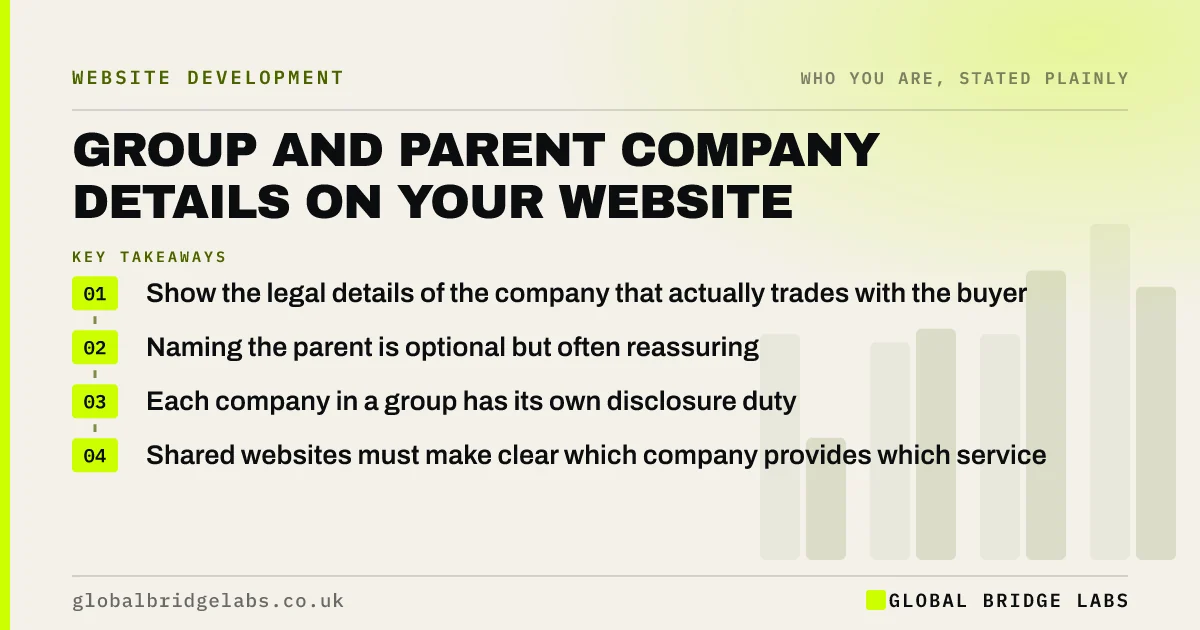
A business in a group should show which company the buyer is dealing with, with that company's own registered name, number and office. Mentioning the parent company is not legally required, but 'part of the X Group' often adds reassurance. Never let the group name blur which entity contracts with the customer.
- Show the legal details of the company that actually trades with the buyer.
- Naming the parent is optional but often reassuring.
- Each company in a group has its own disclosure duty.
- Shared websites must make clear which company provides which service.
Running a group website? Message us on WhatsApp.
Chat on WhatsApp →Should a website show its parent company?
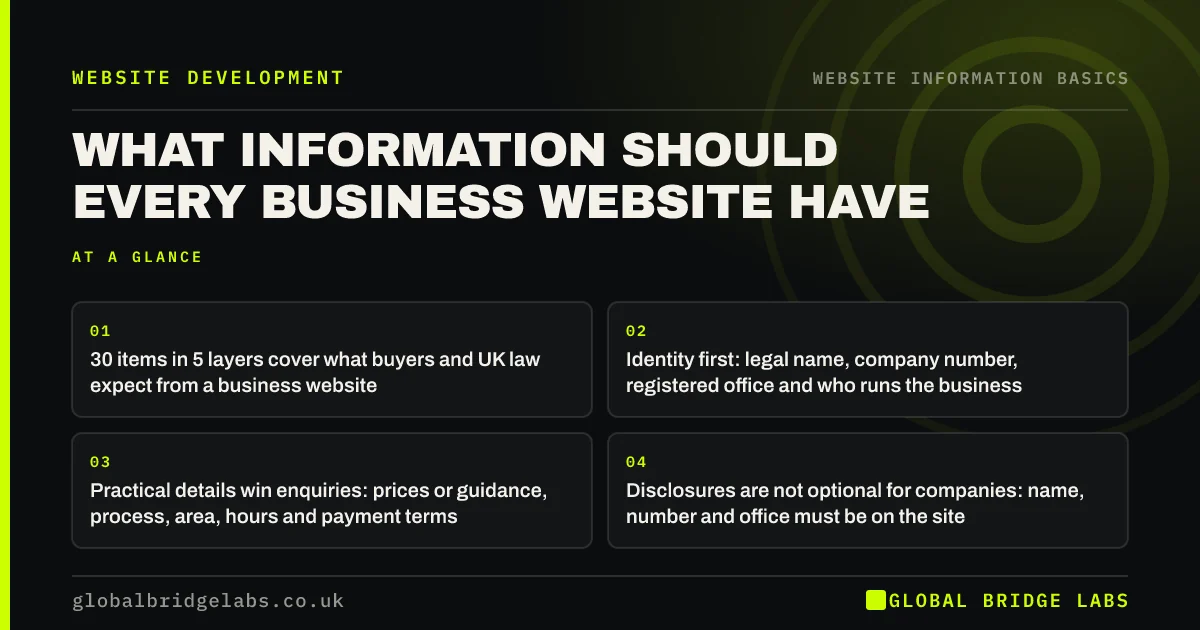
A website may show its parent company, and often should when the group's size or name adds reassurance. It is not required by the disclosure rules. What is required is that the trading company's own registered name, number and office appear. Global Bridge Labs (GBL) advises naming both and making the contracting entity obvious.
What details does each group company need?
Each company that trades through a website has its own duty under the Trading Disclosures Regulations 2015: registered name, company number, place of registration and registered office. Giving only the group holding company's details is not enough when a subsidiary is the one doing business.
How do shared group websites handle disclosures?
A shared group website should say which company provides each service, usually in the footer and on the relevant service pages. A list of group companies with their numbers and offices on a 'legal information' page, linked from the footer, keeps the main footer readable.
Does being part of a group build trust?
It can. 'Part of the X Group' signals financial backing and continuity, which matters to buyers signing long contracts. It can also put off buyers who chose you for being independent. Decide which matters more to your buyers and place the group mention accordingly.
What about terms and invoices?
Make sure the company named on the website matches the company on quotes, terms and invoices. If a buyer reads one company name online and receives an invoice from another, it raises questions about who is liable. The website should set that expectation clearly.
When does the group name not belong on the site?
The group name does not belong on the site when it adds nothing for the buyer, when it is a private holding vehicle with no public identity, or when brands in the group compete with each other. Legal details of the trading company are still required.
What does this look like in practice?
A pattern we see after acquisitions: the acquired firm's website keeps its old footer, while contracts now come from a different company in the group. Updating the footer to show the actual trading company, with 'part of' wording, aligns the website with the paperwork.
Group company details checklist
- Identify the company that trades with buyers.
- Show its registered name, number and office.
- Decide whether naming the parent helps.
- List group companies on a legal page if several trade.
- Match the website with quotes and invoices.
- Update after any restructure.
Next step
Compare the company named in your website footer with the company named on your last invoice. If they differ, fix the website first.
Message us on WhatsApp for a group website disclosure check, with no pitch.
Chat on WhatsApp →Sources and further reading
Frequently asked questions
Do I need to put my holding company on my website?
No. The disclosure rules apply to the company that trades through the website, so its own registered name, number and office must appear. Naming the holding company is optional and is usually done only when it adds reassurance.
How should a group of companies show legal information online?
Show the trading company's details in the footer, and if several companies trade through one site, list each with its name, number, place of registration and registered office on a legal information page linked from every page.
Can two companies share one website?
Yes, but the site must make clear which company provides which service and show each company's disclosure details. Buyers should be able to tell who they are contracting with before they enquire or buy.
Written by

Global Bridge Labs (GBL) is a UK–Sri Lanka partner for social media, websites and BPO. Everything here comes from client delivery, not theory.