On this page
- 01Key takeaways
- 02What should a pest control website include?
- 03How should treatments be explained?
- 04What should be said about safety?
- 05How should prices and guarantees be shown?
- 06What do commercial clients look for?
- 07When is less better?
- 08What does this look like in practice?
- 09Pest control website checklist
- 10Next step
- 11Sources and further reading
- 12Frequently asked questions
Key takeaways
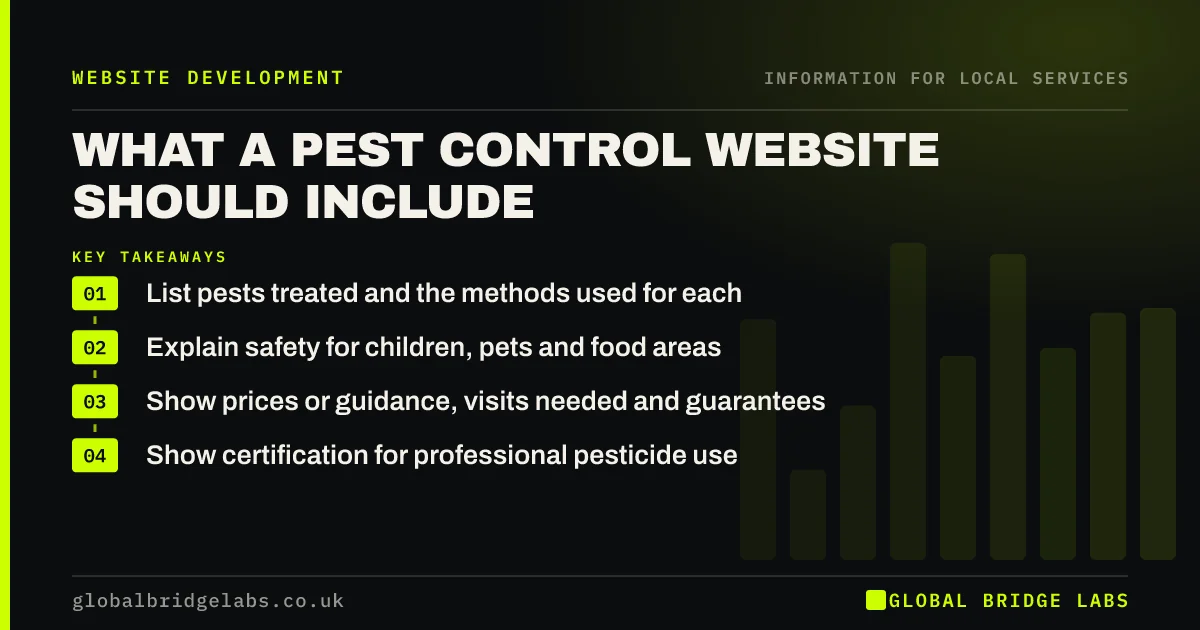
A pest control website should list the pests you treat, how you treat them, how you keep children and pets safe, prices or price guidance, how many visits a treatment usually takes, guarantees, response times and areas covered, plus training and certification. Customers are often distressed and want to know it will be safe and sorted.
- List pests treated and the methods used for each.
- Explain safety for children, pets and food areas.
- Show prices or guidance, visits needed and guarantees.
- Show certification for professional pesticide use.
Running a pest control website? Message us on WhatsApp.
Chat on WhatsApp →What should a pest control website include?
A pest control website should include pests treated, methods, safety measures, prices, the number of visits typically needed, guarantees, response times, areas and credentials. Global Bridge Labs (GBL) sees safety and price as the two questions that decide whether a worried household calls you or the next result.
How should treatments be explained?
Explain each treatment in plain steps: the survey, the treatment itself, follow-up visits and what the customer must do, such as leaving rooms or removing food. Say how long it usually takes to work. Clear steps reduce anxious calls between visits.
What should be said about safety?
Explain how you protect children, pets and food areas, which products are used where, and any precautions after treatment. Professional use of pesticides is regulated, and the HSE sets out requirements for training and certification. Say that technicians are trained and certified.
How should prices and guarantees be shown?
Show prices or ranges for common treatments, including VAT for households, and what they include, such as the number of visits. Explain any guarantee: what it covers, for how long and what happens if pests return. Commercial contracts can show 'from' prices per site.
What do commercial clients look for?
Commercial clients, such as food businesses and landlords, look for contract options, reporting, response times, documentation for audits and insurance. A separate commercial page with these details helps you win contracts without mixing them into household content.
When is less better?
Graphic photos of infestations put some visitors off. Use them sparingly and focus imagery on your team, vans and finished work. Long pest encyclopaedias rarely help a customer decide; short pages per common pest work better.
What does this look like in practice?
A pattern we see: a pest control site lists dozens of pests but never mentions safety, prices or how many visits a treatment takes. Adding those three to each main pest page answers the questions customers ask on every call.
Pest control website checklist
- List pests and methods.
- Explain safety for children and pets.
- Show prices and visits included.
- Explain guarantees.
- Show training and certification.
- Give commercial contract details separately.
Next step
Pick your three most common pests and add safety, price and visit information to each page this week.
Message us on WhatsApp for a website review, with no pitch.
Chat on WhatsApp →Sources and further reading
- Unfair commercial practices guidance (CMA207) · Competition and Markets Authority
Frequently asked questions
Should a pest control company show prices online?
Yes, at least as ranges for common treatments. Customers want to know cost and how many visits are included before they call. Household prices should include VAT, and commercial contracts can show 'from' prices.
What safety information should pest control websites give?
Explain how children, pets and food areas are protected, what precautions customers need to take, and that technicians are trained and certified for professional pesticide use, as the HSE requires.
Do pest control technicians need qualifications?
Professional users of many pesticides must be trained and certified, as set out by the HSE. Showing your training and certification on your website reassures customers that treatments are carried out safely and legally.
Written by

Global Bridge Labs (GBL) is a UK–Sri Lanka partner for social media, websites and BPO. Everything here comes from client delivery, not theory.