On this page
- 01Key takeaways
- 02What does a business website cost include?
- 03What do UK websites typically cost by type?
- 04What drives the price up or down?
- 05What does a website cost to run each year?
- 06How do you judge whether a website is worth the cost?
- 07When is spending less the right decision?
- 08What does this look like in practice?
- 09Website budget checklist
- 10Next step
- 11Sources and further reading
- 12Frequently asked questions
Key takeaways
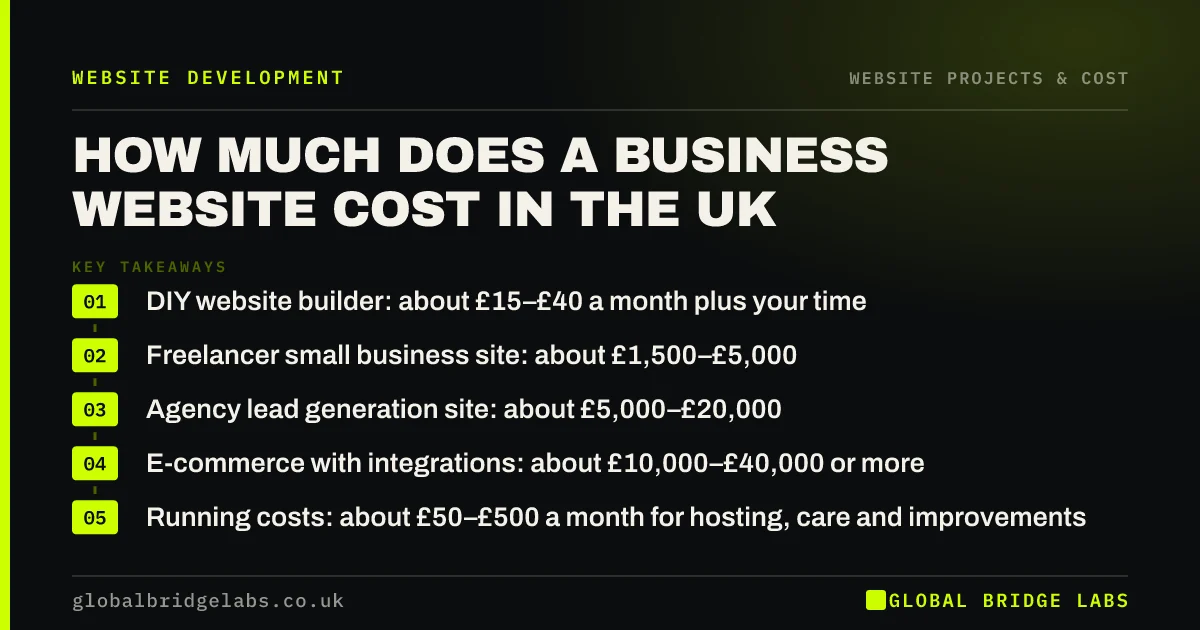
The cost of a business website in the UK typically ranges from a few hundred pounds for a DIY builder site to £5,000–£20,000 for an agency-built lead generation site, and £10,000–£40,000 or more for e-commerce with integrations. Running costs add £50–£500 a month. The right budget depends on what the site must produce, not what it looks like.
- DIY website builder: about £15–£40 a month plus your time.
- Freelancer small business site: about £1,500–£5,000.
- Agency lead generation site: about £5,000–£20,000.
- E-commerce with integrations: about £10,000–£40,000 or more.
- Running costs: about £50–£500 a month for hosting, care and improvements.
Want a costed plan for your site rather than a rate card? Message us on WhatsApp and we will discuss your requirements.
Chat on WhatsApp →What does a business website cost include?
The cost of a business website is the total spend needed to plan, design, build, fill with content, launch and run a site for its working life, typically three to five years, not just the build invoice.
Quotes that look cheap often exclude copywriting, photography, SEO set-up, tracking, training, hosting and maintenance. Quotes that look expensive may include all of them. Compare total cost of ownership over three years, not the headline price.
What do UK websites typically cost by type?
The ranges below are typical UK market prices seen in quotes for small and medium businesses. They vary with region, supplier and scope, so treat them as orientation rather than a price list.
- Website builder, self-built (Squarespace, Wix): about £15–£40 a month, plus your time.
- Template site by a freelancer: about £1,500–£5,000.
- Custom-designed lead generation site by an agency: about £5,000–£20,000.
- Larger multi-service or multi-location site: about £15,000–£40,000.
- E-commerce on Shopify or WooCommerce: about £5,000–£25,000.
- E-commerce with custom integrations (ERP, stock, CRM): about £20,000–£60,000 or more.
What drives the price up or down?
Price is driven by scope, not by pages alone. The biggest factors are listed below, roughly in order of impact.
- Custom design versus an adapted template.
- Integrations: booking systems, CRM, payments, stock or accounting.
- Content: who writes the copy and provides photography.
- Number of unique page templates, rather than total pages.
- Migration of existing content and SEO redirects.
- Accessibility, performance and security requirements.
- Ongoing support and improvement included after launch.
What does a website cost to run each year?
Running costs are often forgotten at quote stage. A .co.uk or .com domain usually costs roughly £10–£20 a year. Hosting runs from a few pounds a month on shared plans to £20–£100 a month for managed hosting. Maintenance and support typically cost £50–£500 a month depending on how much changes.
Add paid tools where used: booking systems, email marketing, call tracking and premium plugins, often £10–£50 a month each. Over three years, running costs can match or exceed the build cost, which is why they belong in the budget from the start.
Want a three-year cost view for the site you have in mind? Send us your requirements on WhatsApp.
Chat on WhatsApp →How do you judge whether a website is worth the cost?
Judge it by cost per enquiry or return on investment. If a £12,000 site produces 30 qualified enquiries a month and one in five becomes a £2,500 job, it generates £15,000 of work a month. A £2,000 site producing three enquiries is cheaper to build and far more expensive per result.
Across our client work, we have seen a 2.4x enquiry rate after a website rebuild. The value came from clarity, speed, proof and tracking, which is why those should be in the scope of any quote you accept.
When is spending less the right decision?
Spend less when the business is new and unproven, when the site's job is simply to confirm you exist, or when most work comes from referrals and the site rarely gets visits. A clean builder site with clear services, contact details and reviews can be enough.
The trade-off is growth. A cheap site that cannot rank, convert or be measured caps how much the website can contribute. Plan to reinvest once the business has a clear idea of which services it wants more of.
What does this look like in practice?
A pattern in UK SMEs: three quotes of £2,500, £7,000 and £16,000 for what looks like the same site. On closer reading, the cheapest excludes copy, SEO migration and tracking, and the most expensive includes a year of improvement work.
Laying the quotes side by side against the same scope list, with three-year running costs included, usually reveals that the gap is smaller, or larger, than it looked. Either way, the decision becomes about value rather than headline price.
Website budget checklist
Use this before requesting quotes.
- Write down what the site must produce each month.
- List required integrations.
- Decide who writes copy and provides photography.
- List pages that must be migrated and redirected.
- Ask for three-year total cost, including running costs.
- Confirm tracking and SEO set-up are in scope.
- Confirm who owns the site, domain and content.
Next step
If you are budgeting for a new website, we will scope it with you in 30 minutes: what it needs to do, what drives the cost, and a realistic range for your requirements.
Message us on WhatsApp for a costed website plan, or book a 30-minute consultation.
Chat on WhatsApp →Sources and further reading
- Business population estimates for the UK and regions 2025 · Department for Business and Trade
- Understanding Core Web Vitals and Google search results · Google Search Central
- About key events · Google Analytics Help
Frequently asked questions
How much should a small business website cost in the UK?
Typically £1,500 to £5,000 from a freelancer for a small template-based site, and £5,000 to £20,000 from an agency for a custom lead generation site. E-commerce with integrations can cost £10,000 to £40,000 or more. Add £50 to £500 a month for hosting, maintenance and improvements.
Why do website quotes vary so much?
Because they include different things. Some quotes cover design and build only, while others include copywriting, photography, SEO migration, tracking, training and months of support. Compare quotes against the same scope list and include three years of running costs before deciding.
What are the ongoing costs of a website?
A domain usually costs roughly £10 to £20 a year, hosting from a few pounds to about £100 a month, and maintenance around £50 to £500 a month. Paid tools such as booking systems, call tracking or premium plugins often add £10 to £50 a month each.
Is a cheap website worth it?
It can be for a new business, or one where the site mainly confirms you exist. If the site needs to rank, convert and be measured, a very cheap build often costs more per enquiry. Judge any quote by what it is expected to produce, not by the build price alone.
Written by

Global Bridge Labs (GBL) is a UK–Sri Lanka partner for social media, websites and BPO. Everything here comes from client delivery, not theory.