On this page
- 01Key takeaways
- 02What must a home care agency website show?
- 03What does CQC require on the website?
- 04What do families check first?
- 05How should fees be explained?
- 06What about safeguarding and complaints?
- 07When is less information better?
- 08What does this look like in practice?
- 09Home care website checklist
- 10Next step
- 11Sources and further reading
- 12Frequently asked questions
Key takeaways
A home care agency website must display its CQC rating, and should show its registration, the services and hours it covers, the areas it serves, how fees work, how carers are checked and trained, and exactly how families start care. Families are anxious and comparing quickly, so clarity on these points decides who they call.
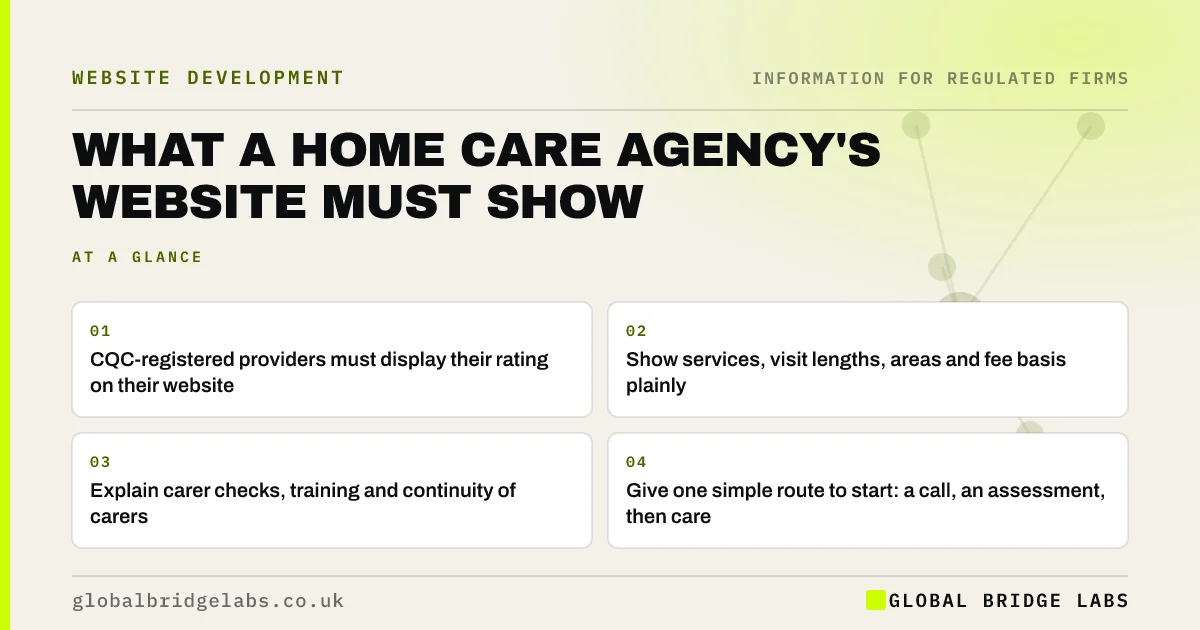
- CQC-registered providers must display their rating on their website.
- Show services, visit lengths, areas and fee basis plainly.
- Explain carer checks, training and continuity of carers.
- Give one simple route to start: a call, an assessment, then care.
Running a care agency website? Message us on WhatsApp.
Chat on WhatsApp →What must a home care agency website show?
A home care agency website must display its current CQC rating and should state its registration, services, areas, fee basis, staff checks and how to start care. Global Bridge Labs (GBL) treats the CQC rating as the regulated item on top of the 30-item inventory, because the requirement is specific and checked.
What does CQC require on the website?
Providers registered with the Care Quality Commission must display their most recent rating on their website, as well as at their premises, once it is published. CQC's guidance explains how, including its rating widget. Add a link to the full inspection report so families can read it themselves.
What do families check first?
Families check whether you cover their area, whether you provide the type and level of care needed, how soon you can start, roughly what it costs, and whether carers are checked, trained and consistent. Answer these near the top of the homepage and service pages, in plain words.
How should fees be explained?
Explain how fees work: hourly rates or ranges, minimum visit lengths, weekend and bank holiday rates, mileage, and what is included. Say whether you accept local authority funded clients. Clear fee information helps families plan and is consistent with consumer law expectations on transparent pricing.
What about safeguarding and complaints?
Show that you take safeguarding seriously: summarise your policy, how concerns are raised and how carers are vetted. CQC-registered providers must operate an effective complaints system, so publish how to complain and what happens next, including where to go if the family remains unhappy.
When is less information better?
Less is better on the homepage. Families do not need your full policy library there; they need the rating, the area, the services and a phone number answered by a person. Put policies and detail on deeper pages, linked clearly.
What does this look like in practice?
A pattern we see in home care: the CQC rating sits in a PDF report linked from the footer, while the homepage shows stock photos and generic values. Moving the rating, areas and 'start care in three steps' to the top answers the questions families phone about.
Home care website checklist
- Display the current CQC rating.
- Link to the full inspection report.
- List services, visit lengths and areas.
- Explain how fees work.
- Describe carer checks and training.
- Publish safeguarding and complaints routes.
Next step
Check that your current CQC rating appears on your website exactly as CQC's guidance describes. Then put your areas and fee basis on the homepage.
Message us on WhatsApp for a care website review, with no pitch.
Chat on WhatsApp →Sources and further reading
- Display your CQC ratings · Care Quality Commission
- Regulations for service providers and managers · Care Quality Commission
Frequently asked questions
Do home care agencies have to show their CQC rating online?
Yes. CQC-registered providers must display their most recent rating on their website, as well as at their premises, once it is published. CQC provides guidance and a widget for displaying it correctly.
Should a home care website show prices?
Showing how fees work, such as hourly rates or ranges, minimum visit lengths and weekend rates, helps families plan and builds trust. Explain what is included and whether you accept local authority funded clients.
What makes families trust a home care agency website?
A visible CQC rating, clear information on services and areas, honest fee guidance, details of carer checks and training, real photos of staff and a phone number answered by a person all build trust with anxious families.
Written by

Global Bridge Labs (GBL) is a UK–Sri Lanka partner for social media, websites and BPO. Everything here comes from client delivery, not theory.