On this page
- 01Key takeaways
- 02Should you publish service levels on your website?
- 03What service levels should you publish?
- 04How do you avoid over-promising?
- 05What happens if you miss a service level?
- 06Should you publish performance against your levels?
- 07When should you not publish service levels?
- 08What does this look like in practice?
- 09Service levels checklist
- 10Next step
- 11Sources and further reading
- 12Frequently asked questions
Key takeaways
Publish your service levels, such as 'we reply within 2 working hours' or 'emergency call-outs within 4 hours in our area', where buyers compare suppliers. Specific, measured promises win contracts and set expectations. Only publish levels you hit at least 9 times out of 10, and say what happens when you miss.
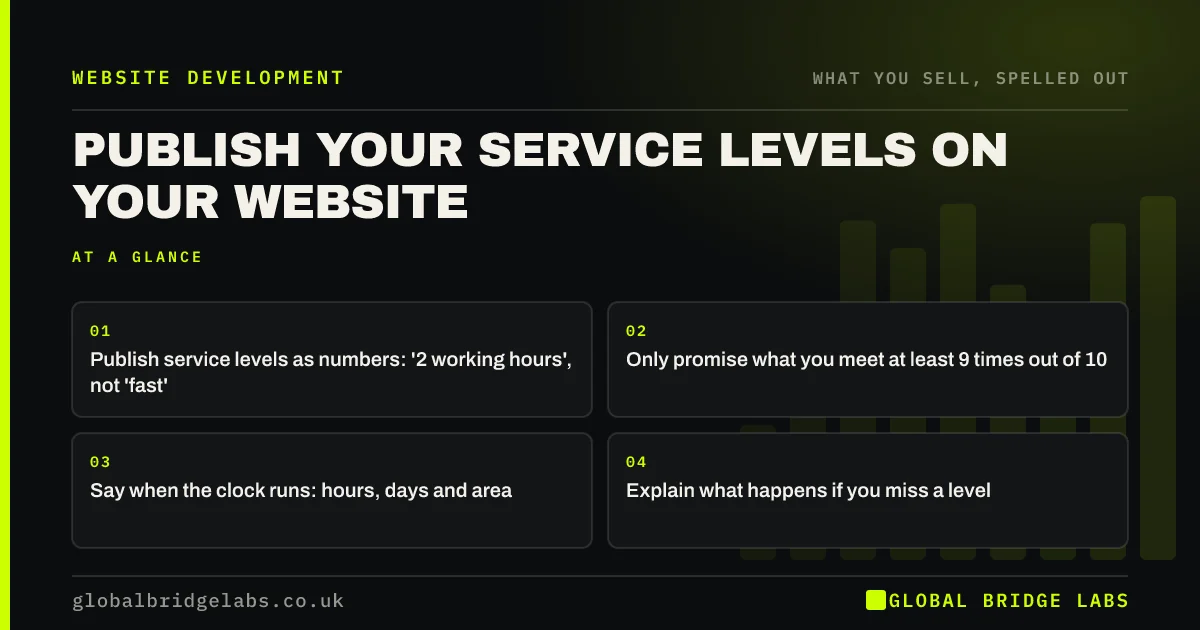
- Publish service levels as numbers: '2 working hours', not 'fast'.
- Only promise what you meet at least 9 times out of 10.
- Say when the clock runs: hours, days and area.
- Explain what happens if you miss a level.
Want your service promises reviewed? Message us on WhatsApp.
Chat on WhatsApp →Should you publish service levels on your website?
Yes, if you can measure and keep them. Service levels such as reply times, attendance times and fix times answer a buyer's main question about ongoing services: what happens when I need you? Global Bridge Labs (GBL) sees published levels matter most for maintenance, IT support, facilities and outsourced services.
What service levels should you publish?
Publish the levels buyers ask about: first response time, attendance or start time, resolution or completion time and availability hours. Make each specific, with a number, a unit and a scope: '4-hour emergency attendance within the M25, 24 hours a day' is a service level; 'rapid response' is not.
How do you avoid over-promising?
Measure first, publish second. As a GBL rule of thumb, publish only a level you already meet at least nine times out of ten. Note the conditions, such as working hours or area, and be clear about the difference between a target and a guarantee. A missed public promise does more harm than a modest one kept.
What happens if you miss a service level?
Say what happens: an apology and explanation, a service credit, escalation to a named manager or a discount on the next invoice. Contracts with business customers often include credits; for consumers, a clear escalation route may be enough. Buyers trust levels that come with consequences.
Should you publish performance against your levels?
Publishing actual performance, such as 'last quarter we answered 94% of calls within 30 seconds', is strong proof when the numbers are good and honestly measured. The UK Customer Satisfaction Index was 78.3 out of 100 in July 2026; showing measured performance helps you stand out against a fairly flat national picture.
When should you not publish service levels?
Do not publish levels you cannot measure, that vary widely with demand, or that apply only to some contracts. Instead describe typical performance and say that levels are agreed per contract. Published levels that contradict your contracts create disputes.
What does this look like in practice?
A pattern we see in IT and facilities firms: the website says '24/7 support' while contracts specify business-hours cover with a paid out-of-hours option. Rewriting the site to match the contract, with clear hours and response times, removes a common source of disputes and makes comparison with competitors fairer.
Service levels checklist
- Measure your current performance.
- Pick levels you meet 9 times in 10.
- Write each with a number, unit and scope.
- State hours and area.
- Explain what happens on a miss.
- Match the website to your contracts.
Next step
Pull last quarter's response times and find the level you hit nine times out of ten. That is the number you can publish.
Message us on WhatsApp for help defining service levels, with no pitch.
Chat on WhatsApp →Sources and further reading
- UK Customer Satisfaction Index · Institute of Customer Service
- Unfair commercial practices guidance (CMA207) · Competition and Markets Authority
- Uptime and availability: keeping your service online · GOV.UK Service Manual
Frequently asked questions
What is a service level on a website?
A service level is a measurable promise, such as replying within two working hours or attending emergencies within four hours in a stated area. Publishing it helps buyers compare suppliers and sets expectations before the contract.
Should I publish my SLA on my website?
Publish a summary of your standard service levels, with hours, area and response times, and say that full terms are in the contract. Keep the summary consistent with your contracts so there is no conflict if a dispute arises.
What response time should I promise customers?
Promise the response time you already meet at least nine times out of ten, measured over a normal period. Buyers value a reliable, modest promise more than an ambitious one you sometimes miss.
Written by

Global Bridge Labs (GBL) is a UK–Sri Lanka partner for social media, websites and BPO. Everything here comes from client delivery, not theory.