On this page
- 01Key takeaways
- 02Do you need an equality policy on your website?
- 03What does the law require?
- 04Why do tenders ask for it?
- 05What should the public statement say?
- 06How do you keep it honest?
- 07When should you not publish one?
- 08What does this look like in practice?
- 09Equality statement checklist
- 10Next step
- 11Sources and further reading
- 12Frequently asked questions
Key takeaways
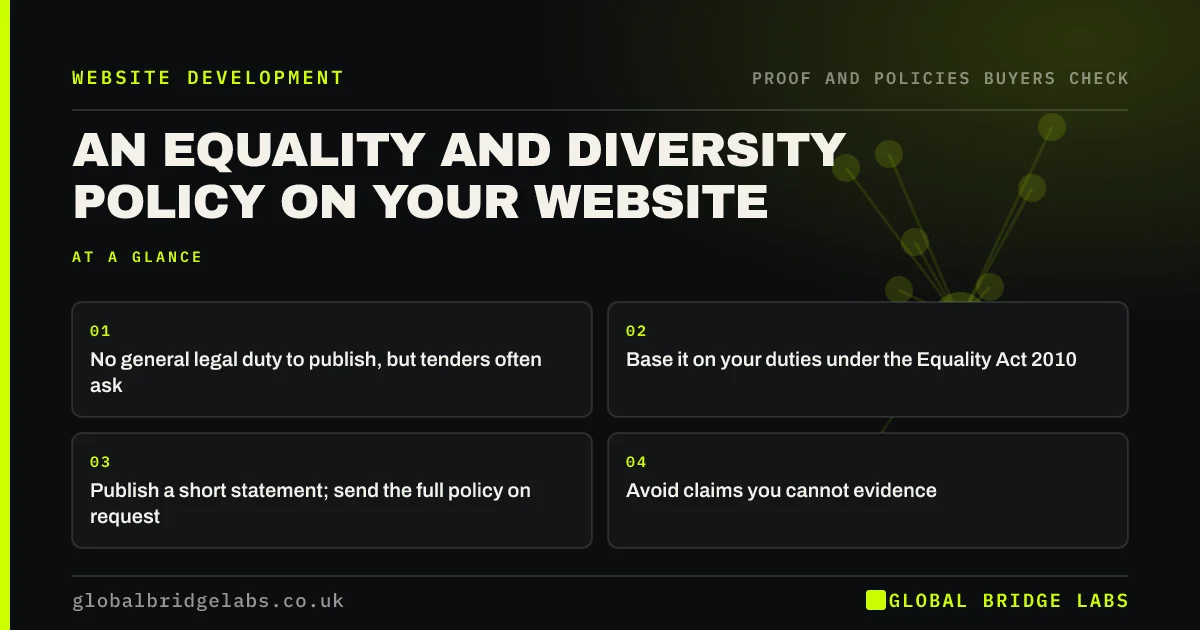
Small private businesses are not legally required to publish an equality and diversity policy, but public sector and large corporate buyers often ask for one in supplier questionnaires. A short public statement of your commitment under the Equality Act 2010, with the full policy on request, saves time. Only publish what you practise.
- No general legal duty to publish, but tenders often ask.
- Base it on your duties under the Equality Act 2010.
- Publish a short statement; send the full policy on request.
- Avoid claims you cannot evidence.
Want help with tender-ready policies? Message us on WhatsApp.
Chat on WhatsApp →Do you need an equality policy on your website?
Not by law, for most private businesses. But public sector and many corporate buyers ask for one in supplier questionnaires, and candidates increasingly look for it. Global Bridge Labs (GBL) recommends a short public statement with the full policy available on request, if you sell to those buyers.
What does the law require?
The Equality Act 2010 protects people from discrimination on nine protected characteristics, in employment and in the provision of services. That applies whether or not you have a written policy. A policy explains how you meet those duties, in hiring, training and serving customers.
Why do tenders ask for it?
Public bodies have their own equality duties and look for suppliers who support them. Under the Procurement Act 2023 regime, buyers still assess suppliers' social value and standards. A published policy shows you have thought about it and lets you answer the question by linking rather than drafting.
What should the public statement say?
The statement should say who it applies to, your commitment in employment and service delivery, how concerns can be raised, who is responsible and when it was last reviewed. Keep it to a few short paragraphs. Specific actions, such as reasonable adjustments, are more credible than broad values.
How do you keep it honest?
Only describe what you do. If you say you offer flexible working or adjustments, make sure staff and managers know about it. A buyer or candidate may test the claim. Review the statement annually and update it when practices change.
When should you not publish one?
Do not publish a generic template you have not adopted. If your buyers and candidates never ask, a policy kept internally is fine. Publish when it answers a real question from people you want to work with or hire.
What does this look like in practice?
A pattern we see with firms starting to bid for public work: the first questionnaire asks for an equality policy, and one is written in a rush. Publishing a short, accurate statement afterwards means the next tender can simply link to it.
Equality statement checklist
- Check whether buyers or tenders ask for it.
- Base it on Equality Act duties.
- Describe specific practices.
- Name who is responsible.
- Date and review it yearly.
- Offer the full policy on request.
Next step
If you bid for public or corporate work, write a five-paragraph equality statement this month and add it to your policies page.
Message us on WhatsApp for help preparing tender-ready policies, with no pitch.
Chat on WhatsApp →Sources and further reading
- Equality Act 2010 · legislation.gov.uk
- Procurement Act 2023: guidance documents · GOV.UK
- Unfair commercial practices guidance (CMA207) · Competition and Markets Authority
Frequently asked questions
Is an equality and diversity policy a legal requirement?
For most private businesses, there is no legal requirement to have a written policy, but the Equality Act 2010 duties apply regardless. Public bodies and many larger buyers ask suppliers for a policy, so it is often a commercial requirement.
What should an equality policy include?
It should include its scope, your commitment in employment and service delivery, how complaints or concerns are handled, who is responsible and review dates. Keep it specific and based on what you actually do.
Should a small business publish its equality policy?
Publish it if buyers, tenders or candidates ask for it. A short public statement with the full policy on request is enough. If nobody asks, keep it internal and make sure it is followed.
Written by

Global Bridge Labs (GBL) is a UK–Sri Lanka partner for social media, websites and BPO. Everything here comes from client delivery, not theory.