On this page
- 01Key takeaways
- 02Who needs a press contact on their website?
- 03What should a press contact include?
- 04What goes on a simple press page?
- 05Why does speed matter?
- 06Should you list past coverage?
- 07When is a press page unnecessary?
- 08What does this look like in practice?
- 09Press contact checklist
- 10Next step
- 11Sources and further reading
- 12Frequently asked questions
Key takeaways
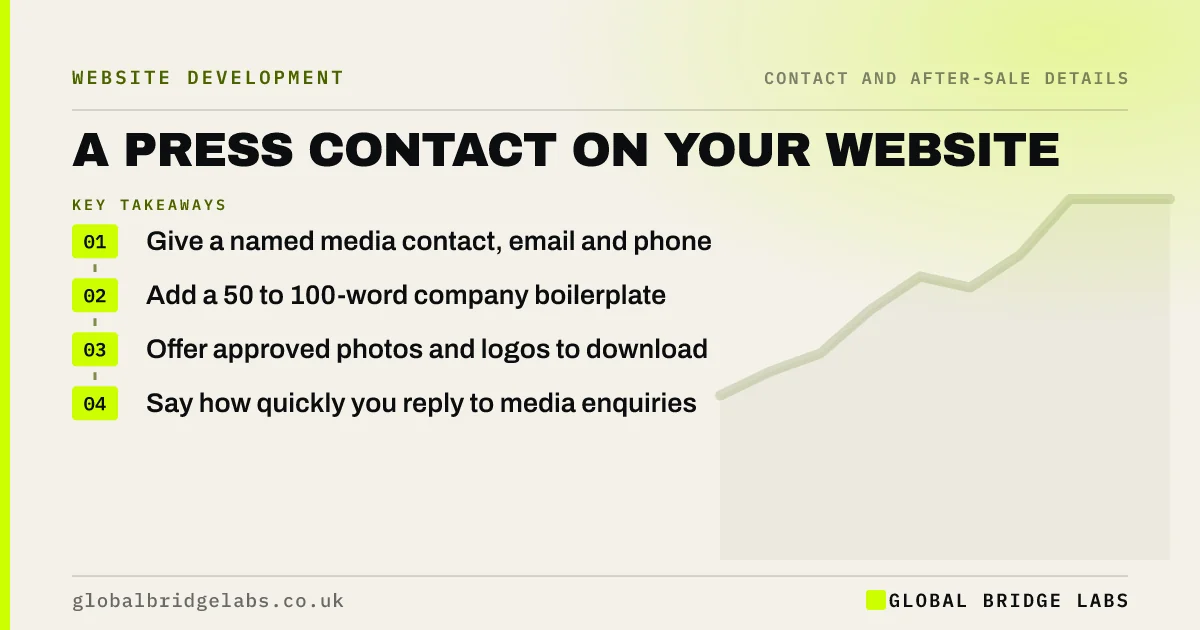
If journalists, podcasters or event organisers ever contact you, give them a named press or media contact, an email and a phone number, plus a short boilerplate about the business, approved photos and logos. Journalists work to deadlines, and an easy route makes you the source that gets quoted.
- Give a named media contact, email and phone.
- Add a 50 to 100-word company boilerplate.
- Offer approved photos and logos to download.
- Say how quickly you reply to media enquiries.
Want a simple press page outline? Message us on WhatsApp.
Chat on WhatsApp →Who needs a press contact on their website?
Any business that wants media coverage, speaks at events, or works in a sector journalists cover needs a press contact. Global Bridge Labs (GBL) suggests it for founders building a profile, businesses with news to share and firms likely to be asked for comment on industry topics.
What should a press contact include?
Include a named person or role, an email address that is checked daily, a phone number for urgent deadlines and how quickly you respond. A separate media address, such as press@, keeps enquiries out of the sales inbox and survives staff changes.
What goes on a simple press page?
A simple press page holds a short company boilerplate, key facts such as founding year, location and services, approved photos of founders and premises, logos and recent news. Journalists use these to write accurately and quickly, which makes accurate coverage more likely.
Why does speed matter?
Journalists often need a comment within hours. If the only route is a contact form with a two-day reply time, they move to the next source. Saying 'media enquiries answered within two hours in UK business hours' signals you understand deadlines.
Should you list past coverage?
Yes, if it is relevant and recent. A list of links to articles and interviews shows journalists you are a credible source and gives buyers third-party proof. Only use publication logos in line with their rules, and link to the coverage rather than copying it.
When is a press page unnecessary?
It is unnecessary for most local service businesses that are rarely approached by media. A line on the contact page, 'media enquiries: press@', is enough. Build a fuller page when coverage becomes part of your marketing.
What does this look like in practice?
A pattern we see: a founder is quoted in a trade publication after a journalist found them on LinkedIn, because the company website had no media route. Adding a press contact and a short boilerplate page makes the next approach easier and the coverage more accurate.
Press contact checklist
- Name a media contact.
- Create a press@ address checked daily.
- Add a phone line for deadlines.
- Write a short boilerplate.
- Offer approved photos and logos.
- List recent coverage.
Next step
Write a 75-word description of your business that a journalist could paste straight into an article. Put it on your about or press page.
Message us on WhatsApp for help with your press page, with no pitch.
Chat on WhatsApp →Sources and further reading
- 'About Us' information on corporate websites · Nielsen Norman Group
- Writing to GOV.UK standards: writing guidelines · GOV.UK
- Organization structured data · Google Search Central
Frequently asked questions
Should a small business have a press page?
Only if media or event organisers contact you, or you want them to. Otherwise a media contact line on the contact page is enough. A press page with a boilerplate, photos and recent coverage helps once publicity is part of your plan.
What is a company boilerplate?
A boilerplate is a short, standard paragraph describing your business, used at the end of press releases and by journalists. It usually covers what you do, for whom, where and since when, in 50 to 100 words. Keep the same version on your website and in every release.
How quickly should I reply to media enquiries?
As fast as you can, ideally within a couple of hours during business hours. Journalists work to tight deadlines, and slow replies usually mean the story runs without you or with a competitor quoted instead.
Written by

Global Bridge Labs (GBL) is a UK–Sri Lanka partner for social media, websites and BPO. Everything here comes from client delivery, not theory.