On this page
- 01Key takeaways
- 02What should a counsellor's website include?
- 03Why does professional body membership matter?
- 04How should fees and sessions be explained?
- 05What about confidentiality?
- 06Which claims should you avoid?
- 07When is less information better?
- 08What does this look like in practice?
- 09Counsellor website checklist
- 10Next step
- 11Sources and further reading
- 12Frequently asked questions
Key takeaways
A counsellor's website should show qualifications and membership of a professional body, ideally one with a register accredited by the Professional Standards Authority, plus approach, issues worked with, fees, session length and format, cancellation terms, confidentiality and its limits, and how to book a first session. Clients need to feel safe before they reach out.
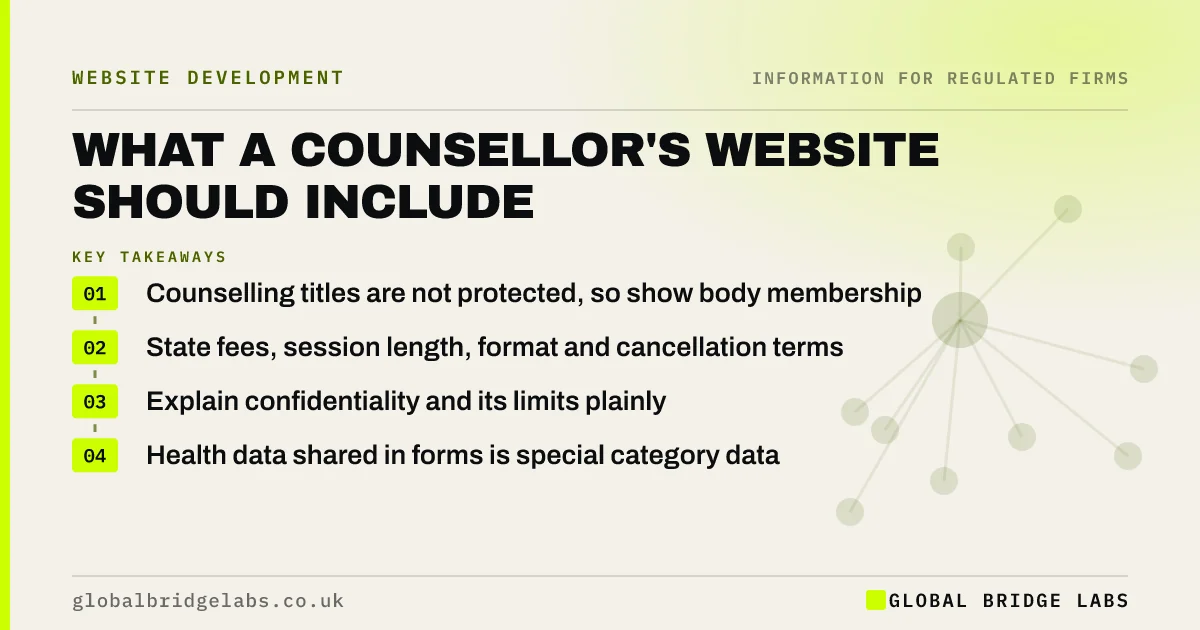
- Counselling titles are not protected, so show body membership.
- State fees, session length, format and cancellation terms.
- Explain confidentiality and its limits plainly.
- Health data shared in forms is special category data.
Running a counselling practice website? Message us on WhatsApp.
Chat on WhatsApp →What should a counsellor's website include?
A counsellor's website should include qualifications, professional body membership, the approach used, the issues you work with, fees, session details, cancellation terms, confidentiality and how to start. Global Bridge Labs (GBL) sees fees and confidentiality as the two items most often missing on therapy websites.
Why does professional body membership matter?
Counselling and psychotherapy titles are not protected by law in the UK, so clients look for membership of a recognised body, such as BACP, and its register. Show your membership level and number and link to the register, so clients can verify you.
How should fees and sessions be explained?
State the fee per session, the session length, whether you work in person, online or by phone, any concessions, and your cancellation policy. Clear fees remove a barrier for people who are already finding it hard to reach out.
What about confidentiality?
Explain confidentiality in plain words, including its limits, such as risk of serious harm, and how you store notes. Contact forms and emails may contain health information, which is special category data under UK GDPR, so explain in your privacy notice how you protect it.
Which claims should you avoid?
Avoid claims to cure or guarantee outcomes, and be careful naming medical conditions you treat. Advertising rules require health claims to be evidenced. Describe how you work, who you work with and what clients can expect from sessions instead, which is both safer and more reassuring.
When is less information better?
Long lists of every therapeutic model can overwhelm people. Most clients want to know whether you can help with their issue, what it costs and what the first session is like. Keep theory brief and put it on a separate page for those who want it.
What does this look like in practice?
A pattern we see on therapy websites: a long page on therapeutic approach and training, with fees and how to book hidden at the bottom. Moving fees, availability and a short 'what happens in the first session' section higher makes it easier for nervous clients to take the first step.
Counsellor website checklist
- Show body membership and register link.
- List qualifications plainly.
- State fees, session length and format.
- Explain cancellation terms.
- Explain confidentiality and its limits.
- Describe the first session.
Next step
Write a short 'your first session' section covering cost, length, what happens and confidentiality. Put it near the top of your homepage.
Message us on WhatsApp for a practice website review, with no pitch.
Chat on WhatsApp →Sources and further reading
- Special category data · Information Commissioner's Office
- UK Code of Non-broadcast Advertising and Direct & Promotional Marketing (CAP Code) · ASA / CAP
Frequently asked questions
Should a counsellor show fees on their website?
Yes. Clear fees remove a barrier for people deciding whether to reach out. Show the fee per session, session length, format and any concessions, alongside your cancellation policy, so clients know the full commitment before they book a first session.
Is counselling a regulated profession in the UK?
Counselling and psychotherapy titles are not protected by law. Many practitioners belong to professional bodies with registers accredited by the Professional Standards Authority, which clients can use to check them.
What should a therapist say about confidentiality online?
Explain what confidentiality means in your practice, its limits, such as serious risk of harm, and how notes and messages are stored. Link to your privacy notice for how personal and health data is handled.
Written by

Global Bridge Labs (GBL) is a UK–Sri Lanka partner for social media, websites and BPO. Everything here comes from client delivery, not theory.