On this page
- 01Key takeaways
- 02Which businesses need a safeguarding policy?
- 03What should the website show?
- 04What do regulators and schools expect?
- 05How does it link to DBS checks?
- 06How often should it be reviewed?
- 07When is a safeguarding policy not needed?
- 08What does this look like in practice?
- 09Safeguarding information checklist
- 10Next step
- 11Sources and further reading
- 12Frequently asked questions
Key takeaways
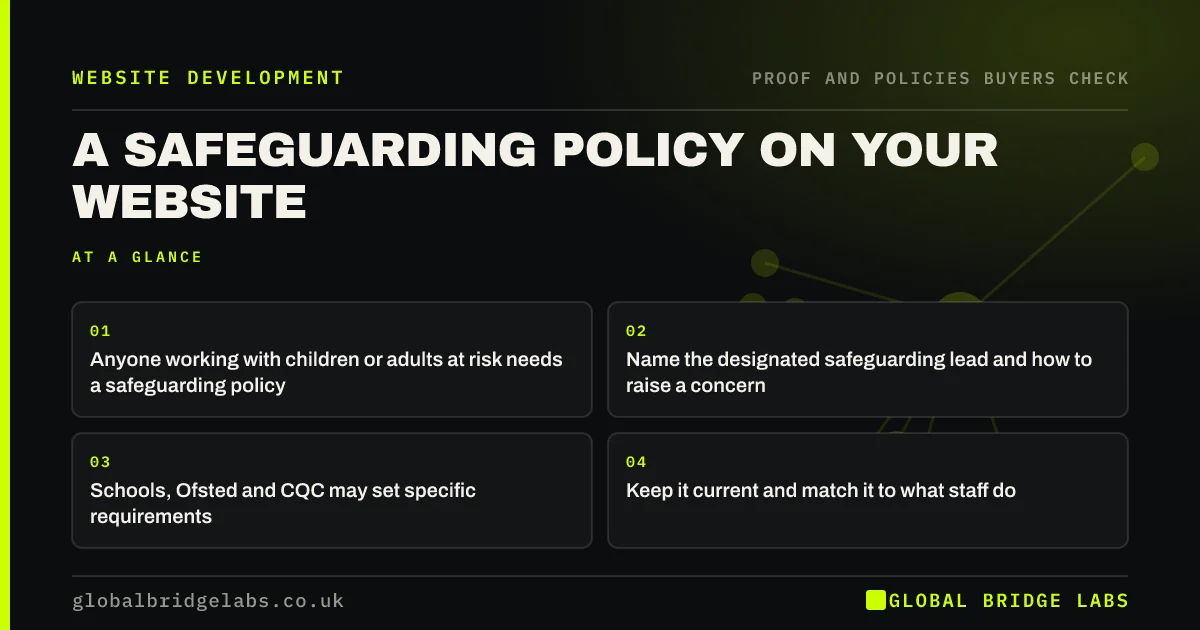
Businesses that work with children or adults at risk, such as nurseries, tutors, clubs, care providers and activity businesses, should have a safeguarding policy and make it easy for parents and carers to see. Publish a summary with your designated safeguarding lead and how to raise a concern. Regulators and schools may require more.
- Anyone working with children or adults at risk needs a safeguarding policy.
- Name the designated safeguarding lead and how to raise a concern.
- Schools, Ofsted and CQC may set specific requirements.
- Keep it current and match it to what staff do.
Want your safeguarding information reviewed? Message us on WhatsApp.
Chat on WhatsApp →Which businesses need a safeguarding policy?
Businesses that work with children or adults at risk need a safeguarding policy: nurseries, childminders, tutors, coaches, clubs, holiday activity providers, care agencies and some health services. Global Bridge Labs (GBL) recommends that any such business makes the policy visible on its website, because parents and carers look.
What should the website show?
Show a summary of your commitment, the name or role of your designated safeguarding lead, how to raise a concern, the checks your staff hold and when the policy was last reviewed. Link to the full policy. Keep the language plain, because parents read it before trusting you with a child.
What do regulators and schools expect?
Schools and colleges follow the statutory guidance Keeping Children Safe in Education and often require providers working with their pupils to show compatible arrangements. Ofsted-registered early years providers must meet the EYFS safeguarding requirements, and CQC-registered services have their own standards.
How does it link to DBS checks?
A safeguarding policy explains how you keep people safe; DBS checks are one part of it. State which roles have which level of check, how you keep them current, and how you supervise new staff. Checks alone are not a safeguarding policy.
How often should it be reviewed?
Review a safeguarding policy at least once a year and whenever statutory guidance changes, and show the date of the last review on the website. An out-of-date policy suggests safeguarding is not taken seriously. Keep the named lead current when staff change.
When is a safeguarding policy not needed?
It is not needed for businesses with no contact with children or adults at risk as part of their service. A trade working in an occupied home may still benefit from a short statement on how staff behave, but a full safeguarding policy is for organisations with that responsibility.
What does this look like in practice?
A pattern we see with tutoring and activity businesses: the safeguarding policy exists but sits in a staff handbook. Parents comparing providers find nothing on the website. Publishing a summary with the lead's role and a concerns route answers their first question before they ask.
Safeguarding information checklist
- Confirm you need a policy.
- Publish a plain summary.
- Name the safeguarding lead.
- Explain how to raise a concern.
- State staff checks.
- Show the last review date.
Next step
If you work with children or adults at risk, check that a parent could find your safeguarding lead and concerns route in two clicks.
Message us on WhatsApp for help with safeguarding information, with no pitch.
Chat on WhatsApp →Sources and further reading
- Keeping children safe in education · Department for Education
- Early years foundation stage (EYFS) statutory framework · GOV.UK
- The fundamental standards of care · Care Quality Commission
Frequently asked questions
Does my business need a safeguarding policy?
If your business works with children or adults at risk, yes. Nurseries, tutors, clubs, activity providers and care services all need one. Regulators, schools and local authorities may also require specific arrangements.
Should a safeguarding policy be on my website?
It is good practice for any business working with children or adults at risk. Parents and carers check before trusting a provider. Publish a summary, the safeguarding lead's role and a concerns route, and link to the full policy.
What is a designated safeguarding lead?
A designated safeguarding lead is the person responsible for safeguarding in an organisation, who handles concerns and liaises with authorities. Naming the role on your website tells parents who to contact with a worry.
Written by

Global Bridge Labs (GBL) is a UK–Sri Lanka partner for social media, websites and BPO. Everything here comes from client delivery, not theory.