On this page
- 01Key takeaways
- 02What do UK website legal requirements cover?
- 03What business details must a website display?
- 04What are the data protection requirements?
- 05What rules apply when selling online?
- 06What other rules affect website content?
- 07When do you need terms and conditions?
- 08What does this look like in practice?
- 09Website legal checklist
- 10Next step
- 11Sources and further reading
- 12Frequently asked questions
Key takeaways
The main legal requirements for a UK business website are: display your business and registration details, explain how you use personal data and cookies, follow consumer rules when selling online, advertise honestly, handle reviews and prices fairly, and make the site reasonably accessible. Most can be met with a few pages and a footer.
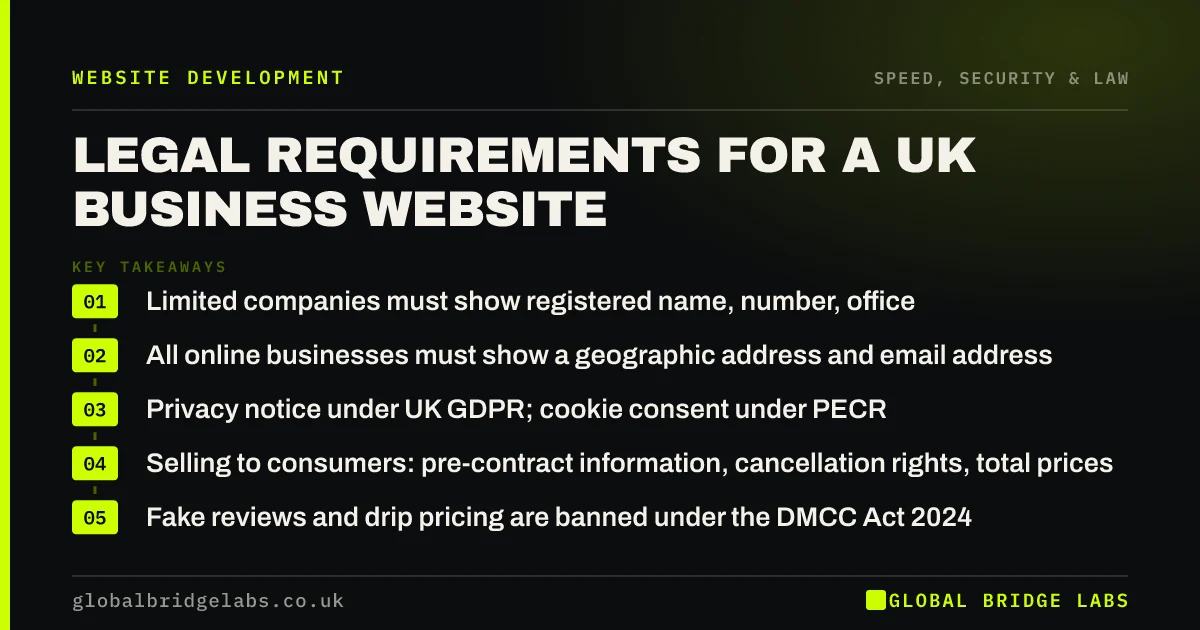
- Limited companies must show registered name, number, office and place of registration.
- All online businesses must show a geographic address and email address.
- Privacy notice under UK GDPR; cookie consent under PECR.
- Selling to consumers: pre-contract information, cancellation rights, total prices.
- Fake reviews and drip pricing are banned under the DMCC Act 2024.
Want a quick legal-basics check of your website footer and key pages? Message us on WhatsApp.
Chat on WhatsApp →What do UK website legal requirements cover?
UK website legal requirements are the obligations that apply to a business's website under company law, e-commerce and consumer protection law, data protection law, advertising rules and equality law.
This article is a practical overview, not legal advice. Regulated sectors such as financial services, legal services and healthcare have additional rules, and businesses should take professional advice for their specific situation.
What business details must a website display?
Limited companies must show their registered name, company number, registered office address and part of the UK where registered, such as England and Wales, on their websites. GOV.UK sets this out in its guidance on running a limited company.
Separately, the Electronic Commerce Regulations 2002 require online service providers to make available their name, geographic address, email address, any trade register or professional body details, and a VAT number if registered. The footer or a Legal information page is the usual place.
What are the data protection requirements?
If your site collects personal data, UK GDPR requires a privacy notice explaining what you collect, why and on what lawful basis. PECR requires consent before setting non-essential cookies and before sending most electronic marketing to individuals.
You must also keep data secure, which includes website security, and most organisations that process personal data must pay the ICO's data protection fee unless exempt.
What rules apply when selling online?
When you sell to consumers at a distance, the Consumer Contracts Regulations 2013 require clear pre-contract information, including the total price with taxes and delivery, the main characteristics of the goods or services, and cancellation rights. Consumers generally have 14 days to cancel most distance contracts.
The Digital Markets, Competition and Consumers Act 2024 strengthens enforcement: the CMA can fine businesses directly for consumer law breaches, fake reviews are banned, and drip pricing, where mandatory fees appear late, is prohibited.
Selling online and unsure about your checkout information? Message us on WhatsApp for a check.
Chat on WhatsApp →What other rules affect website content?
Marketing claims on your website are covered by the CAP Code, enforced by the Advertising Standards Authority. Claims must be honest, and objective claims, such as fastest or cheapest, need evidence.
The Equality Act 2010 requires reasonable adjustments for disabled people, which applies to services offered online. Copyright applies to images, text and fonts, so use material you own or are licensed to use. Regulated professions such as solicitors and financial firms have sector-specific rules, including the SRA's transparency rules and the FCA's financial promotions rules.
When do you need terms and conditions?
Website terms of use are not legally required for a simple brochure site, although they are useful. If you sell online or take bookings, terms of sale are essential, because they set out the contract, payment, delivery, cancellation and liability.
The trade-off is effort against protection. A professionally drafted set of terms costs money once and protects every transaction afterwards. Copying a competitor's terms is a copyright risk and rarely fits your business.
What does this look like in practice?
A pattern in audits of limited company websites: no company number or registered office anywhere on the site, a privacy policy from a template, and prices on the booking page that exclude a mandatory booking fee.
Adding the company details to the footer, rewriting the privacy notice from a list of tools and including all mandatory fees in the headline price addresses three separate legal issues in an afternoon.
Website legal checklist
Use this as a starting point, then take advice for your sector.
- Show company name, number, registered office and registration jurisdiction.
- Show a geographic address, email address and VAT number if registered.
- Publish an accurate privacy notice.
- Get consent for non-essential cookies.
- Show total prices including VAT and mandatory fees to consumers.
- Provide pre-contract information and cancellation rights when selling.
- Use genuine reviews only.
- Check marketing claims can be evidenced.
- Work towards WCAG 2.2 AA accessibility.
Next step
If you are not sure your site covers the basics, we will run through this checklist with you in 30 minutes and flag anything that needs a specialist.
Message us on WhatsApp for a website legal basics check, or book a 30-minute consultation.
Chat on WhatsApp →Sources and further reading
- Running a limited company: signs, stationery and promotional material · GOV.UK
- Consumer Contracts (Information, Cancellation and Additional Charges) Regulations 2013 · legislation.gov.uk
- Unfair commercial practices guidance (CMA207) · Competition and Markets Authority
- Right to be informed (privacy information) · Information Commissioner's Office
Frequently asked questions
What information must a UK company website display?
A UK limited company must show its registered name, company number, registered office address and place of registration. Under the Electronic Commerce Regulations it should also provide a geographic address, email address, any trade register or professional body details, and its VAT number if it is registered for VAT.
Does my business website need terms and conditions?
Terms of use are optional for a simple brochure website, although useful. If you sell online or take bookings, terms of sale are essential, covering the contract, payment, delivery, cancellation and liability, and they must be consistent with consumer rights under UK law.
Do sole traders need to show their address on their website?
Under the Electronic Commerce Regulations 2002, online service providers must make available their name, geographic address and email address. That includes sole traders. If you work from home and are concerned about privacy, take advice on which address you can lawfully use.
What happens if my website breaks consumer law?
Under the Digital Markets, Competition and Consumers Act 2024, the CMA can investigate and directly fine businesses for consumer law breaches, including fake reviews and drip pricing. Trading Standards can also take action, and customers may have rights to refunds or to cancel contracts.
Written by

Global Bridge Labs (GBL) is a UK–Sri Lanka partner for social media, websites and BPO. Everything here comes from client delivery, not theory.