On this page
- 01Key takeaways
- 02Why explain materials and methods on a website?
- 03What should you explain?
- 04How much technical detail is right?
- 05What rules apply to quality and green claims?
- 06Where should this information go?
- 07When is detail counterproductive?
- 08What does this look like in practice?
- 09Materials and methods checklist
- 10Next step
- 11Sources and further reading
- 12Frequently asked questions
Key takeaways
Explain the materials you use and the methods you follow, in plain terms, so buyers can see why your quote differs from a cheaper one. Name grades, standards and suppliers where they matter, and say why you chose them. Specific claims, such as '18mm marine ply' or 'BS 7671 testing on every circuit', are checkable and therefore believable.
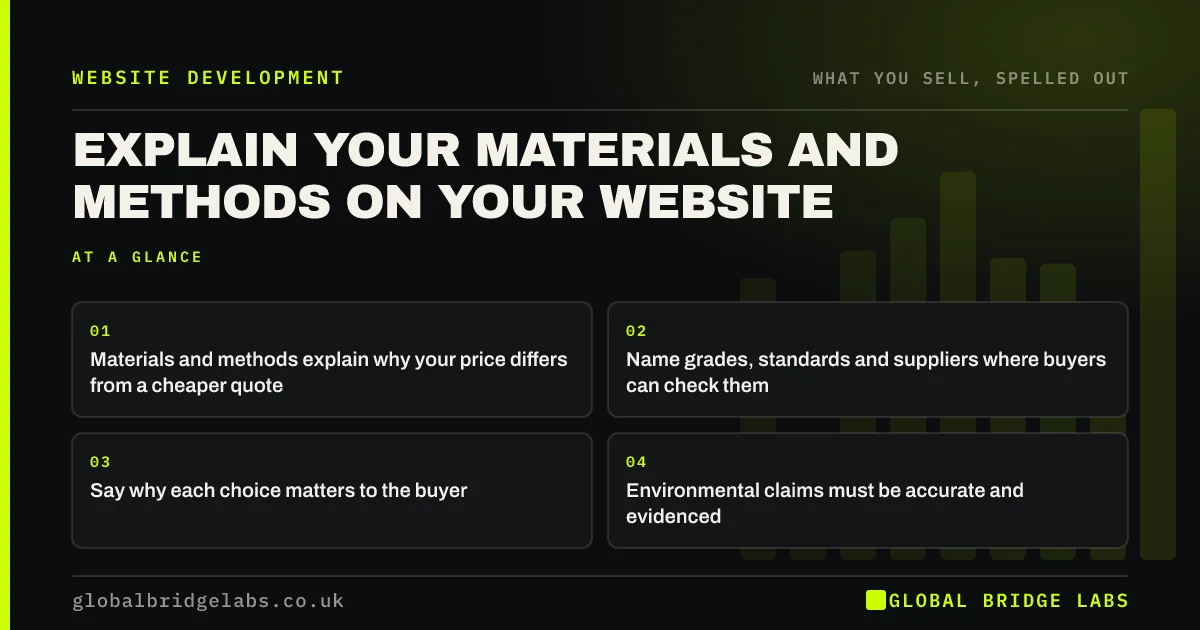
- Materials and methods explain why your price differs from a cheaper quote.
- Name grades, standards and suppliers where buyers can check them.
- Say why each choice matters to the buyer.
- Environmental claims must be accurate and evidenced.
Competing with cheaper quotes? Message us on WhatsApp.
Chat on WhatsApp →Why explain materials and methods on a website?
Explaining materials and methods lets buyers compare quality, not just price. Without it, two quotes look alike and the cheaper one wins. Global Bridge Labs (GBL) sees this information matter most in building, manufacturing, food and crafts, where the difference between suppliers is in what they use and how they work.
What should you explain?
Explain the choices that affect the result: the grade or type of materials, the standards you work to, the steps in your method that cheaper suppliers skip, and how you check quality. For each, add one line on why it matters, such as durability, safety or appearance.
How much technical detail is right?
Give enough detail for a buyer to check and compare, but explain it in plain words. 'BS 7671 testing on every circuit, so you get a certificate for your records' is better than a paragraph of jargon. Specialist buyers can follow a link to full specifications.
What rules apply to quality and green claims?
Claims about materials must be accurate and evidenced. The CMA's Green Claims Code says environmental claims must be truthful, clear and substantiated, and the ASA expects marketers to hold evidence for objective claims. Avoid vague words such as 'eco-friendly' unless you can explain and prove them.
Where should this information go?
Put a short 'how we work' or 'materials we use' section on each relevant service page, and a fuller page if your methods are a main selling point. Photos of materials and work in progress help. Link to it from quotes so buyers can show it to whoever else is deciding.
When is detail counterproductive?
Detail is counterproductive when it is about choices buyers do not care about, when it reveals a method competitors could copy easily, or when it commits you to a material that supply problems might force you to change. In that case, describe the standard you meet rather than a single product.
What does this look like in practice?
A pattern we see in building trades: a firm loses jobs to quotes 20% cheaper without knowing why. Adding a section on the materials and preparation steps it uses, with photos, lets buyers see what the cheaper quote leaves out, and the price conversation becomes a quality conversation.
Materials and methods checklist
- List choices that affect the result.
- Name grades and standards.
- Add one line on why each matters.
- Keep evidence for every claim.
- Avoid vague green words.
- Link it from quotes.
Next step
Write down three things you do that a cheaper competitor usually skips. Explain each in one plain sentence on your service page.
Message us on WhatsApp for help explaining your quality, with no pitch.
Chat on WhatsApp →Sources and further reading
- Green claims code: making environmental claims · Competition and Markets Authority
- Substantiation: advice on backing up marketing claims · ASA and CAP
- Consumer Rights Act 2015 · legislation.gov.uk
Frequently asked questions
How do I justify higher prices on my website?
Explain what the buyer gets for the difference: better materials, extra steps, standards met, guarantees and aftercare. Be specific and checkable. Buyers accept higher prices more readily when they can see what is included and why it matters.
Can I call my products eco-friendly on my website?
Only if you can explain and prove it. The CMA's Green Claims Code requires environmental claims to be truthful, clear and substantiated. Specific claims, such as recycled content percentages, are safer than vague terms.
Should I name my suppliers on my website?
Name them when the brand reassures buyers, such as recognised timber or paint brands, and when you reliably use them. If supply varies, describe the standard or grade instead, so the website stays accurate when you switch.
Written by

Global Bridge Labs (GBL) is a UK–Sri Lanka partner for social media, websites and BPO. Everything here comes from client delivery, not theory.