On this page
- 01Key takeaways
- 02What does it cost to fill information gaps on a website?
- 03What drives the cost?
- 04What does an illustrative sum look like?
- 05What does it cost to do it yourself?
- 06When is a rewrite or redesign worth it?
- 07When should you not spend on content?
- 08What does this look like in practice?
- 09Information gaps budget checklist
- 10Next step
- 11Sources and further reading
- 12Frequently asked questions
Key takeaways
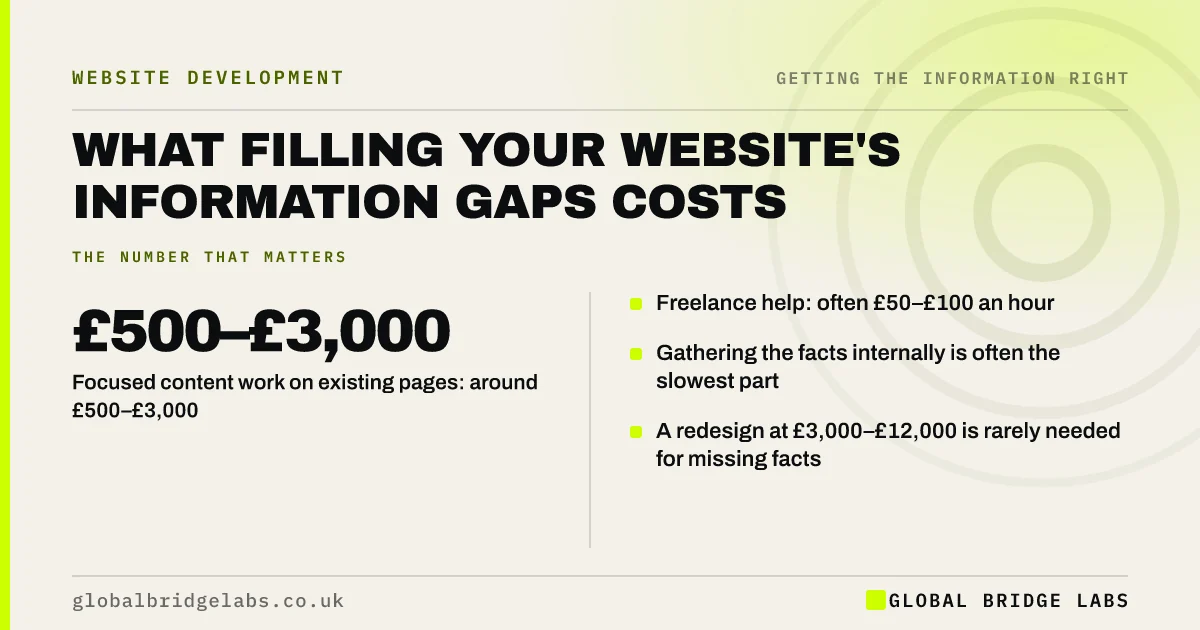
Filling information gaps on an existing website is usually focused work, which GBL's website cost guidance puts at around £500–£3,000 in the UK, or freelance help at about £50–£100 an hour. Much of the real cost is your own time gathering facts. A redesign at £3,000–£12,000 is rarely needed just to add missing information.
- Focused content work on existing pages: around £500–£3,000.
- Freelance help: often £50–£100 an hour.
- Gathering the facts internally is often the slowest part.
- A redesign at £3,000–£12,000 is rarely needed for missing facts.
Want a costed plan for your gaps? Message us on WhatsApp.
Chat on WhatsApp →What does it cost to fill information gaps on a website?
Filling information gaps on an existing site is usually focused work: writing missing facts, adding a few pages and updating existing ones. Global Bridge Labs (GBL) website cost guidance puts focused work on existing pages at around £500–£3,000 in the UK. GBL does not publish its own price list, because scope varies.
What drives the cost?
Cost depends on how many items are missing, whether the facts already exist in the business, how many pages are affected, whether new pages need design, and whether legal review is needed. Writing a missing price guide is quick; agreeing internally what the price guide should say may take weeks.
What does an illustrative sum look like?
As an illustrative example only: a site missing 12 inventory items, each taking one to two hours to write and publish, needs about 12 to 24 hours of work. At freelance rates of £50–£100 an hour, that is roughly £600–£2,400, before any legal review or new design.
What does it cost to do it yourself?
Doing it yourself costs time rather than fees: gathering facts, writing plainly and publishing. Most modern content management systems let owners add text without a developer. The risk is that it never gets finished, so book the hours like a project, not a spare-time job.
When is a rewrite or redesign worth it?
A redesign, which our guidance puts at £3,000–£12,000 on the same platform, is worth it only when the site's structure has no sensible place for the information, it is slow or broken on phones, or it cannot be edited. Otherwise, fix the content first; it often solves more than expected.
When should you not spend on content?
Do not spend on content if the site has no traffic and no plan to get any, or if the business itself is about to change significantly. Fix the facts that carry legal risk regardless, because those cost little and matter in any case.
What does this look like in practice?
A pattern we see: a business budgets for a new website because enquiries are poor, but an inventory shows the current site is simply missing prices, areas and process. Writing those for a fraction of a redesign budget often changes enquiries before any design work starts.
Information gaps budget checklist
- Run the 30-item inventory.
- Count the missing items.
- Check which facts already exist internally.
- Estimate one to two hours per item.
- Add legal review where needed.
- Decide: do it yourself or get help.
Next step
Score your site with the inventory and count the gaps. Multiply by two hours to get a realistic first estimate of the work.
Message us on WhatsApp to discuss your requirements for a costed plan, with no pitch.
Chat on WhatsApp →Sources and further reading
- Creating helpful, reliable, people-first content · Google Search Central
- Writing to GOV.UK standards: writing guidelines · GOV.UK
- How users read on the web · Nielsen Norman Group
Frequently asked questions
How much does it cost to add content to a website?
Focused content work on an existing site typically falls around £500–£3,000 in the UK, depending on scope, and freelance help is often £50–£100 an hour. Doing it yourself costs time rather than fees.
Do I need a new website to add missing information?
Usually not. Most gaps can be filled by adding text and a few pages to the existing site. A redesign is worth it only when the structure, speed or editing tools make adding information impractical.
How long does it take to fill website information gaps?
As a rough guide, allow one to two hours per missing item for writing and publishing, plus time to agree facts internally. A site missing ten to fifteen items is often a two to four week project.
Written by

Global Bridge Labs (GBL) is a UK–Sri Lanka partner for social media, websites and BPO. Everything here comes from client delivery, not theory.