On this page
- 01Key takeaways
- 02Should a website say what you do not do?
- 03Does saying no put buyers off?
- 04How should you word it?
- 05What kinds of things should you name?
- 06Where should it appear?
- 07When is this the wrong move?
- 08What does this look like in practice?
- 09What we don't do checklist
- 10Next step
- 11Sources and further reading
- 12Frequently asked questions
Key takeaways
Saying what you do not do, such as 'we do not take on jobs under £500' or 'we do not repair gas boilers', saves you time on poor-fit enquiries and makes your real offer sharper. It also builds trust, because a business that turns some work away sounds more credible than one that claims to do everything.
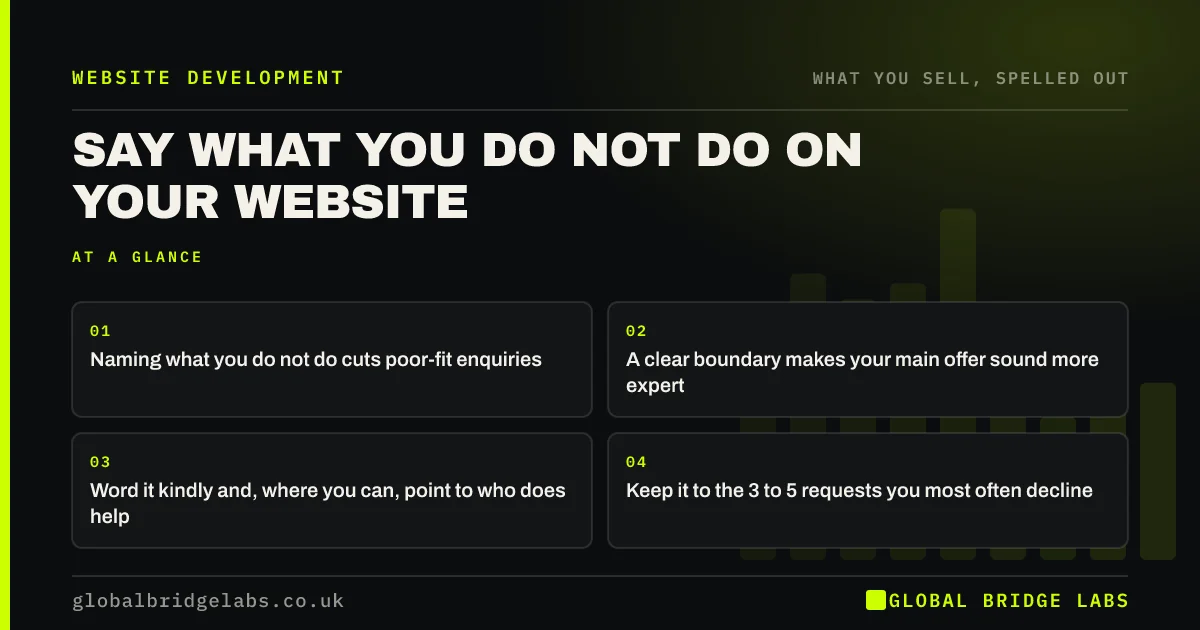
- Naming what you do not do cuts poor-fit enquiries.
- A clear boundary makes your main offer sound more expert.
- Word it kindly and, where you can, point to who does help.
- Keep it to the 3 to 5 requests you most often decline.
Getting the wrong enquiries? Message us on WhatsApp.
Chat on WhatsApp →Should a website say what you do not do?
Yes, when you regularly receive enquiries you decline. A short, polite statement of what you do not do saves both sides time and sharpens the description of what you do. Global Bridge Labs (GBL) suggests limiting it to the three to five requests that most often waste a call.
Does saying no put buyers off?
It puts off the buyers you would turn away anyway, which is the point. For everyone else, a clear boundary reads as expertise and honesty. Specialist firms that say what they leave to others are easier to believe when they claim to be good at what they keep.
How should you word it?
Word it factually and helpfully: 'We do not install solar panels, but we work alongside installers on battery storage.' Avoid sounding dismissive. If there is someone better placed, such as a trade body directory or a partner, say so; it is good service and earns goodwill.
What kinds of things should you name?
Name the services, job sizes, areas and customer types you decline. Common examples are jobs below a minimum value, areas outside your coverage, services a related trade does, and work for certain sectors. Each should be something people actually ask for.
- Services: 'We do not do domestic electrical work.'
- Job size: 'Our minimum job is £750.'
- Area: 'We do not cover north of the M62.'
- Customer type: 'We only work with VAT-registered businesses.'
Where should it appear?
Put it near the point of decision: on service pages under what is included, in the FAQs and near the enquiry form. A line on the homepage helps only if a large share of enquiries are poor fits. Do not bury it in terms and conditions, where buyers will not see it before contacting you.
When is this the wrong move?
It is the wrong move when you are trying to grow into new work and would take those jobs at the right price, or when the list would be long and negative. In that case, describe your focus positively and handle edge cases on the phone.
What does this look like in practice?
A pattern we see: a commercial firm gets regular domestic enquiries because its site never says it is commercial only. A single line on the homepage and contact page, with a link to a directory for domestic work, cuts those calls and makes the business look more focused.
What we don't do checklist
- List enquiries you declined in the last three months.
- Pick the three to five most common.
- Write each as a plain sentence.
- Add who can help where you can.
- Place it near the enquiry form.
- Review it when your focus changes.
Next step
Count the enquiries you turned down last month and group them. The biggest group is your first 'we do not' line.
Message us on WhatsApp for help filtering poor-fit enquiries, with no pitch.
Chat on WhatsApp →Sources and further reading
- Plain language is for everyone, even experts · Nielsen Norman Group
- Writing to GOV.UK standards: writing guidelines · GOV.UK
- Unfair commercial practices guidance (CMA207) · Competition and Markets Authority
Frequently asked questions
Is it bad to turn customers away on my website?
Not if you do it politely and helpfully. Saying what you do not do saves poor-fit buyers time and makes your main offer more credible. Pointing them to someone who can help leaves a good impression even when you cannot.
How do I stop getting the wrong enquiries from my website?
State who you work with, what you do not do, your minimum job size and your area clearly on service pages and near the form. Add price guidance. These filters stop many poor-fit buyers before they enquire.
Where should I say what services I do not offer?
Say it on the relevant service pages, in the FAQs and near the enquiry form, where buyers decide whether to contact you. Burying it in terms and conditions does not help, because few people read them before enquiring.
Written by

Global Bridge Labs (GBL) is a UK–Sri Lanka partner for social media, websites and BPO. Everything here comes from client delivery, not theory.