On this page
- 01Key takeaways
- 02What is the legal risk of inaccurate website information?
- 03What changed with the DMCC Act 2024?
- 04Which errors are most common?
- 05Do claims need evidence?
- 06How do you prevent inaccuracy?
- 07When is a small inaccuracy not a legal problem?
- 08What does this look like in practice?
- 09Website accuracy checklist
- 10Next step
- 11Sources and further reading
- 12Frequently asked questions
Key takeaways
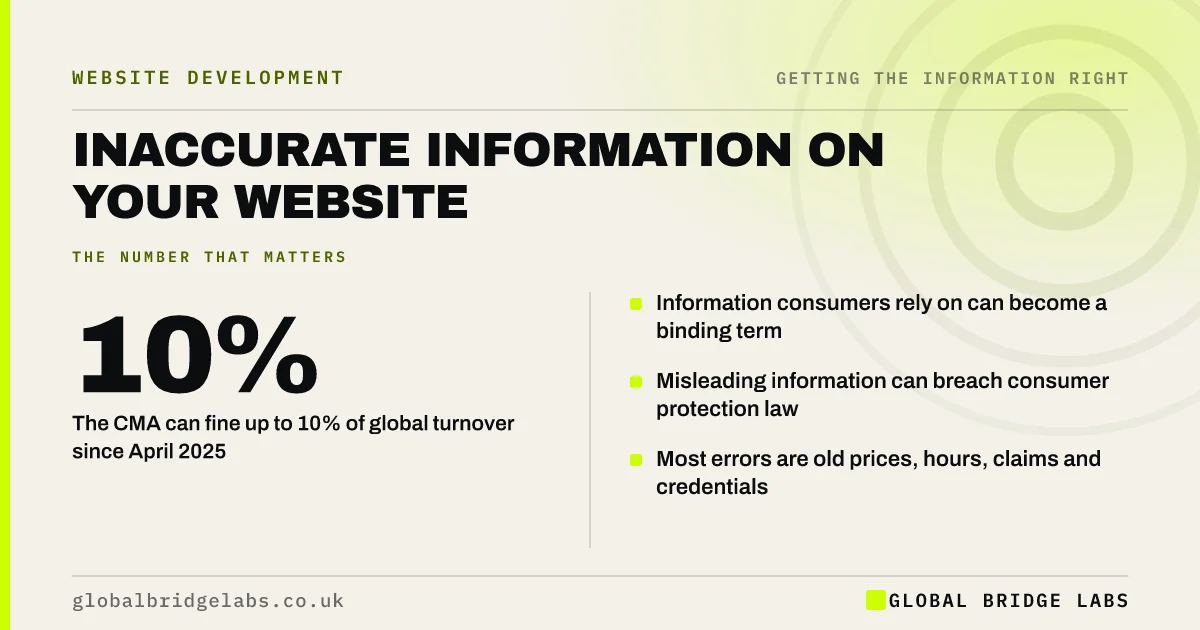
Inaccurate website information carries two legal risks: what you tell consumers about a service can become binding under the Consumer Rights Act 2015, and misleading information can breach consumer protection law, which the CMA can now enforce directly with fines of up to 10% of global turnover. The usual causes are out-of-date prices, hours and claims.
- Information consumers rely on can become a binding term.
- Misleading information can breach consumer protection law.
- The CMA can fine up to 10% of global turnover since April 2025.
- Most errors are old prices, hours, claims and credentials.
Want your site checked for accuracy? Message us on WhatsApp.
Chat on WhatsApp →What is the legal risk of inaccurate website information?
The legal risk is twofold. Under section 50 of the Consumer Rights Act 2015, information about a service that a consumer takes into account can become binding. Separately, misleading information can be an unfair commercial practice. Global Bridge Labs (GBL) sees most risk arise from neglect rather than intent.
What changed with the DMCC Act 2024?
Since April 2025, the DMCC Act 2024 has given the CMA power to decide whether consumer law has been broken and to fine businesses directly, up to 10% of global turnover. Misleading actions and omissions remain at the heart of the rules, so accuracy matters more than ever.
Which errors are most common?
The most common errors are prices that have risen, hours and areas that have changed, credentials or memberships that have lapsed, staff who have left, old offers still live, and claims that cannot be evidenced. Each is easy to miss and easy to fix once found.
- Out-of-date prices and offers.
- Changed hours, areas or addresses.
- Lapsed accreditations and insurance.
- Unsupported claims such as 'best' or 'cheapest'.
Do claims need evidence?
Yes. Advertising rules require marketers to hold evidence for objective claims before making them, and consumer law prohibits misleading claims. 'Fastest response in the area' or 'trusted by 500 businesses' need proof. If you cannot prove it, reword it or remove it.
How do you prevent inaccuracy?
Keep a master fact sheet with an owner for each fact, check the website against it every quarter, and update it the same week anything changes. Add expiry dates for insurance and accreditations, and remove time-limited offers automatically.
When is a small inaccuracy not a legal problem?
Minor errors that would not affect a buyer's decision, such as a typo, are unlikely to be a legal problem. The test is whether the average consumer would be likely to take a different decision because of it. Prices, terms, credentials and availability usually pass that test.
What does this look like in practice?
A pattern we see: a 'free survey' offer from a past campaign stays on the site after the business starts charging for surveys. Customers who book quote the website. Removing expired offers and keeping a list of live ones avoids the dispute entirely.
Website accuracy checklist
- Check prices and offers are current.
- Check hours, areas and addresses.
- Check accreditations and insurance dates.
- Evidence every objective claim.
- Remove expired offers.
- Review against the fact sheet quarterly.
Next step
Read every price, offer and claim on your site this week and ask: could I prove this today? Fix or remove anything you could not.
Message us on WhatsApp for an accuracy check, with no pitch.
Chat on WhatsApp →Sources and further reading
- Consumer Rights Act 2015 · legislation.gov.uk
- Digital Markets, Competition and Consumers Act 2024 · legislation.gov.uk
- Unfair commercial practices guidance (CMA207) · Competition and Markets Authority
- Substantiation: advice on backing up marketing claims · ASA and CAP
Frequently asked questions
Is information on my website legally binding?
It can be. Under the Consumer Rights Act 2015, information about a service that a consumer takes into account when deciding can become a term of the contract. Keep website information accurate and consistent with your quotes and terms.
Can I be fined for misleading information on my website?
Yes. Since April 2025, the CMA can decide that consumer law has been broken and impose fines of up to 10% of global turnover under the DMCC Act 2024. Trading Standards can also take action.
What should I do if I find wrong information on my website?
Correct it promptly, check where else the same error appears, such as Google or directories, and honour any reasonable commitments customers relied on. Then add the fact to your master sheet so it stays right.
Written by

Global Bridge Labs (GBL) is a UK–Sri Lanka partner for social media, websites and BPO. Everything here comes from client delivery, not theory.