On this page
- 01Key takeaways
- 02What is a business fact sheet?
- 03What should the fact sheet include?
- 04Who should own the fact sheet?
- 05How does the sheet keep channels consistent?
- 06How often should the sheet be checked?
- 07When is a fact sheet overkill?
- 08What does this look like in practice?
- 09Business fact sheet checklist
- 10Next step
- 11Sources and further reading
- 12Frequently asked questions
Key takeaways
A business fact sheet is one master document listing every fact you publish: legal details, contact details, services, prices, area, hours, policies and credentials, each with an owner and a last-checked date. Update the sheet first, then the website and listings. It stops your channels drifting apart.
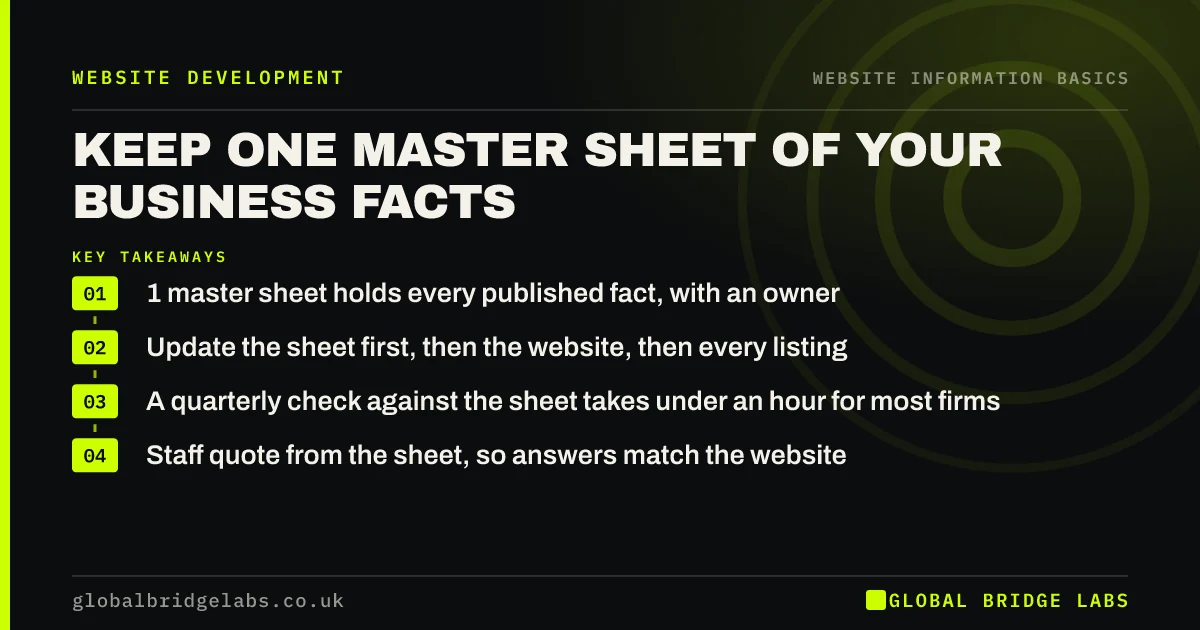
- 1 master sheet holds every published fact, with an owner and a last-checked date.
- Update the sheet first, then the website, then every listing.
- A quarterly check against the sheet takes under an hour for most firms.
- Staff quote from the sheet, so answers match the website.
Want our fact sheet template? Message us on WhatsApp.
Chat on WhatsApp →What is a business fact sheet?
A business fact sheet is a single document, usually a spreadsheet, that lists every fact your business publishes, the current wording, where it appears, who owns it and when it was last checked. Global Bridge Labs (GBL) recommends it as the master record behind your website, Google profile, directories and sales materials.
What should the fact sheet include?
Include every fact a buyer, search engine or regulator might rely on. Group them by the five inventory layers so nothing is missed, and add a column listing each place the fact appears, so an update can be pushed everywhere at once.
- Legal name, trading name, company number, registered office, VAT number.
- Phone, email, addresses and hours, including holiday hours.
- Services, inclusions, price guidance, area and timescales.
- Credentials, insurance, memberships and their expiry dates.
- Policies, with the page each one lives on.
Who should own the fact sheet?
One named person should own the sheet, usually an operations lead or the owner of a small firm, with each fact assigned to whoever can confirm it. Prices belong to whoever sets them, insurance to whoever renews it. Ownership of website edits can sit elsewhere; ownership of the facts should not.
How does the sheet keep channels consistent?
The sheet keeps channels consistent by making every change start in one place. When a price or address changes, it is updated on the sheet, and the 'appears on' column becomes the to-do list. Without it, changes reach the website but not the Google profile, or the brochure but not the FAQs.
How often should the sheet be checked?
Check the sheet against the live website every quarter and whenever the business changes. As a GBL rule of thumb, a quarterly check takes under an hour for a site of 10 to 30 pages. Also set reminders for anything that expires, such as insurance certificates and accreditations.
When is a fact sheet overkill?
A fact sheet is overkill for a one-person business with a single-page site and no listings beyond Google. Even then, a short note of your key facts helps when you update a profile in a hurry. It becomes essential once more than one person can edit the website or answer buyers.
What does this look like in practice?
A pattern we see in growing teams: the website says 'reply within 24 hours', the email signature says 'same day' and the Google profile shows hours from a previous year. Nobody chose these differences. A fact sheet with one owner usually removes them within a single afternoon of updates.
Business fact sheet checklist
- Create a sheet with fact, wording, appears on, owner and checked date.
- Fill it from your website and listings.
- Resolve every conflicting version.
- Name an owner for each fact.
- Diary a quarterly check.
- Add expiry reminders for certificates.
Next step
Open a spreadsheet today with five columns: fact, current wording, appears on, owner and last checked. Fill in your contact details first.
Message us on WhatsApp for our business fact sheet template, with no pitch.
Chat on WhatsApp →Sources and further reading
- Google Business Profile Help · Google
- Principle (d): Accuracy · Information Commissioner's Office
- Maintain consistency and adhere to standards (usability heuristic #4) · Nielsen Norman Group
Frequently asked questions
What is a single source of truth for business information?
It is one master record of your business facts that every other channel copies from. For most small firms this is a spreadsheet listing each fact, its wording, where it appears and who owns it. Changes are made there first and then pushed out.
Who should update business information online?
One named person should own the accuracy of the facts, even if someone else makes the edits. They update the master sheet, then make sure the website, Google profile and listings match. Without a single owner, different channels drift apart.
How do I keep my business details consistent online?
Hold every detail in one master sheet, record every place each one appears, and update all of them together when anything changes. Check the main listings, such as your Google Business Profile, against the sheet every quarter.
Written by

Global Bridge Labs (GBL) is a UK–Sri Lanka partner for social media, websites and BPO. Everything here comes from client delivery, not theory.