On this page
- 01Key takeaways
- 02Which company policies should be on a website?
- 03Which policies are legal requirements?
- 04Which depend on your size?
- 05Which do buyers ask for?
- 06How should a policies page be organised?
- 07Which policies should you not publish?
- 08What does this look like in practice?
- 09Policies page checklist
- 10Next step
- 11Sources and further reading
- 12Frequently asked questions
Key takeaways
Publish the policies the law requires (privacy notice, cookie information, terms for online sales, and statements like modern slavery if you meet the threshold), plus the ones buyers ask for, such as complaints, health and safety, equality and data security. Keep internal policies internal. One policies page linking to each keeps them findable.
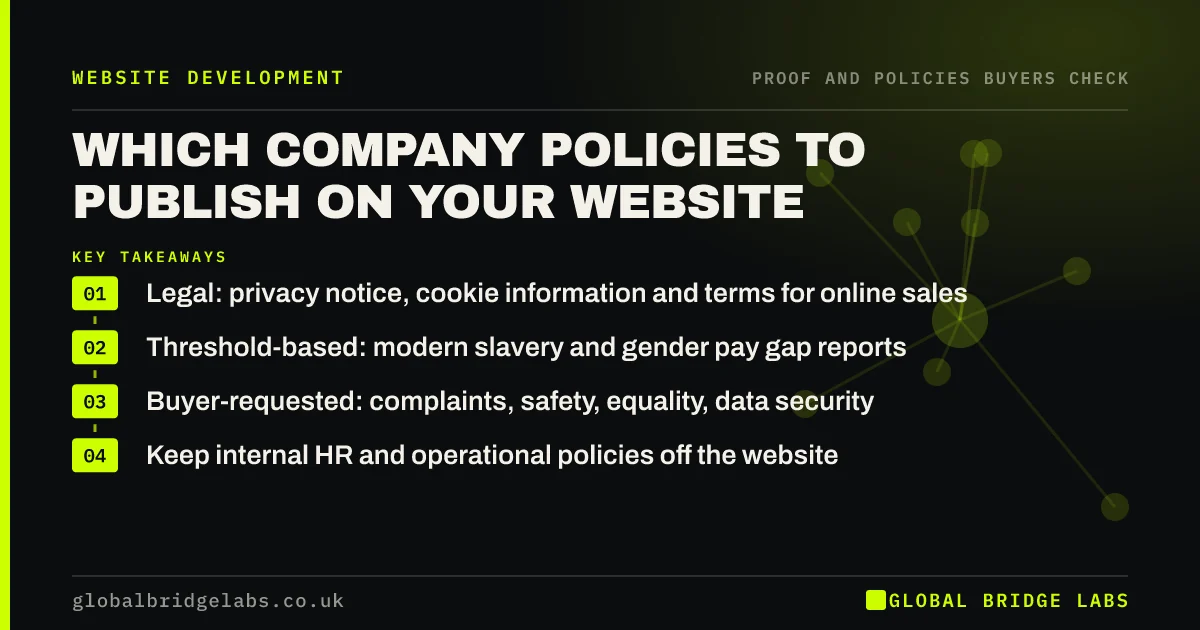
- Legal: privacy notice, cookie information and terms for online sales.
- Threshold-based: modern slavery and gender pay gap reports.
- Buyer-requested: complaints, safety, equality, data security.
- Keep internal HR and operational policies off the website.
Want a policies page plan? Message us on WhatsApp.
Chat on WhatsApp →Which company policies should be on a website?
A website should carry the policies required by law for your activities, plus those your buyers routinely ask for. Global Bridge Labs (GBL) groups them into three tiers: legal, threshold-based and buyer-requested. Anything purely internal, such as disciplinary procedures, stays off the public site.
Which policies are legal requirements?
A privacy notice is required wherever you collect personal data, including through forms and analytics. Cookie information and consent are required for non-essential cookies. Businesses selling online to consumers need pre-contract information and terms, including cancellation rights. Regulated sectors add their own.
Which depend on your size?
Organisations with turnover of £36 million or more must publish an annual modern slavery statement, linked from the homepage. Employers with 250 or more staff must publish gender pay gap reports on their own website and the government service. Public sector bodies need an accessibility statement.
Which do buyers ask for?
Commercial and public buyers commonly ask for health and safety, equality and diversity, environmental, data protection and information security, anti-bribery and quality policies. Publishing a summary of each, with full versions on request, shortens supplier questionnaires.
How should a policies page be organised?
Use one policies page with a short description of each policy and a link to its own page or document. Link it from the footer of every page. Date each policy and name an owner. Keep policies in HTML where they are short, and offer PDFs only for long documents.
Which policies should you not publish?
Do not publish internal HR procedures, security details that would help an attacker, or policies you do not follow. A published policy is a promise. If you cannot show evidence of following it when a buyer asks, it does more harm than good.
What does this look like in practice?
A pattern we see in growing B2B firms: policies exist as Word files on a shared drive, and every tender means hunting for the latest versions. A single policies page with dated summaries saves that hunt and makes the business look ready for larger customers.
Policies page checklist
- List legal policies for your activities.
- Check size thresholds.
- Add policies buyers ask for.
- Date each policy and name an owner.
- Link the page from every footer.
- Keep internal procedures off the site.
Next step
List every policy buyers or tenders asked you for in the last year. Those, plus the legal ones, are your policies page.
Message us on WhatsApp for a policies page plan, with no pitch.
Chat on WhatsApp →Sources and further reading
- Right to be informed (privacy information) · Information Commissioner's Office
- Slavery and human trafficking in supply chains: guidance for businesses · Home Office
- Cookies and similar technologies under PECR · Information Commissioner's Office
Frequently asked questions
What policies does a business website need?
Most need a privacy notice and cookie information. Online sellers need terms with cancellation rights. Larger organisations may need modern slavery and gender pay gap statements. Many add complaints, health and safety, equality and data security summaries for buyers.
Should I publish my company policies online?
Publish legal policies and those buyers ask for. Summaries with full versions on request work well for longer documents. Keep internal procedures private, and only publish policies you actually follow.
Where should policies go on a website?
Put them on a single policies page linked from the footer, with each policy on its own page or document. This keeps them findable from anywhere on the site without cluttering the main navigation.
Written by

Global Bridge Labs (GBL) is a UK–Sri Lanka partner for social media, websites and BPO. Everything here comes from client delivery, not theory.