On this page
- 01Key takeaways
- 02Should your website say how big your team is?
- 03Does being small put buyers off?
- 04When does team size matter most?
- 05Can 'we' language mislead?
- 06How do you describe capacity without numbers?
- 07When should you leave size out?
- 08What does this look like in practice?
- 09Team size checklist
- 10Next step
- 11Sources and further reading
- 12Frequently asked questions
Key takeaways
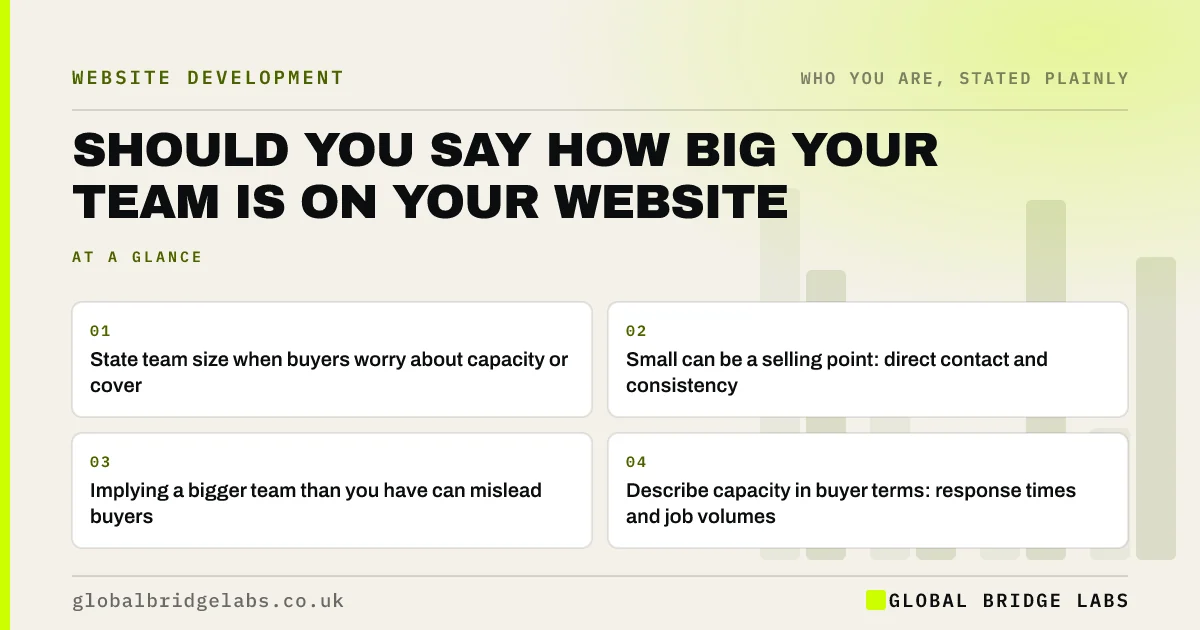
Say how big your team is when size answers a buyer's real question, such as capacity, cover during holidays or personal attention. Small firms can turn size into a benefit: 'a team of four, so you deal with the person doing the work'. Never inflate size with 'we' language that implies people you do not have.
- State team size when buyers worry about capacity or cover.
- Small can be a selling point: direct contact and consistency.
- Implying a bigger team than you have can mislead buyers.
- Describe capacity in buyer terms: response times and job volumes.
Unsure how to present your size? Message us on WhatsApp.
Chat on WhatsApp →Should your website say how big your team is?
Yes, when size answers a question buyers have, such as whether you can cope with their job, cover staff holidays or give personal attention. Global Bridge Labs (GBL) suggests stating size plainly and framing it in buyer terms, for example 'six engineers covering Greater Manchester, so a same-week visit is normal'.
Does being small put buyers off?
Not when it is presented honestly and as a benefit. Many buyers choose small firms for direct contact, consistency and the owner's personal involvement. The DBT counted 5.7 million private sector businesses in the UK at the start of 2025, and 99.8% are small or medium-sized, so buyers expect most suppliers to be small.
When does team size matter most?
Team size matters most for contracts with ongoing commitments, such as maintenance, outsourcing or retained services, and for buyers with procurement checks. Here, show how cover works: who stands in during holidays or sickness and how many people know each account.
Can 'we' language mislead?
It can. A sole trader using 'our team of specialists' or stock photos of a large office implies a business that does not exist. The CMA's unfair commercial practices guidance covers misleading claims about a trader's nature and resources. 'We' is fine for a small team; invented departments are not.
How do you describe capacity without numbers?
If you prefer not to state headcount, describe capacity in outcomes: typical response times, the number of jobs or clients you handle in a year, or the size of project you take on. These answer the real question, which is whether you can deliver, more directly than a staff count.
When should you leave size out?
Leave size out when it does not affect the buying decision, such as for simple product sales, or when numbers fluctuate seasonally and would quickly be wrong. Never leave it out to hide that you subcontract the work; if subcontractors do the job, say how you choose and supervise them.
What does this look like in practice?
A pattern we see with two-person firms: the site uses stock photos of a big team and 'our departments' language. Replacing them with real photos of the two people and a line about direct access often makes the business more appealing to exactly the clients who want a personal service.
Team size checklist
- Decide whether size answers a buyer question.
- State it plainly if it does.
- Frame it as a benefit for the buyer.
- Explain holiday and sickness cover.
- Remove stock photos that imply a bigger team.
- Say how subcontractors are chosen if you use them.
Next step
Write one sentence about your team size that a buyer would see as a reason to choose you. Use it on your about page.
Message us on WhatsApp for help presenting your team, with no pitch.
Chat on WhatsApp →Sources and further reading
- Business population estimates for the UK and regions 2025 · Department for Business and Trade
- Unfair commercial practices guidance (CMA207) · Competition and Markets Authority
- 'About Us' information on corporate websites · Nielsen Norman Group
Frequently asked questions
Should a small business pretend to be bigger online?
No. Implying a larger team than you have can mislead buyers and backfire at the first meeting. Present your size honestly and explain the benefits, such as direct contact and consistency. Many buyers prefer small suppliers for exactly those reasons.
How do I show capacity on my website?
Show capacity through response times, typical project sizes, the number of jobs or clients you handle each year, and how you cover holidays and sickness. These answer a buyer's question about whether you can deliver more directly than a headcount.
Is it OK to use 'we' as a sole trader?
Many sole traders use 'we' and it is generally accepted, especially if you work with regular subcontractors. Avoid language that invents departments or specialists you do not have, and show your own name and photo so buyers know who they will deal with.
Written by

Global Bridge Labs (GBL) is a UK–Sri Lanka partner for social media, websites and BPO. Everything here comes from client delivery, not theory.