On this page
- 01Key takeaways
- 02What must a UK returns policy include?
- 03How do change-of-mind returns work?
- 04Who pays for return postage?
- 05What rights apply to faulty goods?
- 06Which items can be excluded?
- 07Can you offer more than the law requires?
- 08What does this look like in practice?
- 09Returns policy checklist
- 10Next step
- 11Sources and further reading
- 12Frequently asked questions
Key takeaways
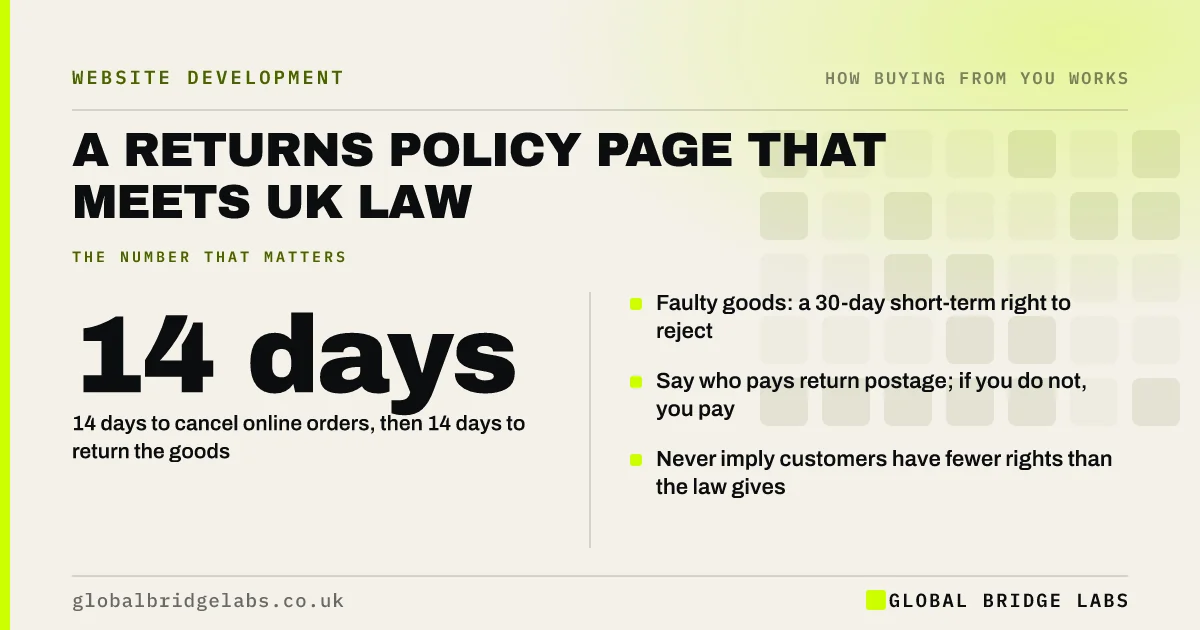
A UK returns policy page must explain the 14-day right to cancel online orders, 14 more days to send goods back, refunds within 14 days, who pays return postage, and the separate rights for faulty goods, including the 30-day right to reject. Write it plainly, link it from every product page and checkout, and never suggest customers have fewer rights than the law gives.
- 14 days to cancel online orders, then 14 days to return the goods.
- Faulty goods: a 30-day short-term right to reject.
- Say who pays return postage; if you do not, you pay.
- Never imply customers have fewer rights than the law gives.
Want your returns page reviewed? Message us on WhatsApp.
Chat on WhatsApp →What must a UK returns policy include?
A UK returns policy must cover the right to cancel online and distance orders within 14 days, the time to return goods, how and when refunds are paid, who pays return postage and any exceptions, plus rights for faulty goods. Global Bridge Labs (GBL) recommends separate headings for change-of-mind returns and faulty goods.
How do change-of-mind returns work?
For goods bought online, by phone or by mail order, consumers have 14 days from delivery to cancel, then a further 14 days to send the goods back. You must refund within 14 days of receiving the goods, or evidence they were sent. The original standard delivery charge is refunded too.
Who pays for return postage?
The customer pays return postage for change-of-mind returns only if you told them before they ordered. If you did not, you must cover it. For faulty goods, the trader bears the cost of returning them. State your approach clearly on the returns page and at checkout.
What rights apply to faulty goods?
Under the Consumer Rights Act 2015, goods must be of satisfactory quality, fit for purpose and as described. If they are not, consumers have a 30-day short-term right to reject for a full refund, then rights to repair or replacement, and then a price reduction or final right to reject. These apply in shops and online.
Which items can be excluded?
Change-of-mind returns can exclude personalised or made-to-order items, perishable goods and sealed hygiene items once unsealed, among others. Faulty goods rights cannot be excluded. Wording such as 'no refunds on sale items' is misleading if it suggests faulty goods are not covered.
Can you offer more than the law requires?
Yes, and many retailers do, for example 30 or 60-day returns. Describe the extra as your own policy, and make clear that it is in addition to statutory rights, not a replacement. A generous, clear returns policy can lift conversion, because it lowers the risk of buying.
What does this look like in practice?
A pattern we see in small online shops: a returns page copied from a template that says 'returns within 7 days', which is shorter than the legal minimum. Rewriting it around the 14-day right and the faulty goods rules removes the legal risk and usually reads as more customer-friendly.
Returns policy checklist
- Explain the 14-day cancellation right.
- Give 14 days to send goods back.
- Refund within 14 days, including standard delivery.
- Say who pays return postage.
- Explain faulty goods rights separately.
- List only lawful exclusions.
Next step
Compare your returns page with the GOV.UK guide on accepting returns. Fix any period shorter than the law allows today.
Message us on WhatsApp for a returns policy check, with no pitch.
Chat on WhatsApp →Sources and further reading
- Accepting returns and giving refunds · GOV.UK
- Consumer Rights Act 2015 · legislation.gov.uk
- Consumer Contracts (Information, Cancellation and Additional Charges) Regulations 2013 · legislation.gov.uk
- Online and distance selling for businesses · GOV.UK
Frequently asked questions
How many days does a customer have to return an online order in the UK?
Consumers have 14 days from delivery to cancel an online order, then another 14 days to send the goods back. You must refund within 14 days of receiving the goods or proof of return. Faulty goods have separate rights.
Can I refuse a refund on sale items?
You can refuse change-of-mind returns only within the legal rules, but faulty sale items have the same rights as full-price ones. Notices such as 'no refunds on sale items' can mislead customers about their rights.
Do I have to pay for return postage?
For faulty goods, yes. For change-of-mind returns, the customer pays only if you told them before they ordered. If your policy and checkout do not say so, you are responsible for the cost.
Written by

Global Bridge Labs (GBL) is a UK–Sri Lanka partner for social media, websites and BPO. Everything here comes from client delivery, not theory.