On this page
- 01Key takeaways
- 02What does missing website information cost a business?
- 03How do you know information is missing?
- 04Does buried information count as missing?
- 05Which missing items carry legal risk?
- 06Why do businesses leave information out?
- 07When is leaving something out the right call?
- 08What does this look like in practice?
- 09Missing information checklist
- 10Next step
- 11Sources and further reading
- 12Frequently asked questions
Key takeaways
Missing information on a website costs you in three ways: buyers leave for a competitor who answered the question, the ones who stay phone or email to ask, and some legal gaps expose the business to enforcement. The fix is rarely a redesign. It is writing down the facts buyers already ask for.
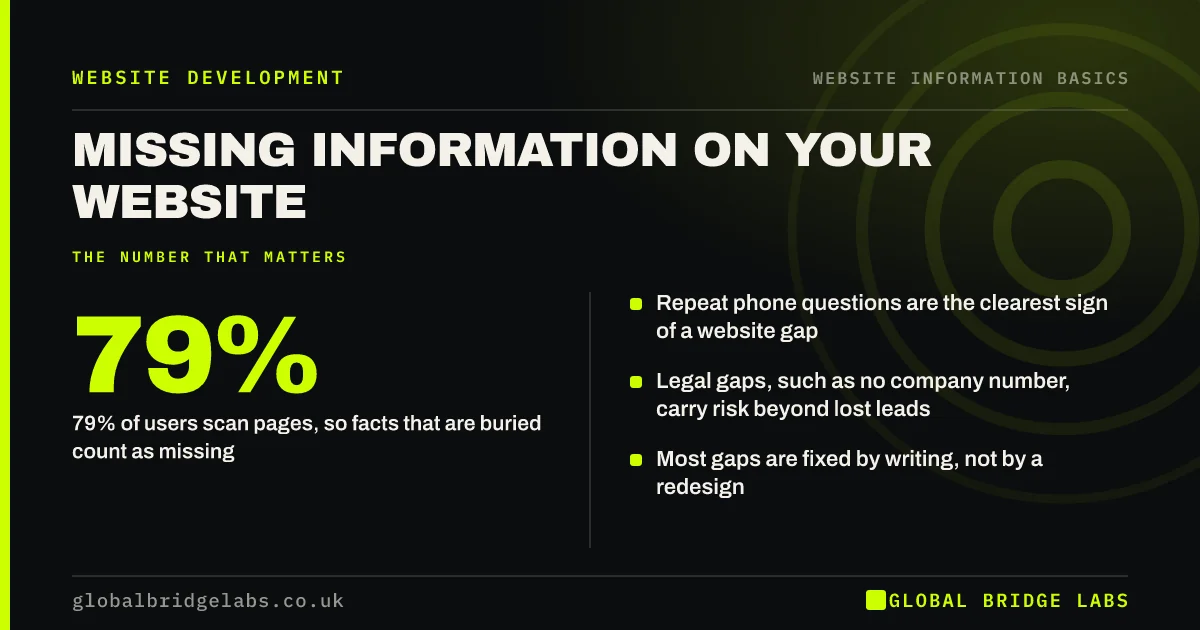
- 79% of users scan pages, so facts that are buried count as missing.
- Repeat phone questions are the clearest sign of a website gap.
- Legal gaps, such as no company number, carry risk beyond lost leads.
- Most gaps are fixed by writing, not by a redesign.
Want your gaps found? Message us on WhatsApp.
Chat on WhatsApp →What does missing website information cost a business?
Missing information costs a business enquiries, staff time and, sometimes, compliance. Buyers who cannot find a price guide, area or timescale tend to try the next result rather than ask. Those who do ask take up staff time with questions the site could have answered. Legal omissions add risk on top.
How do you know information is missing?
You know information is missing when the same questions keep arriving by phone, email or chat. Global Bridge Labs (GBL) suggests logging every pre-sale question for two weeks. Any question asked three or more times is a website gap. Search Console queries and site search terms show the same thing from another angle.
Does buried information count as missing?
Yes. Nielsen Norman Group found 79% of users scan new pages and only 16% read word by word, so a fact in the middle of a long paragraph, inside a PDF or behind an unclear link is effectively absent. Information has to be findable within two clicks and visible when skimming.
Which missing items carry legal risk?
Legal risk sits with trading disclosures for companies and LLPs, pre-contract information and cancellation rights for consumer sales, privacy information where you collect personal data, and sector notices such as an FCA status or CQC rating. Under the Consumer Contracts Regulations 2013, failing to give cancellation information can extend a consumer's cancellation period by up to 12 months.
Why do businesses leave information out?
Businesses usually leave information out for three reasons: the facts live in people's heads, someone fears that publishing a price or policy will put buyers off, or the site was built from a template that never asked for it. Only the second is a real decision, and even then a range or an explanation beats silence.
When is leaving something out the right call?
Leaving something out is right when it is internal, out of date, legally risky to state without checking, or relevant to so few visitors that it clutters the page. Some details are better given at quote stage, such as a full contract. The test is whether a typical buyer needs it to decide to enquire.
What does this look like in practice?
A pattern we see often: a firm's sales team answers 'do you cover my area?' and 'roughly what does it cost?' on most first calls. Neither appears on the site. Adding a clear area statement and a price guide does not remove the calls, but it changes them from qualification to booking, and it filters out buyers who were never a fit.
Missing information checklist
- Log every pre-sale question for two weeks.
- Mark questions asked three or more times.
- Check each against the site.
- Check legal disclosures in the footer.
- Move buried facts up the page.
- Write the missing facts in plain language.
Next step
Start the two-week question log tomorrow. By the end of it you will have a ranked list of the information your website is missing.
Message us on WhatsApp for help turning your question log into page updates, with no pitch.
Chat on WhatsApp →Sources and further reading
- How users read on the web · Nielsen Norman Group
- Consumer Contracts (Information, Cancellation and Additional Charges) Regulations 2013 · legislation.gov.uk
- Digital Markets, Competition and Consumers Act 2024 · legislation.gov.uk
- Company, Limited Liability Partnership and Business Names (Trading Disclosures) Regulations 2015 · legislation.gov.uk
Frequently asked questions
How do I find out what my website is missing?
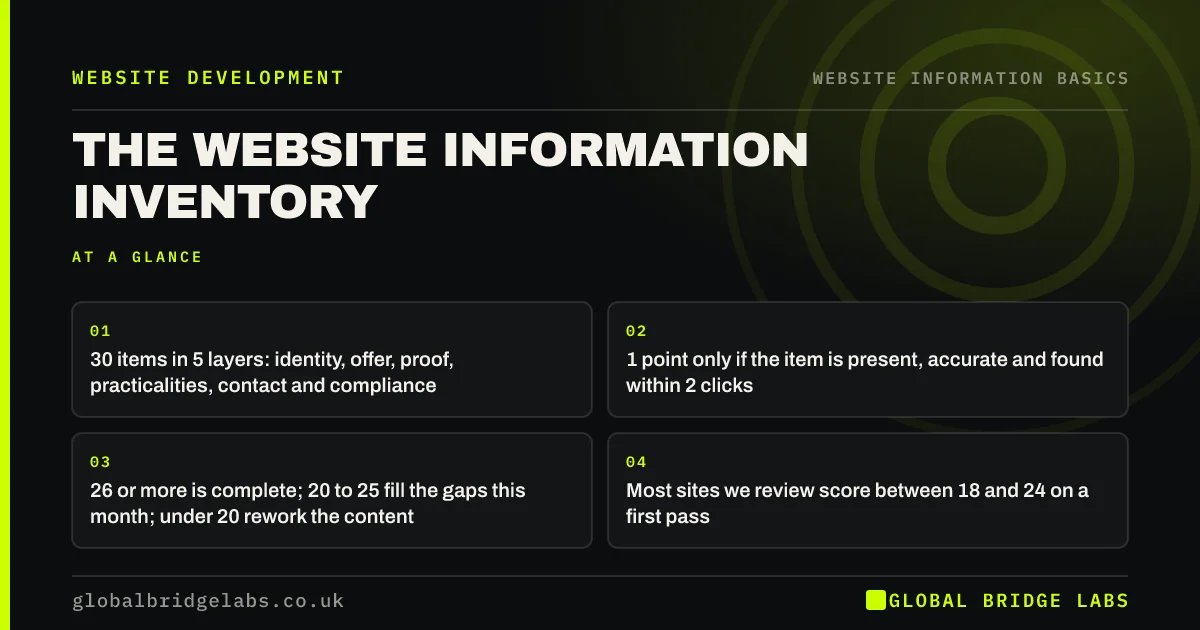
Log the questions buyers ask before they buy for two weeks, then check whether the site answers each one. Add a quick check of legal disclosures and sector requirements. A structured list such as the 30-item GBL inventory catches anything the log misses.
Can missing website information get a business fined?
It can. Missing trading disclosures are an offence for companies, and failing to give consumers required pre-contract information can lead to enforcement and longer cancellation rights. Since April 2025 the CMA can fine businesses directly for consumer law breaches under the DMCC Act 2024.
Do I need a new website to add missing information?
Usually not. Most gaps are fixed by writing new text and adding it to existing pages, which a modern content management system lets you do yourself. A redesign is only worth it when the structure has no sensible place for the information buyers need.
Written by

Global Bridge Labs (GBL) is a UK–Sri Lanka partner for social media, websites and BPO. Everything here comes from client delivery, not theory.