On this page
- 01Key takeaways
- 02Does a company number have to be on a website?
- 03What exactly must be shown?
- 04Where on the website should it go?
- 05Does it apply to every website and channel?
- 06What if the registered office is an accountant's address?
- 07What happens if you leave it out?
- 08What does this look like in practice?
- 09Company number checklist
- 10Next step
- 11Sources and further reading
- 12Frequently asked questions
Key takeaways
UK companies and LLPs must show their company registration number on their website, along with the registered name, the part of the UK where they are registered and the registered office address. The Trading Disclosures Regulations 2015 set this out. One footer line on every page meets the requirement.
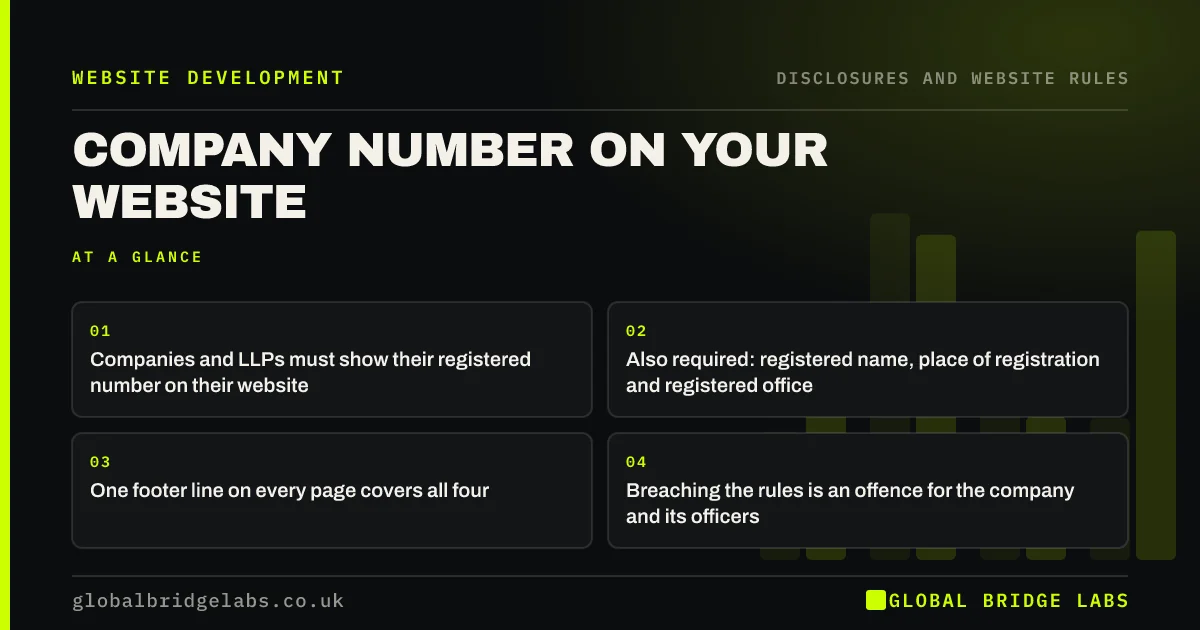
- Companies and LLPs must show their registered number on their website.
- Also required: registered name, place of registration and registered office.
- One footer line on every page covers all four.
- Breaching the rules is an offence for the company and its officers.
Want your footer disclosure checked? Message us on WhatsApp.
Chat on WhatsApp →Does a company number have to be on a website?
Yes. Under the Trading Disclosures Regulations 2015, every UK company must disclose its registered number, the part of the UK in which it is registered, and its registered office address on its websites, and display its registered name. LLPs have equivalent duties. Global Bridge Labs (GBL) treats this as item 29 of the 30-item inventory.
What exactly must be shown?
Show the registered name, registered number, place of registration (England and Wales, Scotland or Northern Ireland) and registered office address. Some companies must add more: a company exempt from using 'limited' must say it is a limited company, and a company being wound up must say so.
- Registered name: J Smith Services Ltd.
- Registered number: 01234567.
- Place of registration: England and Wales.
- Registered office: full address.
Where on the website should it go?
Put it in the footer of every page, so it appears wherever a visitor lands. A single line works: 'J Smith Services Ltd, registered in England and Wales, company number 01234567, registered office: [address]'. A separate legal page alone is less safe than the footer.
Does it apply to every website and channel?
It applies to the company's websites, and the same details are required on business letters, order forms and other documents. Social media profiles and email footers are not named in the same way, but adding the details there is common good practice and keeps everything consistent.
What if the registered office is an accountant's address?
That is fine, as long as it is your registered office at Companies House. The website must show the registered office, even if you trade from elsewhere. Since March 2024, registered offices must be an appropriate address where documents will come to the company's attention.
What happens if you leave it out?
Failing to comply with the trading disclosure rules is an offence, and the company and every officer in default can be fined. In practice, the more common cost is trust: buyers and procurement teams check Companies House, and a missing number makes a site look less established.
What does this look like in practice?
A pattern we see across small company websites: the footer shows a copyright line and social icons but no company details. Adding one disclosure line takes minutes and meets a legal requirement that many owners do not know about.
Company number checklist
- Check your details on Companies House.
- Write one footer disclosure line.
- Include name, number, place and office.
- Add any extra status, such as being wound up.
- Show it on every page.
- Update it when your registered office changes.
Next step
Copy your details from Companies House into a single footer line today. It is the quickest legal fix on most small company websites.
Message us on WhatsApp for a footer disclosure check, with no pitch.
Chat on WhatsApp →Sources and further reading
- Company, Limited Liability Partnership and Business Names (Trading Disclosures) Regulations 2015 · legislation.gov.uk
- Running a limited company: signs, stationery and promotional material · GOV.UK
- Set up a private limited company: registered office address · GOV.UK
- Find and update company information · Companies House
Frequently asked questions
Is it a legal requirement to put your company number on your website?
Yes, for UK companies and LLPs. The Trading Disclosures Regulations 2015 require the registered number, place of registration and registered office address on the company's websites, and the registered name must be displayed too.
Where should my company number go on my website?
The footer of every page is the usual and safest place, because it appears wherever a visitor lands. A single line with the registered name, number, place of registration and registered office meets the requirement.
Do sole traders need a company number on their website?
No. Sole traders do not have a company number. If you trade under a business name, make your own name and an address easy to find, and if you sell online, meet the Electronic Commerce Regulations' information requirements.
Written by

Global Bridge Labs (GBL) is a UK–Sri Lanka partner for social media, websites and BPO. Everything here comes from client delivery, not theory.