On this page
- 01Key takeaways
- 02What premises accessibility information should a website give?
- 03Why publish it?
- 04How should access information be written?
- 05What about adjustments?
- 06How does this differ from website accessibility?
- 07When is an access page unnecessary?
- 08What does this look like in practice?
- 09Premises access checklist
- 10Next step
- 11Sources and further reading
- 12Frequently asked questions
Key takeaways
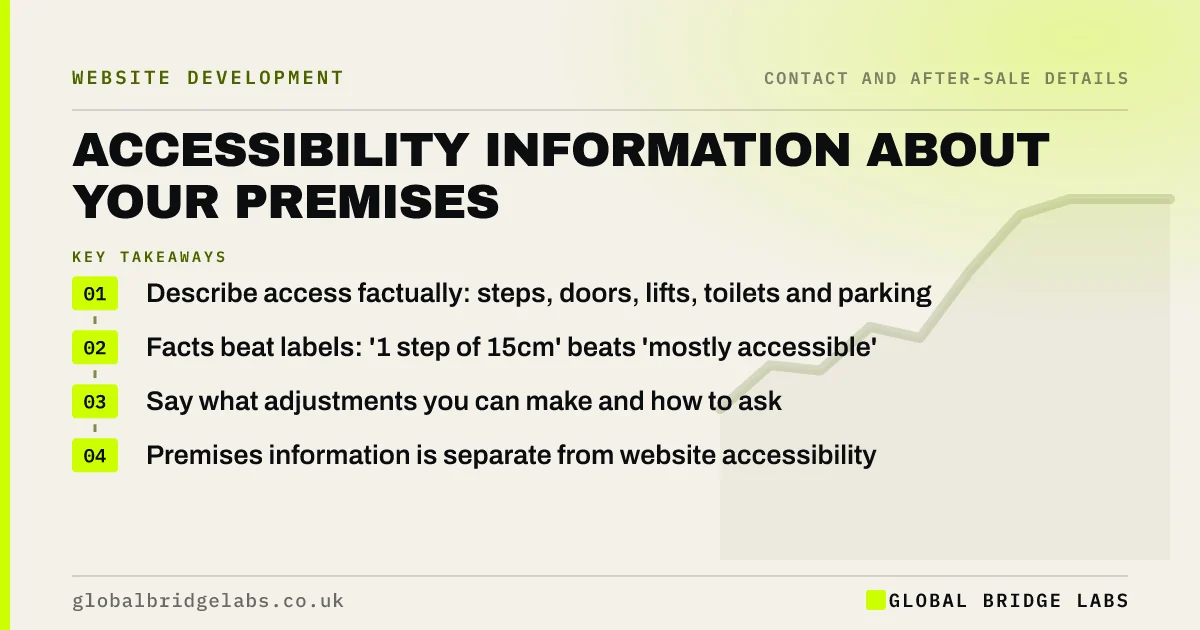
Publish clear information about access to your premises: step-free routes, door widths, lifts, accessible toilets, parking, seating, hearing loops, lighting and quiet times. Disabled visitors use it to decide whether they can visit at all. It supports your duty to make reasonable adjustments under the Equality Act 2010.
- Describe access factually: steps, doors, lifts, toilets and parking.
- Facts beat labels: '1 step of 15cm' beats 'mostly accessible'.
- Say what adjustments you can make and how to ask.
- Premises information is separate from website accessibility.
Want help writing an access guide? Message us on WhatsApp.
Chat on WhatsApp →What premises accessibility information should a website give?
Give factual detail on arrival, entrance, moving around, facilities and support: parking and drop-off, steps and ramps, door widths, lifts, accessible toilets, seating, hearing loops, lighting, noise and quiet times. Global Bridge Labs (GBL) recommends a dedicated access page linked from the contact page.
Why publish it?
Disabled visitors often need to know before they travel whether they can get in and use your facilities. Without information, many will not risk it. The Equality Act 2010 requires service providers to make reasonable adjustments, and clear information is a simple, low-cost one.
How should access information be written?
Use measurements and facts rather than labels. 'One step of 15cm at the front door; level access via the side door, which is 90cm wide' lets each visitor decide for themselves. 'Wheelchair friendly' or 'mostly accessible' does not, because needs vary.
What about adjustments?
Say which adjustments you can make and how to request them: a ground-floor room, a quieter appointment time, longer appointment slots, a British Sign Language interpreter, or information in another format. Give a contact route for access questions.
How does this differ from website accessibility?
Premises access is about your building and service; website accessibility is about whether disabled people can use your site. Both matter. An accessibility statement covers the website. An access guide covers the premises. Link each to the other.
When is an access page unnecessary?
It is unnecessary only when customers never visit your premises. If you visit customers instead, say how you can adapt, such as arranging appointment times or communication methods. Everyone who receives visitors benefits from publishing it.
What does this look like in practice?
A pattern we see: a venue's site says 'fully accessible', but a wheelchair user arrives to find a heavy door and a narrow corridor to the toilet. Replacing the label with measured facts and a photo of the entrance lets visitors judge for themselves and avoids a wasted journey.
Premises access checklist
- Measure steps, ramps and door widths.
- Describe toilets, lifts and seating.
- Note hearing loops and lighting.
- Offer quiet times if possible.
- Explain how to ask for adjustments.
- Add photos of key access points.
Next step
Take a tape measure and a phone camera around your premises this week. Write down what a wheelchair user, a visually impaired visitor and a parent with a pushchair would need to know.
Message us on WhatsApp for help writing an access guide, with no pitch.
Chat on WhatsApp →Sources and further reading
- Equality Act 2010 · legislation.gov.uk
- Web Content Accessibility Guidelines (WCAG) 2.2 · W3C
- Plain language is for everyone, even experts · Nielsen Norman Group
Frequently asked questions
What should an accessibility guide for a venue include?
It should include parking and drop-off, entrance details, steps, ramps and door widths, lifts, accessible toilets, seating, hearing loops, lighting, noise levels and how to request adjustments. Use measurements and photos rather than general labels.
Is it a legal requirement to publish access information?
There is no specific duty to publish it for most businesses, but the Equality Act 2010 requires reasonable adjustments, and clear information helps meet that duty. It also helps disabled customers decide whether to visit.
Should I say my premises are wheelchair accessible?
Give the facts instead of a label: steps, ramp gradients, door widths and toilet details. Needs vary, and a label can be wrong for some visitors. Measured information lets each person decide.
Written by

Global Bridge Labs (GBL) is a UK–Sri Lanka partner for social media, websites and BPO. Everything here comes from client delivery, not theory.