On this page
- 01Key takeaways
- 02Which payment methods should a website list?
- 03Why do payment methods matter to buyers?
- 04Can you charge extra for card payments?
- 05How should you describe bank transfer and Direct Debit?
- 06Should you show payment logos?
- 07When should payment details stay off the website?
- 08What does this look like in practice?
- 09Payment methods checklist
- 10Next step
- 11Sources and further reading
- 12Frequently asked questions
Key takeaways
List every way customers can pay, such as card, bank transfer, Direct Debit, Apple Pay or finance, and when payment is taken. Buyers check before committing, and an unexpected method or timing is a common reason to abandon. Surcharges on most consumer card payments have been banned in the UK since January 2018.
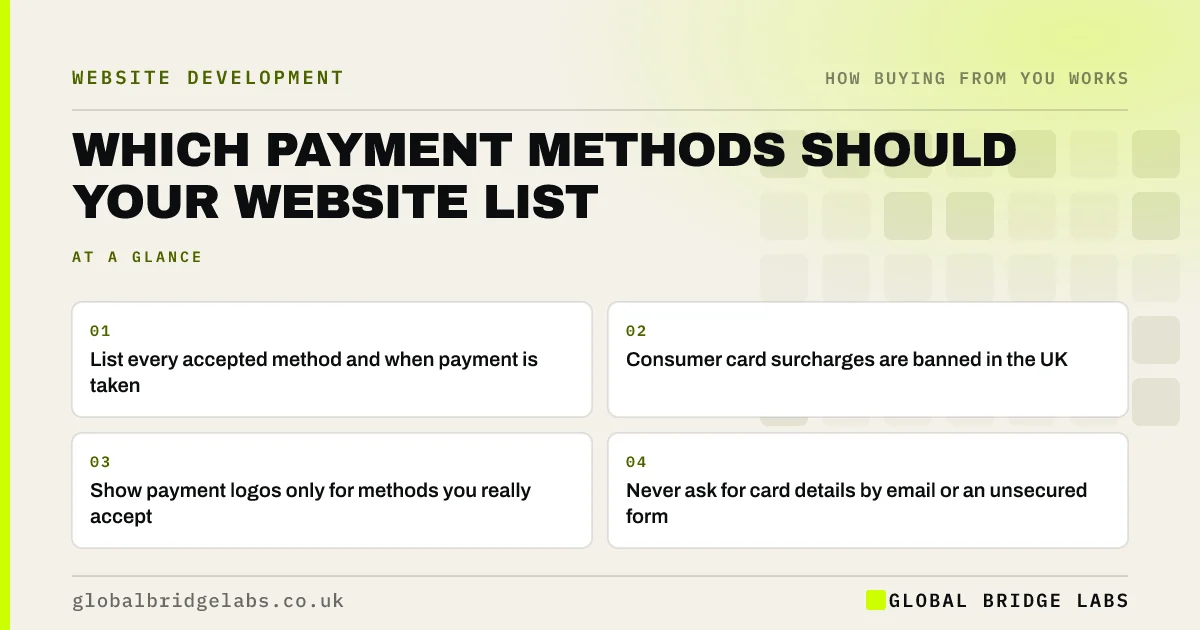
- List every accepted method and when payment is taken.
- Consumer card surcharges are banned in the UK.
- Show payment logos only for methods you really accept.
- Never ask for card details by email or an unsecured form.
Want your payment information checked? Message us on WhatsApp.
Chat on WhatsApp →Which payment methods should a website list?
A website should list every payment method you accept, and when each is used: deposit, staged payments or on completion. Typical methods are debit and credit cards, digital wallets, bank transfer, Direct Debit, cash and finance. Global Bridge Labs (GBL) treats payment methods and timing as item 20 of the 30-item inventory.
Why do payment methods matter to buyers?
Payment methods matter because a buyer who cannot pay the way they want, or only finds out at checkout, often leaves. Baymard Institute's research on checkout abandonment lists extra costs, trust in payment security and complicated checkouts among the leading reasons. Stating methods early removes one more uncertainty.
Can you charge extra for card payments?
Not for most consumer payments. The Consumer Rights (Payment Surcharges) Regulations 2012, as amended, ban surcharges on consumer payments by most card types and many other electronic methods. Business-to-business surcharges are more restricted than they were. Build card costs into your prices rather than adding a fee.
How should you describe bank transfer and Direct Debit?
For bank transfer, say when you will send bank details and warn that you will never change them by email, which helps protect customers from invoice fraud. For Direct Debit, mention the Direct Debit Guarantee and the payment dates. Never ask for card details by email or through an unsecured form.
Should you show payment logos?
Show logos only for methods you accept, near the price or checkout, not as decoration in every footer. Card and wallet logos can reassure buyers, but a logo for a method you have stopped taking is misleading and frustrating. Text works as well as logos for service businesses.
When should payment details stay off the website?
Keep bank account details off the public website, and send them only in a verified invoice or portal. Also keep detailed credit terms for trade accounts off public pages if they differ by customer. Publish the general rule and give account-specific terms in writing.
What does this look like in practice?
A pattern we see: a firm takes card payments over the phone but its website never says so, and customers assume bank transfer only. A single 'how to pay' line on the contact page and in the FAQs, listing methods and timing, removes a common pre-booking question.
Payment methods checklist
- List every method you accept.
- Say when each payment is taken.
- Remove card surcharges for consumers.
- Warn that bank details never change by email.
- Show logos only for accepted methods.
- Keep account numbers off public pages.
Next step
Write one 'how to pay' paragraph listing your methods and timing. Put it in your FAQs and on the contact page this week.
Message us on WhatsApp for help with payment information, with no pitch.
Chat on WhatsApp →Sources and further reading
- Cart abandonment rate statistics · Baymard Institute
- The Direct Debit Guarantee · Direct Debit (Bacs)
- Payment Card Industry Data Security Standard · PCI Security Standards Council
Frequently asked questions
Can I charge a fee for paying by card in the UK?
For most consumer payments, no. Surcharges on consumer card payments, and many other electronic methods, are banned under the Consumer Rights (Payment Surcharges) Regulations 2012 as amended. Build card costs into your prices instead.
Should I put my bank details on my website?
No. Send bank details in a verified invoice or customer portal, and tell customers you will never change them by email. Publishing account details publicly adds fraud risk and does not help buyers decide.
Do I need to show payment logos on my website?
Not necessarily. Logos can reassure online shoppers, but a short text list of accepted methods works for service businesses. Only show logos for methods you currently accept, near the price or checkout.
Written by

Global Bridge Labs (GBL) is a UK–Sri Lanka partner for social media, websites and BPO. Everything here comes from client delivery, not theory.