On this page
- 01Key takeaways
- 02What is a high-converting homepage?
- 03Why does the homepage deserve this much effort?
- 04What are the six stages of creating a homepage?
- 05Stage 1: how do you brief a new homepage?
- 06Stage 2: what should you learn about buyers first?
- 07Stage 3: how do you write the homepage message?
- 08Stage 4: how do you plan layout and visuals?
- 09Stage 5: which platform should you build on?
- 10Stage 6: what must happen before go-live?
- 11How much does it cost to create a homepage in the UK?
- 12How does a homepage change by business type?
- 13Homepage guides by sector: trades, care and health
- 14Homepage guides by sector: firms and venues
- 15When should you not create a new homepage?
- 16What does this look like in practice?
- 17High-converting homepage checklist
- 18Next step
- 19Sources and further reading
- 20Frequently asked questions
Key takeaways
To create a high-converting homepage for an SME, decide the one action the page exists to produce, learn how your buyers describe their problem, write the words, arrange them in sections, build it fast on the platform you can maintain, then test the enquiry route before launch. Design comes after the message, never before it.
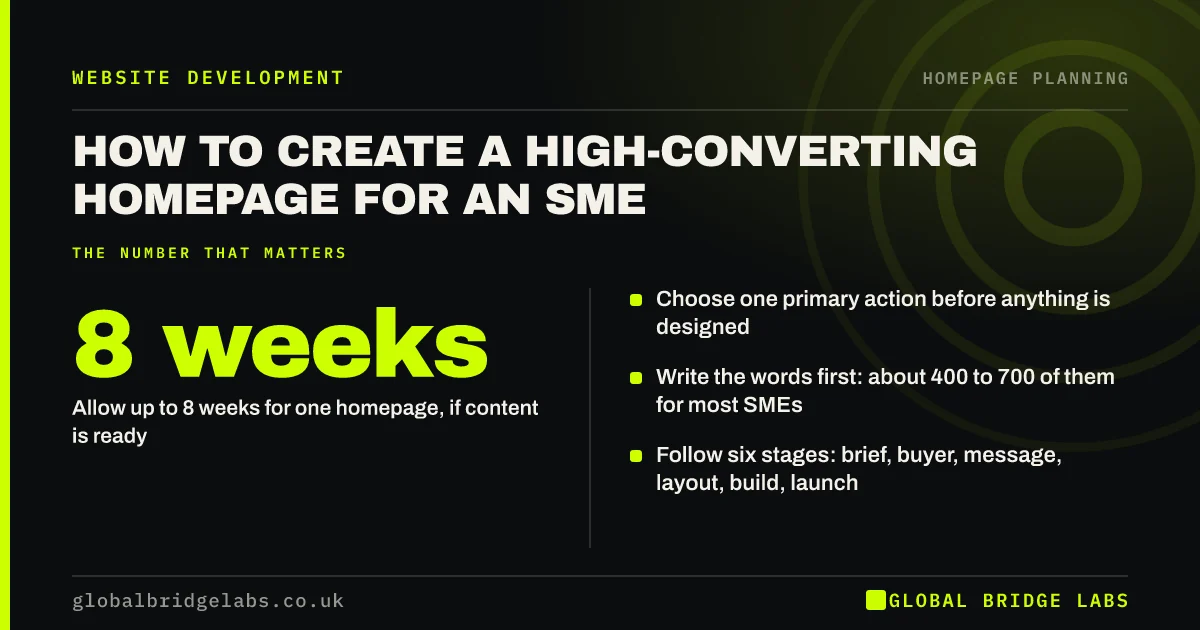
- Choose one primary action before anything is designed.
- Write the words first: about 400 to 700 of them for most SMEs.
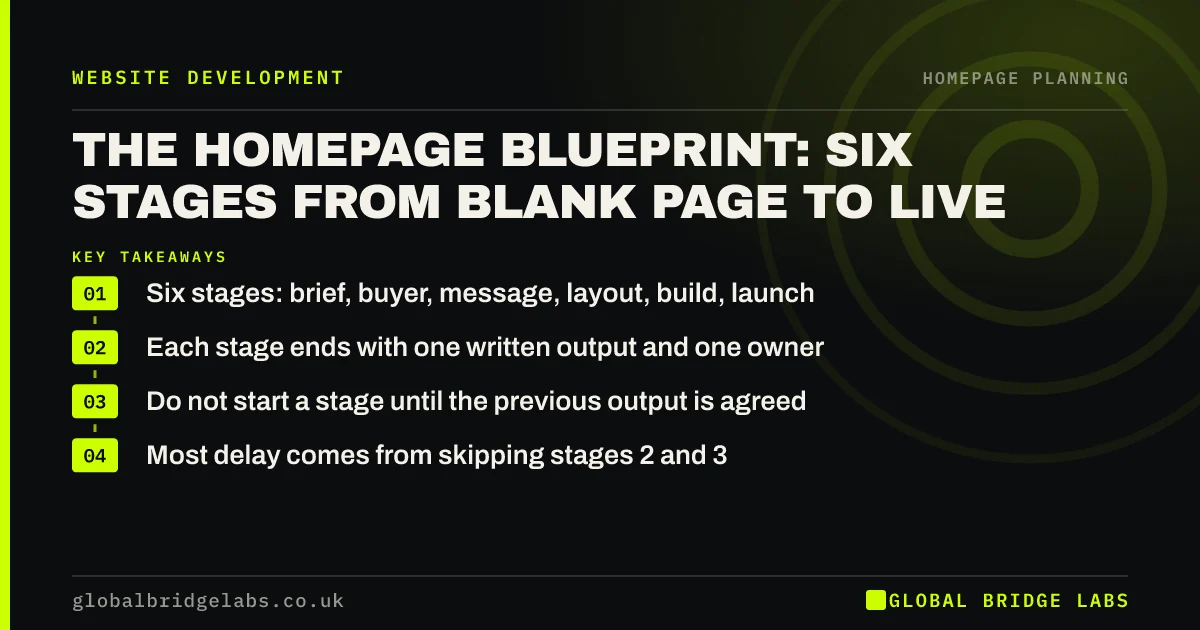
- Follow six stages: brief, buyer, message, layout, build, launch.
- Allow up to 8 weeks for one homepage, if content is ready.
- Test the enquiry route end to end before you go live.
Want this mapped to your business? Message us on WhatsApp.
Chat on WhatsApp →What is a high-converting homepage?
A high-converting homepage is a business's main web page, built so that the right visitors understand the offer within seconds, believe the claim and take one clear next step. It is judged by enquiries, bookings or sales, not by how impressive it looks in a design review or how many awards it collects.
This guide is about creating that page from a blank start, or replacing an old page entirely. If you already have a homepage and want to know why it leaks, start with the diagnosis instead. The build order below is different, because a new page has no data to read yet.
Why does the homepage deserve this much effort?
The homepage is usually the most visited page on an SME website, and the one visitors use to decide whether you are a serious option. Nielsen Norman Group found users often leave pages within 10 to 20 seconds, so a page that takes longer than that to explain itself loses people who could have bought.
The cost of getting it wrong is quiet. Nobody phones to say your homepage confused them. They open the next result. Because the loss is invisible, owners often respond by buying more traffic, which only sends more people to the same confusing page.
What are the six stages of creating a homepage?
We call the build order the GBL Homepage Blueprint: brief, buyer, message, layout, build and launch. Each stage produces one output the next stage depends on. Skipping ahead is the most common reason homepage projects stall, because design decisions made without agreed words get reopened at sign-off.
- Brief: one goal, one primary action, one budget and one decision-maker.
- Buyer: the words real customers use, and the fears that stop them.
- Message: a written draft of every section, in plain language.
- Layout: a section order and wireframe, before any visual design.
- Build: the page on a platform you can run, fast on a phone.
- Launch: tracking, a tested enquiry route and a rollback plan.
Stage 1: how do you brief a new homepage?
Brief a homepage by writing down one sentence on who it is for, the single action it should produce, the budget, the deadline and who signs it off. If you cannot fill this on one page, the project is not ready. Most stalled homepages have three goals and four people who think they are in charge.
A brief also records what the page will not do. Careers, supplier information and investor news can have their own pages. Saying so early protects the page from every department adding a section in the final week.
Stage 2: what should you learn about buyers first?
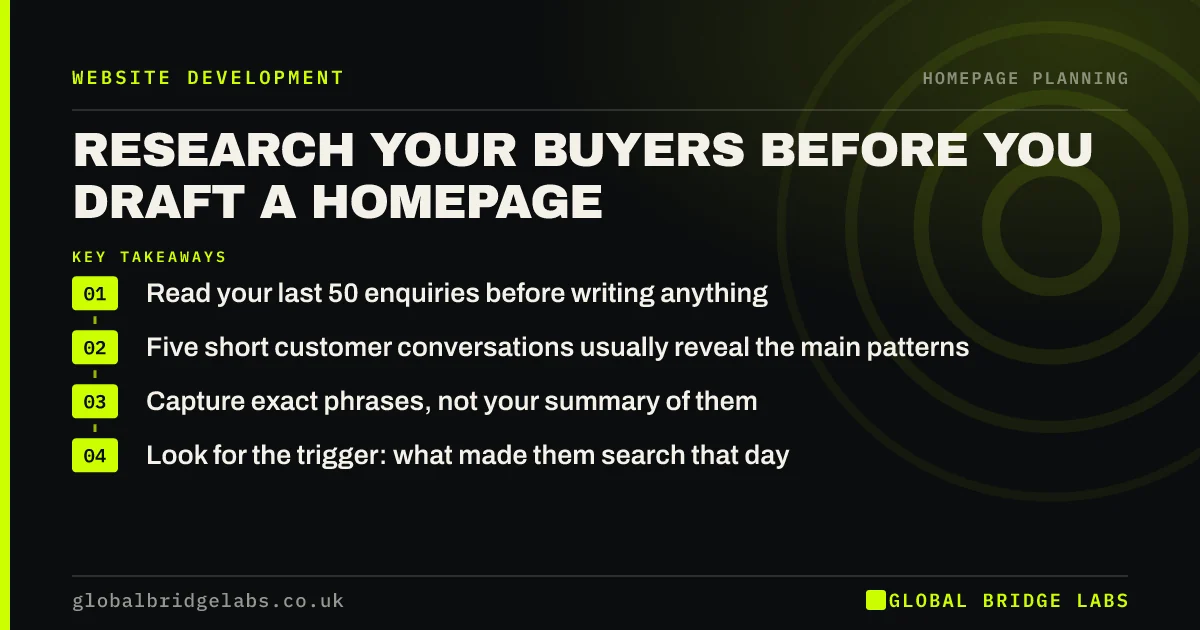
Learn the words buyers use for their problem, what triggered the search, what they fear and what they compare you with. Five recent customer conversations, your last 50 enquiry emails and your reviews will usually tell you more than a workshop. Copy built from these words sounds like the customer, because it is.
Stage 3: how do you write the homepage message?
Write the whole page as a plain document before opening a design tool. Start with one sentence on what you do and for whom, then draft each section in order. As a GBL rule of thumb, aim for about 10 words in the headline, 25 in the subheadline and 400 to 700 overall.
Writing first works because it exposes the gaps. If you cannot write the proof section, you have no proof yet, and a designer's placeholder would have hidden that until launch week.
- A homepage copy template you can fill in
- Draft homepage copy with AI, then make it yours
- Homepage section headings that carry the message
- Write a homepage benefits section buyers will read
- A short about section for your homepage
- Write a first homepage draft in one sitting
- Edit your homepage draft: cut it by a third
- The last section of a homepage: how to close the page
- The problem section: show visitors you understand
- Choose between two homepage headlines without an A/B test
Stage 4: how do you plan layout and visuals?
Sketch the sections on paper, turn the sketch into a grey wireframe and only then apply design. The order follows a buyer's questions: what is this, is it for me, can I trust it and what happens next. Decide what to leave out as firmly as what to include.
Nielsen Norman Group's eyetracking research found 57% of viewing time sits above the fold and 74% in the first two screenfuls, so most of your message has to work early. Later sections still matter, but they serve people who are already interested.
- Sketch your homepage on paper in 30 minutes
- Homepage wireframe: plan the page before the design
- How many sections should a homepage have?
- A portfolio section that shows your best work
- A team section on your homepage: yes or no?
- A comparison section: you vs the alternatives
- An Instagram feed on your homepage: worth it?
- An industries section for your homepage
- The minimum viable homepage: what to ship first
- Homepage header: logo, menu, phone and button
- Sustainability claims on a homepage: stay within the rules
- Which homepage sections can you leave out?
- Set a visual direction before you design a homepage
- How long should a homepage be?
- A homepage grid layout that keeps sections tidy
- Section backgrounds that give a homepage rhythm
- Mock up a homepage in Canva or Figma
- Homepage heading sizes that guide the eye
- Gather your homepage content before design starts
- A homepage photo shot list for a half-day shoot
- Why lorem ipsum ruins a homepage design
- Hand a homepage design to a developer
Stage 5: which platform should you build on?
Build on the platform your team can keep up to date. For most SMEs that means WordPress, Shopify for online shops, or a hosted builder such as Wix or Squarespace. Any of them can produce a page that converts. The poor results usually come from heavy templates, too many plugins and unedited demo content.
Set a speed target at this stage rather than after launch. Google's Core Web Vitals thresholds are Largest Contentful Paint within 2.5 seconds, Interaction to Next Paint within 200 milliseconds and Cumulative Layout Shift below 0.1. Treat them as build requirements, tested on a mid-range phone.
- How to choose a homepage template that can convert
- Custom vs template homepage for a small business
- Create a WordPress homepage that converts
- Create a Wix homepage that converts
- Create a Squarespace homepage that converts
- Create a Shopify homepage that sells
- Create a Webflow homepage that converts
- Build an Elementor homepage that stays fast
- AI homepage builders: what to keep and what to rewrite
- Build your new homepage on a staging site
- The homepage H1: what it should say
- New homepage not showing on Google? Check these first
- Homepage internal links: what to link and why
- The image people see when your homepage is shared
- Set up homepage tracking before you launch
- A homepage for UK and overseas buyers
- Which keywords should your homepage target?
- One homepage address: www, non-www and redirects
- Plan a rollback before you change your homepage
- Make your homepage easy to edit yourself
Stage 6: what must happen before go-live?
Before go-live, confirm tracking works, submit the enquiry form yourself on a phone, make sure each message reaches a named person, and show the page to people who match your buyer. Keep a copy of the old page so you can roll back in minutes if something important breaks.
Then keep watching. A homepage's first 30 days tell you more than any review meeting, because real buyers are finally using it. Change one thing at a time, and leave enough time between changes to see a result.
- A franchise homepage: one brand, many local owners
- Test a new homepage on real buyers before launch
- Test your homepage enquiry route from end to end
- Replace your homepage without losing rankings
- Homepage launch day: the order to do things in
- When to launch a new homepage: pick the quiet week
- Tell customers about your new homepage
- The first 30 days after launching a homepage
- Ask new enquirers what your homepage told them
- A 90-day review of a new homepage
How much does it cost to create a homepage in the UK?
Indicative UK market ranges put focused work on an existing site at £500–£3,000, a redesign on the same platform at £3,000–£12,000 and a small new site from a freelancer at £1,500–£5,000. An agency lead generation site typically runs £5,000–£20,000. Global Bridge Labs (GBL) does not publish prices, so ask us to scope your requirements.
The cheapest option is rarely the page itself. Words and photography are what most budgets forget, and they do more for enquiries than any design flourish. Across our client work, conversion-first rebuilds have delivered a 2.4× enquiry rate, which is why we spend the early budget on the message.
How does a homepage change by business type?
The six stages stay the same, but the page's job changes with the business. A plumber's homepage must work for someone with water on the floor; an architect's homepage must win a long, considered decision. A new business has no reviews, while a franchise has one brand and many local owners.
Start from your closest match below, then keep only what your buyers need. Regulated sectors have extra rules on claims and required information, and those belong in the brief, not in a late legal review.
- A homepage for a brand new business
- A homepage with no reviews or case studies yet
- A sole trader homepage that looks established
- Launch the homepage first, then the rest of the site
- Create a homepage without professional photos
- A B2B homepage that starts sales conversations
- A B2C homepage that turns browsers into buyers
- A local business homepage that wins nearby buyers
- A homepage for a membership or subscription business
- A homepage for a seasonal business
Homepage guides by sector: trades, care and health
These sector guides show how the blueprint changes when the buyer is a homeowner, a patient or a pet owner. Accreditation, urgency and local trust do most of the work on these pages.
- An electrician's homepage that wins local jobs
- A plumber's homepage built for urgent calls
- A construction company homepage that wins bigger jobs
- A roofer's homepage that earns trust fast
- A landscaper's homepage that sells the finished garden
- A cleaning company homepage that wins contracts
- A removals company homepage that wins bookings
- A dental practice homepage that fills the diary
- A physiotherapy clinic homepage that books first visits
- A vet practice homepage that wins new clients
Homepage guides by sector: firms and venues
These guides cover longer B2B decisions and venues people visit. Here the page has to qualify the right buyer, show relevant proof and make the first conversation easy to start.
- A consultant's homepage that wins first calls
- An architect's homepage that wins the right briefs
- An IT support homepage that wins contracts
- A mortgage broker's homepage within the FCA rules
- A recruitment agency homepage for two audiences
- A manufacturer's homepage that wins RFQs
- A care home homepage that families can trust
- A cafe homepage that gets people through the door
- A wedding venue homepage that books viewings
When should you not create a new homepage?
Do not start a new homepage if traffic is the real problem, if your offer is unclear or if the current page has never been tested. A new design cannot fix an offer buyers do not want. If your page gets very few visitors, marketing will usually return more than rebuilding.
Also hold off during your busiest trading period, and when your site is about to change platform anyway. If the page mostly works, a rewrite of the words may do the job at a fraction of the price, which is why the diagnosis deserves an hour before the budget is set.
What does this look like in practice?
A pattern we see in new homepage projects: the owner briefs a designer on colours and competitor sites, three rounds of visuals follow, and the words arrive last. Reordering the same project so the copy is agreed first usually removes most of the revision rounds, because the design now has something real to serve.
High-converting homepage checklist
- Write one sentence stating the page's single goal.
- Name one person who signs off the page.
- Collect buyer language from enquiries and reviews.
- Draft every section as words before design starts.
- Wireframe the section order in grey.
- Test speed on a mid-range phone.
- Confirm tracking records a real enquiry.
- Submit the form yourself and find out who receives it.
- Keep the old page ready to restore.
Next step
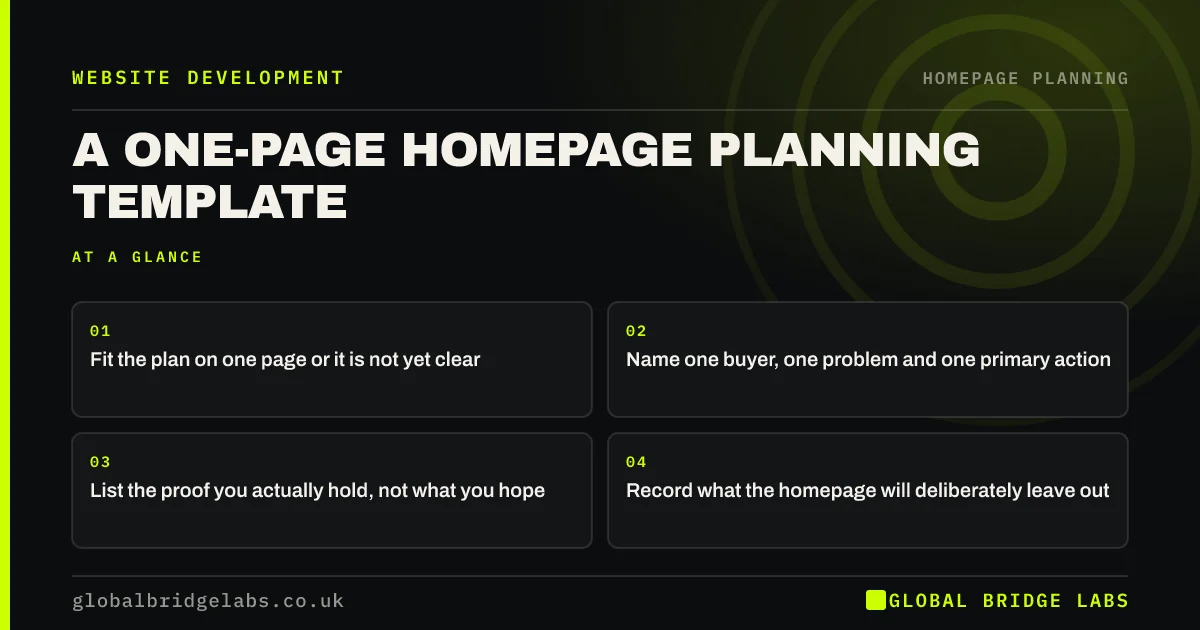
Fill in the one-page planning template this week, even if the build is months away. It will show you whether you need a new homepage or a better message on the page you already have.
Message us on WhatsApp to discuss your requirements, or book a 30-minute consultation.
Chat on WhatsApp →Sources and further reading
- How long do users stay on web pages? · Nielsen Norman Group
- Scrolling and attention · Nielsen Norman Group
- Understanding Core Web Vitals and Google search results · Google Search Central
- Web Vitals: essential metrics for a healthy site · web.dev (Google)
- Creating helpful, reliable, people-first content · Google Search Central
Frequently asked questions
How do you create a high-converting homepage?
Set one goal, learn how buyers describe their problem, write the page in plain words, arrange the sections, build it on a platform you can maintain and test the enquiry route before launch. Design follows the message, so the words are agreed before visual work starts.
What should a high-converting homepage include?
It needs a clear headline, a short explanation, proof such as reviews or results, what you offer, how working with you goes and one repeated next step. Our guide to homepage structure sets out the usual sections and their order for a small business.
How long does a homepage take to create?
As a GBL rule of thumb, allow 2 to 4 weeks on a template and 4 to 8 weeks with custom design, if words and photos are ready on time. Late content, not design or development, is the most common cause of delay.
Should a small business hire someone to build its homepage?
Hire help if the page matters to revenue and you lack time or writing and design skills. A confident owner can build a good template homepage, but paying for copy and photography usually matters more than paying for custom design.
Do I need a new homepage or just better copy?
If visitors arrive but do not enquire, and the page is reasonably fast and works on phones, rewrite the words first. A new build makes sense when the platform blocks change, the page is slow or the business has moved on.
Written by

Global Bridge Labs (GBL) is a UK–Sri Lanka partner for social media, websites and BPO. Everything here comes from client delivery, not theory.