On this page
- 01Key takeaways
- 02Should a small business choose custom or template?
- 03How do the two compare?
- 04Does custom design convert better?
- 05What is the middle option?
- 06When is a template the wrong choice?
- 07What does this look like in practice?
- 08Custom vs template checklist
- 09Next step
- 10Sources and further reading
- 11Frequently asked questions
Key takeaways
In the custom homepage vs template decision, most SMEs should start with a good template and spend the savings on copy and photography. Custom design earns its cost when your journey is unusual, your brand depends on looking distinctive or the page must connect to complex systems. Neither option converts by itself.
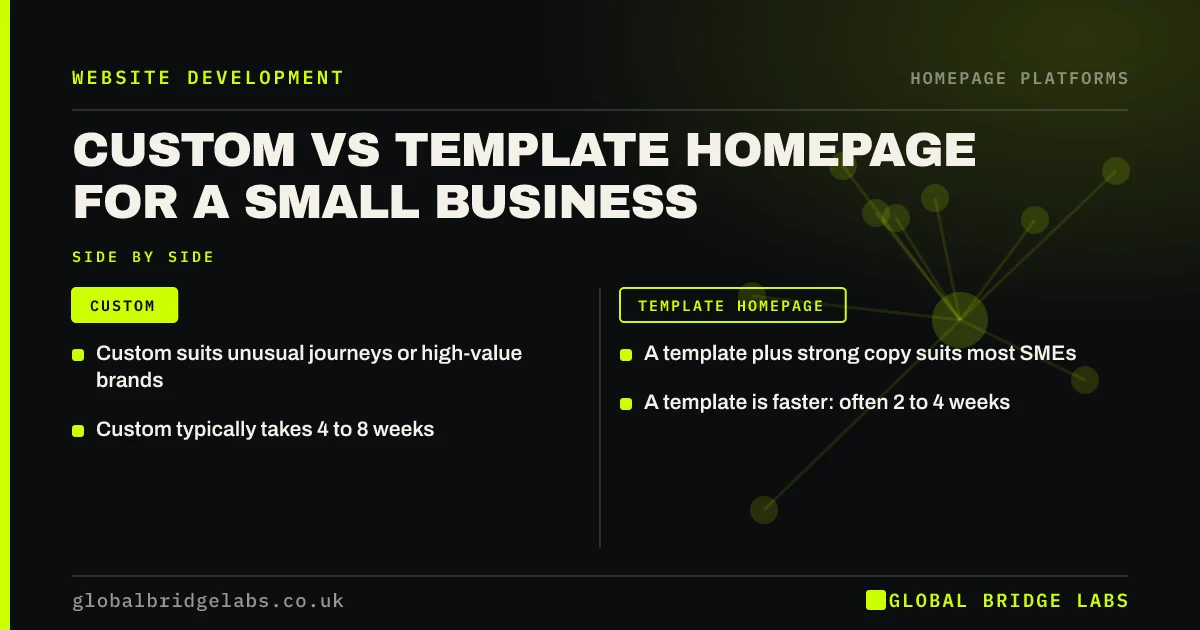
- Custom suits unusual journeys or high-value brands.
- A template plus strong copy suits most SMEs.
- Custom typically takes 4 to 8 weeks.
- A template is faster: often 2 to 4 weeks.
Unsure which route fits? Message us on WhatsApp.
Chat on WhatsApp →Should a small business choose custom or template?
Most small businesses should choose a template, because the biggest gains come from the message and proof, not from unique layouts. Choose custom when a template clearly blocks what buyers need to do. If you cannot name the specific problem custom design solves, you probably do not need it yet.
How do the two compare?
Templates are cheaper and faster, while custom work is more flexible and distinctive. The comparison below uses indicative market ranges and Global Bridge Labs (GBL) rules of thumb, so check them against real quotes. Ongoing costs matter too, because custom code needs someone who can maintain it.
- Cost: template often under £3,000; custom often £3,000–£12,000.
- Time: template 2 to 4 weeks; custom 4 to 8 weeks.
- Flexibility: template within its limits; custom almost unlimited.
- Maintenance: template relies on the theme maker; custom on your developer.
- Risk: template may look common; custom may overrun.
Does custom design convert better?
Not automatically. Buyers do not reward uniqueness for its own sake, and familiar patterns are often easier to use. Nielsen Norman Group's Jakob's Law notes that users spend most of their time on other sites, so they prefer yours to work like those. Custom pays only when it serves a real need.
What is the middle option?
The middle option is a customised template: a solid base with your own type, colours, images and sections, adjusted by a designer. It often gives most of the benefit at a fraction of the cost. It suits SMEs that want to look like themselves, without paying for everything to be built from nothing.
When is a template the wrong choice?
A template is wrong when your process needs configurators, account areas or deep CRM links, or when your sales depend on premium positioning. If a client pays five figures for your service, a generic-looking page may undersell you. Measure that risk against what the extra spend would otherwise buy.
What does this look like in practice?
A pattern worth recognising: a business pays for custom design, spends most of the budget on visuals and has little left for words or testing. The launch looks impressive, and enquiries stay flat. Moving even part of that budget to copy and proof usually changes the result more than the design does.
Custom vs template checklist
- Name the problem custom design would solve.
- Try your content in a template first.
- Compare ongoing maintenance costs.
- Ask who can edit the page after launch.
- Protect the budget for copy and photos.
- Consider a customised template.
Next step
Write down the one thing a template cannot do for you. If you cannot think of one, start with a template and spend the difference on your message.
Message us on WhatsApp for a recommendation, or book a 30-minute consultation.
Chat on WhatsApp →Sources and further reading
- Jakob's law of internet user experience · Nielsen Norman Group
- The role of visual complexity and prototypicality regarding first impression of websites · Google Research (Tuch et al., 2012)
- Web Vitals: essential metrics for a healthy site · web.dev (Google)
Frequently asked questions
Is a custom website better than a template?
Only when you need something a template cannot do. Custom gives flexibility and distinctiveness but costs more and takes longer. For many SMEs, a well-chosen template with strong copy and real photos produces similar or better results.
How much more does a custom homepage cost?
As an indicative guide, custom work often costs several times what a template build does, and typically falls in the £3,000–£12,000 range within a redesign. The gap widens with integrations, testing and the amount of original design involved.
Will customers notice if I use a template?
Very few will, and fewer will care. They judge whether the page is clear, credible and easy to use. The problem is not having a template. It is leaving demo content or generic images that make the site look unfinished.
Written by

Global Bridge Labs (GBL) is a UK–Sri Lanka partner for social media, websites and BPO. Everything here comes from client delivery, not theory.