On this page
- 01Key takeaways
- 02Why cut a third of your draft?
- 03How do you replace claims with facts?
- 04How do you simplify the language?
- 05Why read the page aloud?
- 06When have you cut too much?
- 07What does this look like in practice?
- 08Homepage copy edit checklist
- 09Next step
- 10Sources and further reading
- 11Frequently asked questions
Key takeaways
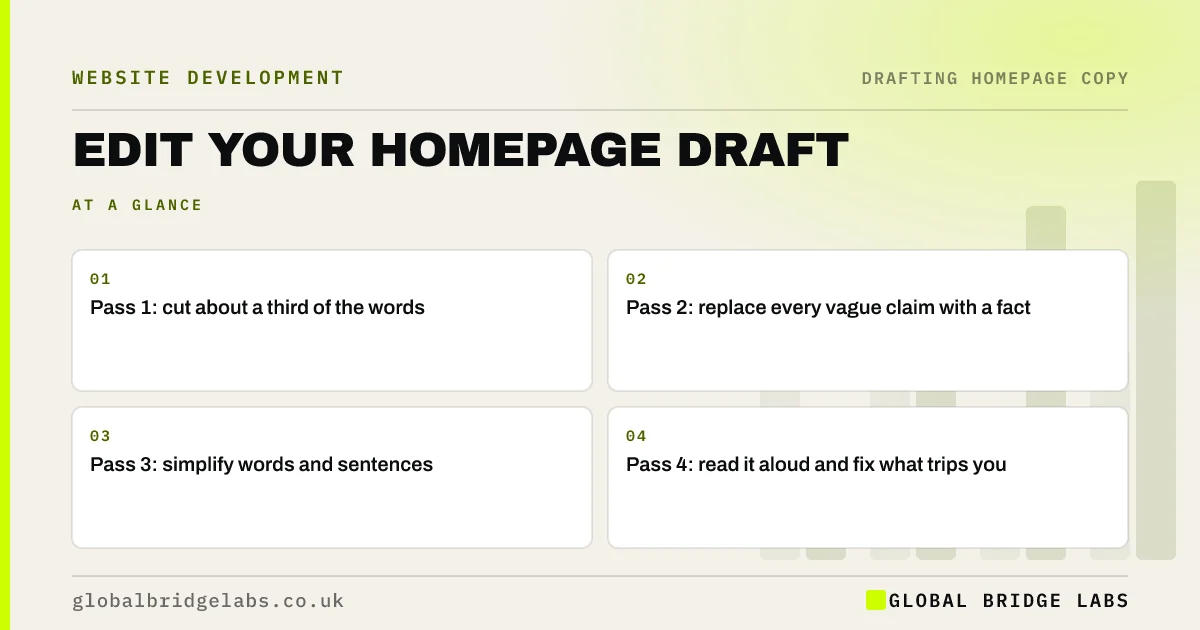
To edit homepage copy, make four passes over your draft: cut roughly a third of the words, replace vague claims with facts, simplify the language, then read it aloud. Each pass has a single job. Short, plain copy gets read more, and it signals confidence in what you are selling.
- Pass 1: cut about a third of the words.
- Pass 2: replace every vague claim with a fact.
- Pass 3: simplify words and sentences.
- Pass 4: read it aloud and fix what trips you.
Want a professional edit of your homepage? Message us on WhatsApp.
Chat on WhatsApp →Why cut a third of your draft?
Cutting forces you to decide what matters. First drafts carry repeated ideas, warm-up sentences and things you want to say that buyers do not need. Removing them leaves the useful material more visible. An early Nielsen Norman Group study on web writing found concise, scannable text scored far higher on usability.
How do you replace claims with facts?
Underline every adjective about yourself, such as 'leading', 'trusted' or 'friendly'. Replace each with something a buyer could check. 'Trusted by local firms' can become '140 reviews on Google, averaging 4.8'. If you cannot find a fact, delete the claim. A shorter, truthful page outperforms a longer, inflated one.
How do you simplify the language?
Aim for a reading age that suits a busy person, with sentences mostly under 25 words and everyday terms. Swap 'utilise' for 'use' and 'facilitate' for 'help'. Keep sector terms only if your buyers use them. GOV.UK writes for a reading age of around nine, even for highly educated audiences.
Why read the page aloud?
Reading aloud exposes clumsy rhythm, long sentences and things no human would say. If you stumble or run out of breath, a reader will too. Listening to a text-to-speech tool works well, because it reads what is really on the page rather than what you meant to write.
When have you cut too much?
You have cut too much when a buyer's main question is left unanswered, or when detail that builds trust has gone. Short is not the same as thin. High-value or technical purchases may need longer pages. Test by asking a target buyer what they would still want to know.
What does this look like in practice?
A pattern we see in editing sessions: the first paragraph of each section can often go, because writers warm up before they get to the point. Deleting those openers typically removes a good share of the words, and the page reads as though it was written by someone more confident.
Homepage copy edit checklist
- Cut warm-up sentences.
- Remove repeated ideas.
- Replace adjectives with facts.
- Shorten long sentences.
- Swap jargon for plain words.
- Read the page aloud.
- Ask a buyer what is missing.
Next step
Count the words in your draft, then cut a third before you show it to anyone. You will be surprised how little you miss.
Message us on WhatsApp for an edit, or book a 30-minute consultation.
Chat on WhatsApp →Sources and further reading
- Plain language is for everyone, even experts · Nielsen Norman Group
- Writing to GOV.UK standards: writing guidelines · GOV.UK
- How users read on the web · Nielsen Norman Group
Frequently asked questions
How do I make my homepage copy shorter?
Delete warm-up sentences, repeated points and claims without evidence. Turn long paragraphs into a sentence and a short list. Keep what a buyer needs to decide, and move extra detail to service pages linked from the homepage.
What reading level should website copy be?
Plain enough for a busy reader to understand quickly. The guidelines we use aim for about grade 8 to 10, and GOV.UK aims lower. Technical buyers can handle their own sector's terms, but everyone reads faster when the language is simple.
How do I know if my homepage has too many words?
If visitors cannot pick out the main points in a quick scan, or if sections repeat each other, there are too many. Ask someone to read it for 30 seconds and explain the offer. Confusion usually means the page needs cutting.
Written by

Global Bridge Labs (GBL) is a UK–Sri Lanka partner for social media, websites and BPO. Everything here comes from client delivery, not theory.