On this page
- 01Key takeaways
- 02How is a B2B homepage different?
- 03What should a B2B homepage headline say?
- 04What proof do B2B buyers want?
- 05What is the right call to action for B2B?
- 06When does B2B advice not apply?
- 07What does this look like in practice?
- 08B2B homepage checklist
- 09Next step
- 10Sources and further reading
- 11Frequently asked questions
Key takeaways
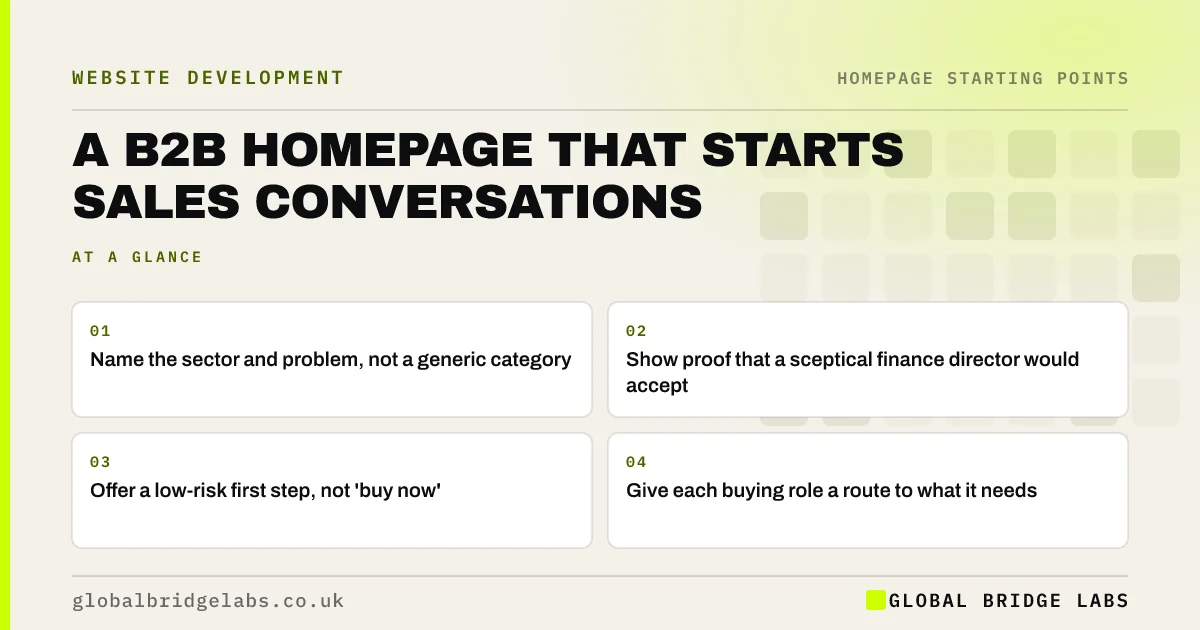
A B2B homepage has to convince several people during a long decision. It should name the sectors and problems you handle, show relevant proof, and offer a low-risk first step such as a short call. Most visits are research rather than purchase, so helping the buyer build a case matters more than urgency.
- Name the sector and problem, not a generic category.
- Show proof that a sceptical finance director would accept.
- Offer a low-risk first step, not 'buy now'.
- Give each buying role a route to what it needs.
Selling to other businesses? Message us on WhatsApp for a homepage plan.
Chat on WhatsApp →How is a B2B homepage different?
A B2B homepage serves a longer, shared decision. A user may find the problem, a manager compares suppliers and a director signs. The page must help someone explain you to colleagues, so clear wording and evidence matter more than emotional hooks. Purchases are rarely made in one visit.
What should a B2B homepage headline say?
It should state what you do, for which type of business, and the result that matters to them. 'Outsourced payroll for UK care groups' beats 'People-powered solutions'. Naming a sector will put off some visitors, which is fine, because the right ones will recognise themselves and move forward.
What proof do B2B buyers want?
B2B buyers want proof from businesses like theirs: sector case studies, named client logos where permitted, accreditation, security statements and clear service levels. A manager needs material that survives an internal review. Vague praise will not help them, while a short case with a measurable result will.
- Case studies from a similar sector or size.
- Accreditations such as ISO 27001 or Cyber Essentials, if you hold them.
- Named clients, with their permission.
- Service levels and how you report on them.
What is the right call to action for B2B?
The right action is a low-risk conversation, such as 'book a 30-minute call', or something useful like a sample report. 'Buy now' rarely suits a considered service. For cautious buyers, add a secondary step: a checklist or a case study they can pass on to colleagues.
When does B2B advice not apply?
It applies less to low-cost, repeat B2B purchases such as consumables or trade supplies, where buyers want price, stock and quick ordering. There, the homepage should act more like a shop. Check how your orders actually happen before assuming your buyers run a formal process.
What does this look like in practice?
A pattern we see in B2B: a homepage lists every capability the firm has, in its own internal terms, and buyers cannot tell whether it serves companies like theirs. Naming two or three sectors and matching a case study to each usually produces fewer but better conversations.
B2B homepage checklist
- Name the sectors you serve.
- State the problem in the buyer's terms.
- Add a relevant case study.
- Show security or compliance credentials you hold.
- Offer a short, low-risk conversation.
- Provide something a buyer can share internally.
Next step
Ask a recent client what they had to show their boss before signing. Put a version of that on your homepage.
Message us on WhatsApp for a B2B homepage review, or book a 30-minute consultation.
Chat on WhatsApp →Sources and further reading
- Minimize cognitive load to maximize usability · Nielsen Norman Group
- Trustworthiness in web design: 4 credibility factors · Nielsen Norman Group
- Small organisations guide to cyber security · National Cyber Security Centre
Frequently asked questions
What makes a good B2B homepage?
It states clearly what you do and for which businesses, shows relevant proof and offers a low-risk next step. It helps a researcher make the case internally, rather than pushing for an instant decision that the buyer cannot make alone.
Should a B2B homepage show prices?
Show indicative ranges or starting points if you can, because buyers filter suppliers on budget. Where pricing is truly bespoke, explain what affects cost. Hiding all commercial information can lose you serious buyers early in their research.
How long should a B2B homepage be?
Long enough to answer what you do, who for, why trust you and what to do next. That is often longer than a consumer page, but each section must earn its place. Detailed material belongs on service pages and case studies.
Written by

Global Bridge Labs (GBL) is a UK–Sri Lanka partner for social media, websites and BPO. Everything here comes from client delivery, not theory.