On this page
- 01Key takeaways
- 02What should an architect's homepage show first?
- 03How do you attract the right clients?
- 04How do you explain the process?
- 05What about fees?
- 06What must you get right about the title?
- 07When is a minimal design a problem?
- 08What does this look like in practice?
- 09Architect homepage checklist
- 10Next step
- 11Sources and further reading
- 12Frequently asked questions
Key takeaways
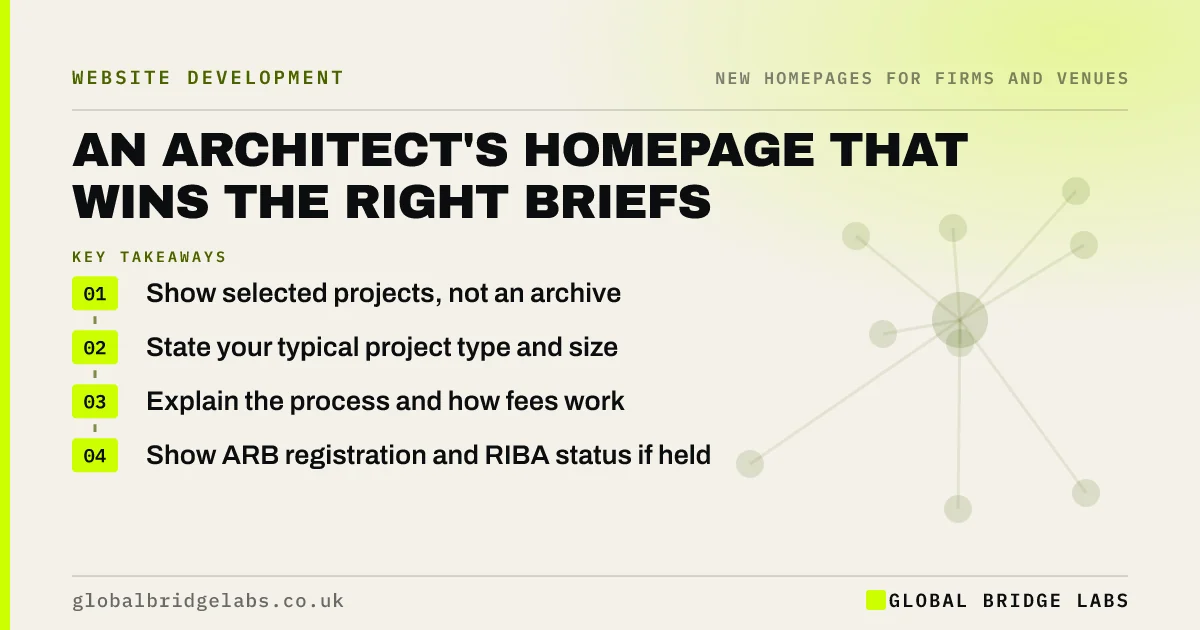
An architect homepage should attract the right briefs, rather than every enquiry. Show selected projects, explain the type and size of work you take on, set out the process and fee basis and confirm you are registered with the ARB. A visually restrained page suits the profession, but it still has to tell clients what to do next.
- Show selected projects, not an archive.
- State your typical project type and size.
- Explain the process and how fees work.
- Show ARB registration and RIBA status if held.
Running a practice? Message us on WhatsApp for a homepage review.
Chat on WhatsApp →What should an architect's homepage show first?
It should show a strong project, a clear line on what you design and where, and a route into your work. Many practice sites show only large images, with tiny text. Beautiful work is essential, but a homeowner still needs to know whether you take on a house extension in their town.
How do you attract the right clients?
State the kind of work you do, and the size you usually take on. An honest line such as 'most of our residential projects start at £X build cost' filters enquiries before anyone has spent time on them. Choosing what you show also signals who you want, so feature projects you would like to repeat.
How do you explain the process?
Many clients have never hired an architect, and they worry about cost and planning. Summarise the stages, for example with the RIBA Plan of Work, in plain language: feasibility, design, planning, technical design and construction. Say which stages you offer, and how long each usually takes.
What about fees?
Explain the basis of your fees: percentage of build cost, fixed fee or hourly. Add typical ranges if you can. Clarity builds trust with clients who fear an open-ended bill. Explain which other costs they should expect, such as planning fees, engineers and building control.
What must you get right about the title?
'Architect' is protected in the UK under the Architects Act 1997, so only people on the ARB register can use the title in business. Show your registration, and RIBA Chartered status if you hold it. If you are an architectural designer or technologist, describe yourself accurately, as misuse of the title is an offence.
When is a minimal design a problem?
It becomes a problem when it hides basic information. Tiny text, unusual navigation and image-only pages may impress peers, yet they lose clients who cannot find a phone number. Keep the visual restraint, but make sure that the text is legible, the images are fast and the contact route is obvious.
What does this look like in practice?
A pattern we see in design practices: an elegant full-screen slideshow, one word for navigation and a contact page with only an email address. Homeowners who could become excellent clients cannot tell whether the practice would consider their project. A few plain lines usually change the quality of enquiries.
Architect homepage checklist
- Show selected, relevant projects.
- State project type and size.
- Summarise your stages.
- Explain how fees work.
- Show ARB registration.
- Keep text legible.
- Check image speed.
Next step
Show your homepage to a friend planning an extension. Ask whether they would know how to start and if you would take their project on.
Message us on WhatsApp for an architect homepage review, or book a 30-minute consultation.
Chat on WhatsApp →Sources and further reading
- Architects Registration Board · Architects Registration Board
- Substantiation: advice on backing up marketing claims · ASA and CAP
- Photos as web content · Nielsen Norman Group
- Building regulations approval · GOV.UK
Frequently asked questions
What should an architect have on their website?
Selected projects, the type and size of work you do, your process, how fees work, your registration and an obvious way to get in touch. A restrained design works well, as long as visitors can still find the basics.
Can anyone call themselves an architect in the UK?
No. 'Architect' is a protected title under the Architects Act 1997, and only people registered with the Architects Registration Board can use it in business. Other titles, such as architectural designer, are not protected in the same way.
Should architects publish their fees?
Explain your fee basis, and give indicative ranges if you can. Clients worry about open-ended costs, so transparency builds trust. Explain which additional costs they should expect too, such as planning applications and specialist consultants.
Written by

Global Bridge Labs (GBL) is a UK–Sri Lanka partner for social media, websites and BPO. Everything here comes from client delivery, not theory.