On this page
- 01Key takeaways
- 02What makes a homepage template good for conversion?
- 03How do you test a template before buying?
- 04Free or paid template?
- 05What features should make you walk away?
- 06When should you avoid a template altogether?
- 07What does this look like in practice?
- 08Homepage template checklist
- 09Next step
- 10Sources and further reading
- 11Frequently asked questions
Key takeaways
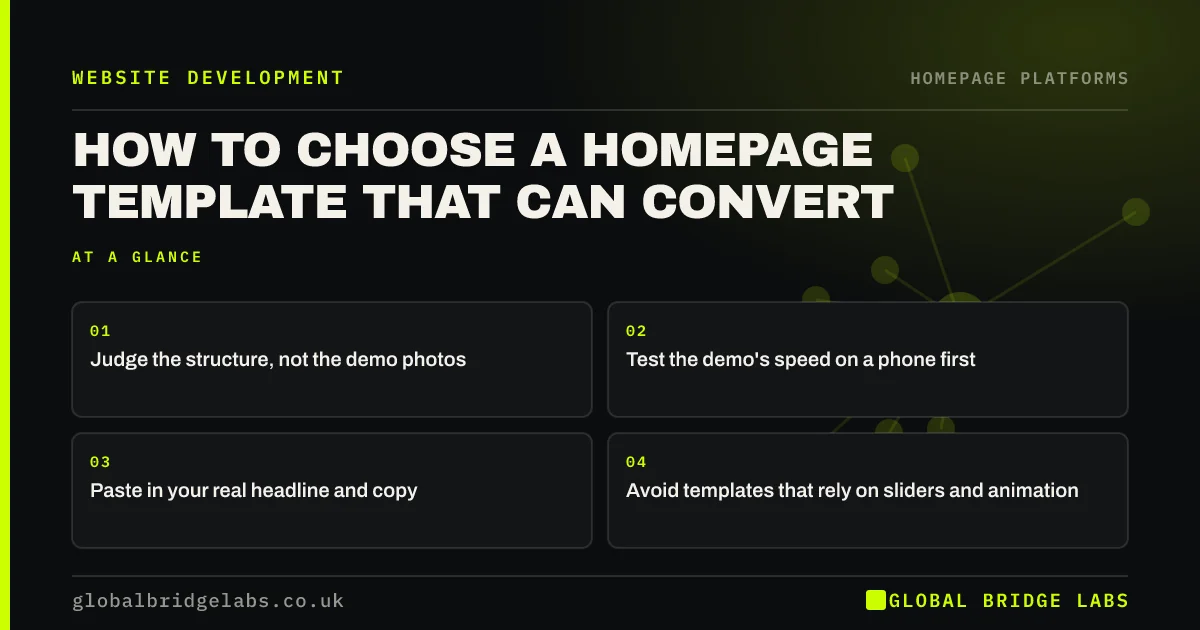
To choose a homepage template that can convert, ignore the demo photos and judge the structure. Check that it has the sections you need, loads quickly on a phone, handles your real headline length and lets you change things easily. A homepage template is a starting structure, not a finished message.
- Judge the structure, not the demo photos.
- Test the demo's speed on a phone first.
- Paste in your real headline and copy.
- Avoid templates that rely on sliders and animation.
Choosing a template? Message us on WhatsApp for a quick second opinion.
Chat on WhatsApp →What makes a homepage template good for conversion?
A good template gives you a clear hero, room for proof, a services area, a repeatable button and a simple mobile layout. It should look plain without its demo images. If a template only looks good with professional photography and three-word headlines, it will struggle once your real content goes in.
How do you test a template before buying?
Open the demo on a phone, run it through PageSpeed Insights and look at its Core Web Vitals. Then try your real headline in the theme customiser or a trial, because long business headlines often break tidy demo layouts. Check that the supplier updates it regularly, and read support comments.
- Run the demo through PageSpeed Insights.
- Check it on a real mid-range phone.
- Test your longest headline and button text.
- Look at the date of the last update.
- Check that it passes a basic contrast review.
Free or paid template?
Free is fine if it is fast, maintained and flexible, and many official free themes meet that bar. Paid templates often add features you will never use, which adds weight. Pay for support and a sound structure, not a long feature list. The price of the template rarely decides how well a page converts.
What features should make you walk away?
Walk away from automatic sliders, heavy scroll animation, tiny text, full-screen video heroes and templates that need many add-on plugins. Be wary of 'multipurpose' themes that bundle dozens of demos, because their code carries all of it. Simpler templates are also easier to change later.
When should you avoid a template altogether?
Avoid one when your buying journey is unusual, when you need complex calculators or integrations, or when several competitors use the same look and appearance is central to your brand. For most SMEs, though, a well-chosen template plus strong copy will beat a weak custom design.
What does this look like in practice?
A pattern we see: an owner chooses a template because the demo shows beautiful interiors, then replaces the images with phone shots and the two-word headline with a real explanation. The layout falls apart. Testing with real content for ten minutes first would have shown this straight away.
Homepage template checklist
- Write your headline before you browse.
- Run the demo through PageSpeed Insights.
- Check it on a phone.
- Test it with real words.
- Confirm when it was last updated.
- Avoid anything that needs many extra plugins.
Next step
Shortlist three templates and test each with your real headline and first paragraph. The one that still looks sound is your answer, whatever its demo looks like.
Send us your shortlist on WhatsApp and we will tell you what we would pick, with no pitch.
Chat on WhatsApp →Sources and further reading
- PageSpeed Insights · Google
- Web Vitals: essential metrics for a healthy site · web.dev (Google)
- Theme Handbook · WordPress.org
Frequently asked questions
What is the best homepage template for a small business?
There is no single best one. Choose a template that is fast on a phone, regularly updated, simple to edit and able to hold your real content. A plain, well-built theme usually outperforms an elaborate one with demo-led design.
Are website templates bad for SEO?
No. Google does not penalise a site for using a template. Poor results come from slow code, thin content or unedited demo text. A fast template with original words and useful content can rank well.
Can I change a homepage template later?
Yes, but expect some rework, because sections and layouts may not transfer cleanly. Keeping your copy and images in a separate document makes this much easier, and it stops your message being tied to any one design.
Written by

Global Bridge Labs (GBL) is a UK–Sri Lanka partner for social media, websites and BPO. Everything here comes from client delivery, not theory.