On this page
- 01Key takeaways
- 02What do overseas buyers need to see?
- 03Do you need a separate site for each country?
- 04How do hreflang and search work?
- 05Should you translate your homepage?
- 06What legal differences should you check?
- 07When should you keep the site UK-only?
- 08What does this look like in practice?
- 09International homepage checklist
- 10Next step
- 11Sources and further reading
- 12Frequently asked questions
Key takeaways
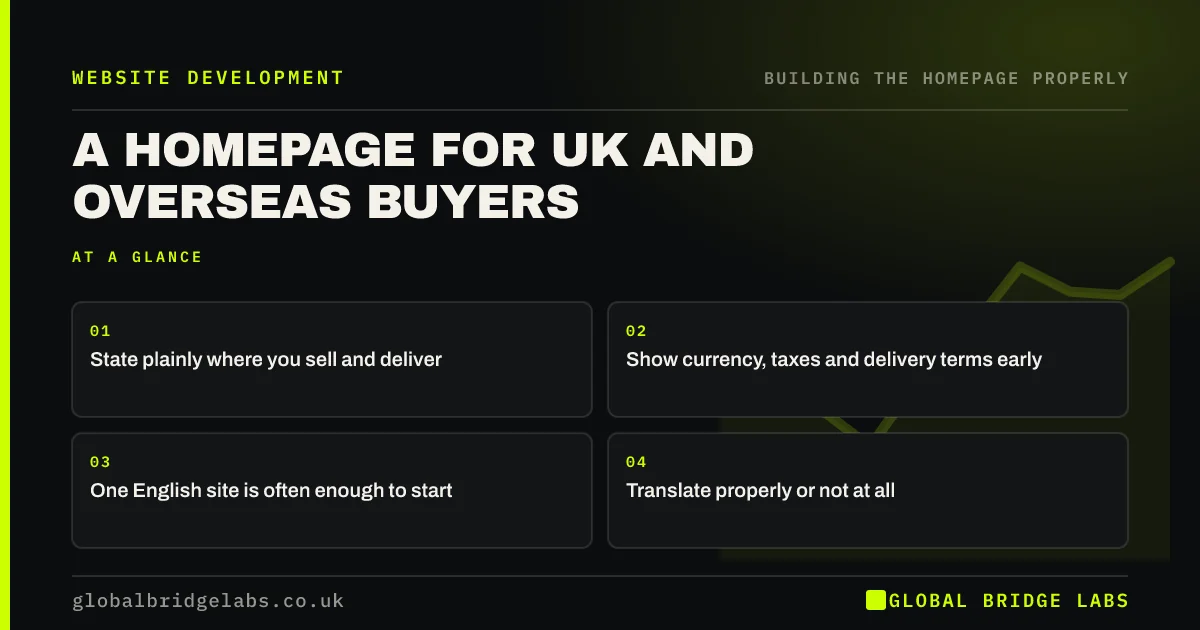
A homepage for international customers has to reassure overseas buyers without confusing UK ones. State where you deliver, how pricing and currency work, what time zones you cover and which terms apply. For a small exporter, one English site with clear information is often enough. Add country versions only when demand proves it.
- State plainly where you sell and deliver.
- Show currency, taxes and delivery terms early.
- One English site is often enough to start.
- Translate properly or not at all.
Selling overseas? Message us on WhatsApp for a homepage review.
Chat on WhatsApp →What do overseas buyers need to see?
Overseas buyers need to know you can serve them, how much it will cost in total and how to get help across time zones. State the countries you deliver to, the delivery times, any duties or taxes and how to contact you. A visitor who is unsure whether you ship abroad will not ask.
Do you need a separate site for each country?
Usually not at first. A small business can often serve several countries from one English site, with a clear page for international customers. Separate country sites make sense when you have real demand, local pricing, translated content and someone to maintain it. Each version adds cost and maintenance.
How do hreflang and search work?
If you do create country or language versions, hreflang tags tell Google which version suits which audience. Google's guidance is to use clear, separate URLs for each version, and not to redirect people automatically by location alone. Automatic redirects can trap users and stop Google from crawling your alternatives.
Should you translate your homepage?
Translate only for markets that truly matter, and use a professional, ideally a native speaker who knows your sector. Machine translation without review can introduce embarrassing errors and damage trust. Translated pages must also lead to support that the buyer can use, so plan who answers when they reply.
What legal differences should you check?
Selling abroad can bring different consumer laws, tax and data rules. Selling to EU consumers, for example, may trigger EU VAT and consumer obligations, and EU GDPR can apply alongside UK GDPR. Take proper advice before you actively target another country, because the homepage is where you state your offer.
When should you keep the site UK-only?
Keep it UK-focused when overseas orders are occasional, or when your costs and delivery make them unprofitable. Saying 'UK only' is perfectly fine, and it saves everyone's time. A clear limit filters out enquiries you cannot serve, and it reassures UK buyers that you are a local business.
What does this look like in practice?
A pattern we see with UK exporters: a large share of enquiries come from overseas, and each one asks the same questions about delivery, tax and returns, because the homepage does not mention them. A short section answering those questions saves time on both sides, and it costs far less than building country sites.
International homepage checklist
- List the countries you serve.
- State delivery times and costs.
- Explain duties and tax responsibility.
- Show currency clearly.
- State your support hours with time zones.
- Avoid automatic location redirects.
- Take advice before targeting a new market.
Next step
Look at your enquiries from the past year by country. If overseas interest is real, add one clear section. If it is rare, a line of text is enough.
Message us on WhatsApp for a homepage plan, or book a 30-minute consultation.
Chat on WhatsApp →Sources and further reading
- Managing multi-regional and multilingual sites · Google Search Central
- Electronic Commerce (EC Directive) Regulations 2002 · legislation.gov.uk
- International transfers of personal data · Information Commissioner's Office
Frequently asked questions
Do I need different websites for different countries?
Not at first. One clear English site works for many small exporters. Consider separate versions when a market has enough demand to justify local pricing, translation and support, because each version has to be maintained.
What is hreflang?
It is a tag that tells search engines which language or regional version of a page to show. You only need it if you have several versions of a page. It does not translate anything or improve ranking by itself.
Should my homepage redirect visitors based on their country?
Avoid automatic redirects. They can frustrate people and stop search engines from reaching other versions. It is better to suggest the relevant version and let visitors choose, with clear links between each site.
Written by

Global Bridge Labs (GBL) is a UK–Sri Lanka partner for social media, websites and BPO. Everything here comes from client delivery, not theory.