On this page
- 01Key takeaways
- 02Why does the order of homepage fixes matter?
- 03What should you fix first?
- 04How do you choose between the rungs?
- 05Within a rung, what comes first?
- 06When should you break the order?
- 07What does this look like in practice?
- 08Homepage fix priority checklist
- 09Next step
- 10Sources and further reading
- 11Frequently asked questions
Key takeaways
To prioritise homepage fixes, work up the GBL Homepage Ladder: first anything that stops visitors arriving or seeing the page (wrong traffic, slow loading, broken mobile layout), then the first-screen message, then proof, then the call to action, then the enquiry route. Within each rung, fix what is cheap and reversible first.
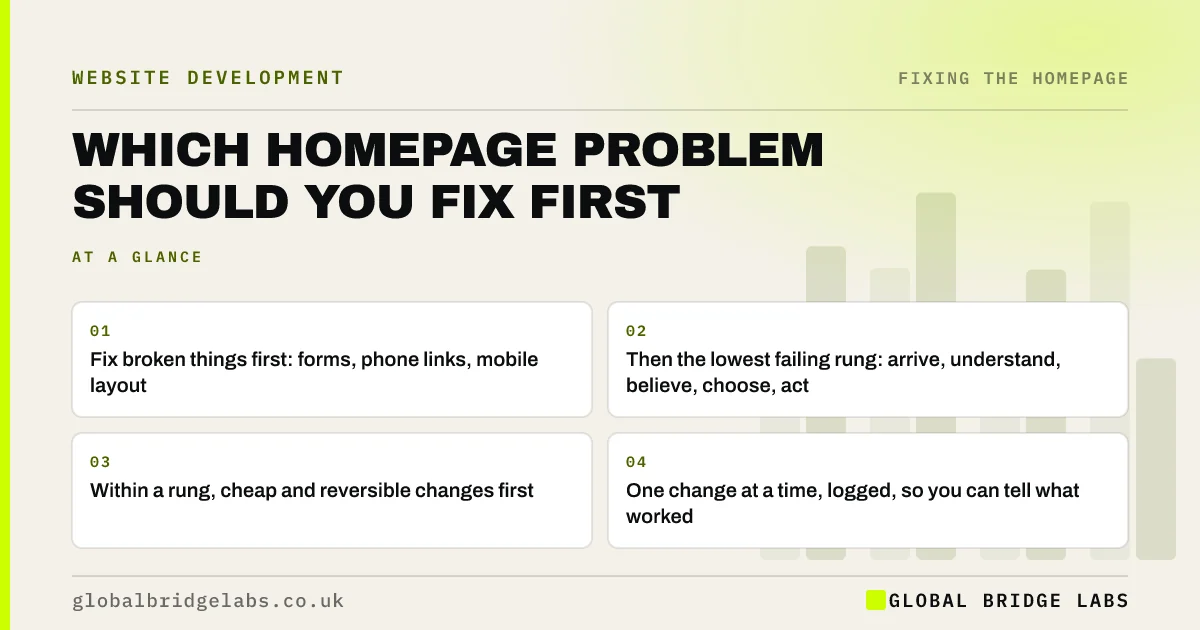
- Fix broken things first: forms, phone links, mobile layout.
- Then the lowest failing rung: arrive, understand, believe, choose, act.
- Within a rung, cheap and reversible changes first.
- One change at a time, logged, so you can tell what worked.
Want your homepage fixes put in order? Message us on WhatsApp.
Chat on WhatsApp →Why does the order of homepage fixes matter?
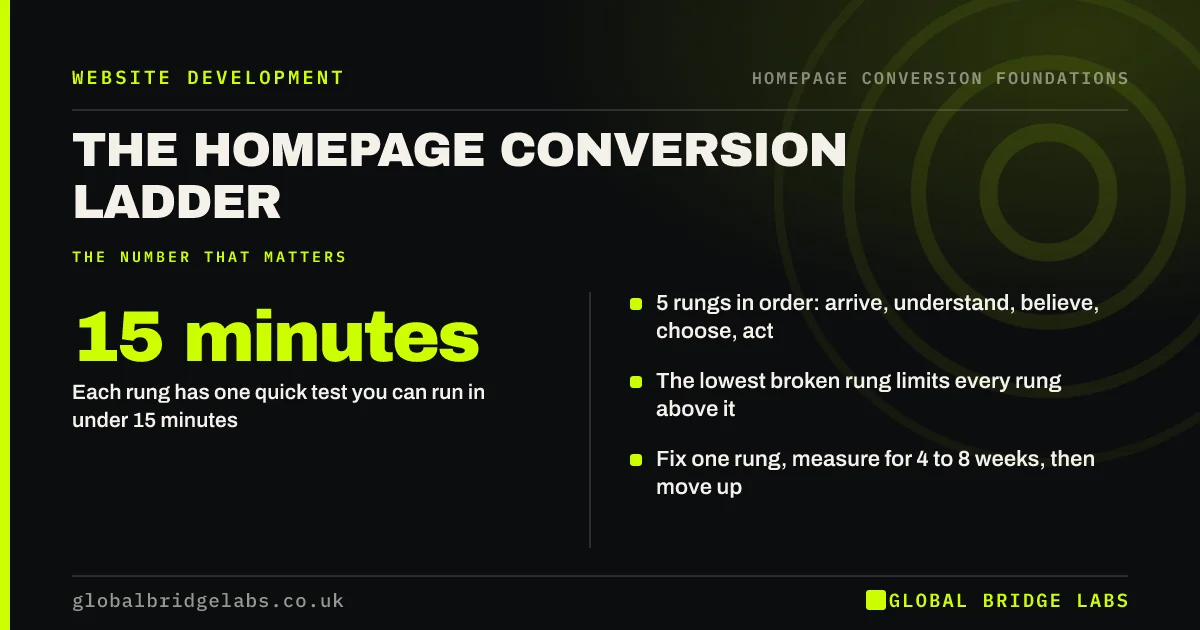
Order matters because each rung of the ladder depends on the one below. Better proof cannot help visitors who left because the headline was unclear, and a better button cannot help visitors who never saw it because the page loaded slowly. Fixing in the wrong order spends money on parts of the page few people reach. General website change prioritisation is covered in our guide to prioritising by impact; this is the homepage version.
What should you fix first?
Anything broken: a form that does not send, a phone number that cannot be tapped, a layout that breaks on iPhones, a pop-up that covers the first screen. These cost enquiries today and are usually quick to fix. Check them before any rewriting.
How do you choose between the rungs?
Score each rung using the homepage ladder tests and start with the lowest score. If two are equal, start with the lower rung. In practice, the most common first fix on small business homepages is the understand rung: the headline, subheadline and service area.
Within a rung, what comes first?
Start with changes that are cheap, quick and easy to reverse: wording, order and removing clutter. Leave changes that need design or development, such as a new hero layout or booking integration, until the cheap ones have been tried and measured.
When should you break the order?
Break it when a higher-rung fix is trivial and obviously right, such as adding a missing phone number to the header. Also break it for legal problems, such as misleading claims or missing required information, which should be fixed immediately whatever rung they sit on.
What does this look like in practice?
A pattern we see: an owner has a list of 25 homepage ideas from staff, agencies and competitors. Sorting them by rung and cost usually shows that three or four cheap changes to the first screen and the form deserve to go first, and many of the rest can wait or be dropped.
Homepage fix priority checklist
- Test forms, phone links and mobile layout first.
- Score each rung of the ladder.
- Start with the lowest-scoring rung.
- Within it, try wording and order changes first.
- Make one change at a time and log it.
- Fix legal issues immediately.
Next step
Write every homepage idea you have on a list, then tag each with its rung and whether it is cheap or costly. Start with cheap ideas on the lowest failing rung.
Message us on WhatsApp to sort the list together, or book a 30-minute consultation.
Chat on WhatsApp →Sources and further reading
- 10 usability heuristics for user interface design · Nielsen Norman Group
- Web Vitals: essential metrics for a healthy site · web.dev (Google)
Frequently asked questions
What should I fix first on my homepage?
Anything broken, such as forms, phone links or mobile layout. Then the lowest failing step of the visitor journey: traffic and speed, then the first-screen message, then proof, then the call to action, then the enquiry route.
How do I prioritise website improvements?
Rank them by where they sit in the visitor journey and by cost. Fix broken things first, then the earliest step that fails, starting with cheap and reversible changes such as wording and order before design or development work.
Should I fix the design or the content first?
Usually the content. Most homepage problems are unclear wording, missing proof or a weak call to action, which can be fixed without a redesign. Fix design first only if it breaks the page, slows it badly or undermines trust.
Written by

Global Bridge Labs (GBL) is a UK–Sri Lanka partner for social media, websites and BPO. Everything here comes from client delivery, not theory.