On this page
- 01Key takeaways
- 02What does the homepage copy template contain?
- 03How much should you write for each section?
- 04How do you fill in the headline prompt?
- 05How do you stop a template sounding like a template?
- 06When should you drop the template?
- 07What does this look like in practice?
- 08Homepage copy template checklist
- 09Next step
- 10Sources and further reading
- 11Frequently asked questions
Key takeaways
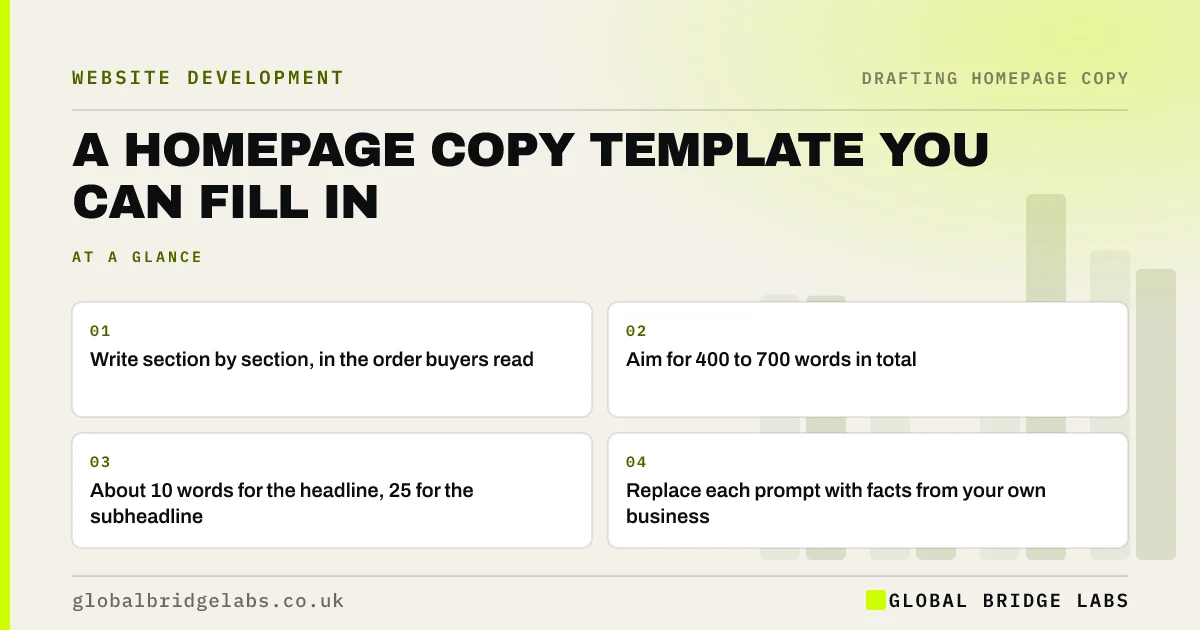
A homepage copy template gives you a prompt for each section, so you write answers rather than stare at a blank page. Fill in the hero, proof line, problem, services, process, proof, FAQ and closing action in order. Use plain sentences first, because polished wording is much easier to add than missing substance.
- Write section by section, in the order buyers read.
- Aim for 400 to 700 words in total.
- About 10 words for the headline, 25 for the subheadline.
- Replace each prompt with facts from your own business.
Want your filled-in template checked? Message us on WhatsApp.
Chat on WhatsApp →What does the homepage copy template contain?
It contains one prompt per section, each answering a buyer's question. Complete the sentence starters with your real details, then edit them into your own voice. Do not worry about style at this point. The aim is a complete first version where every section has real content.
- Headline: We help [buyer] get [result].
- Subheadline: How you do it, for whom and where.
- Button: The action, in plain words.
- Proof line: Reviews, clients, years or credentials.
- Problem: What buyers are dealing with now.
- Services: Three to six offers, each with a one-line result.
- How it works: Three steps from enquiry to result.
- Proof: A review or case with detail.
- FAQ: The questions that stop people enquiring.
- Closing: Restate the offer and repeat the button.
How much should you write for each section?
As a Global Bridge Labs (GBL) rule of thumb, allow about 10 words for the headline, 25 for the subheadline and 40 to 80 for most sections, for 400 to 700 overall. Some pages need more, particularly complex B2B services. Nielsen Norman Group found 79% of users scan, so each line must work alone.
How do you fill in the headline prompt?
Start with what you do and who it helps, using the customer's own words. 'We help Leeds landlords pass electrical inspections first time' is stronger than 'Excellence in electrical services'. Write five versions without judging them, then pick the plainest. Headlines often come easier once the rest of the page exists.
How do you stop a template sounding like a template?
Add details only you could write: your actual process, your area, a typical job, a real objection. Read each sentence and ask whether a competitor could say the same. If they could, replace it with something specific. Template structure is fine, because visitors never see the structure, only the content.
When should you drop the template?
Drop it, or reorder it, when your buyers ask different questions in a different order. A plumber's page needs the phone number and coverage area long before a process section. Treat the template as a checklist, and let your research decide the sequence and which sections stay.
What does this look like in practice?
A pattern we see when owners use a template: the hardest section is usually proof, and the blank box reveals that nobody has been collecting reviews or examples. That discovery is valuable. It is far better to find the gap in a document than after the designer has left a neat space for it.
Homepage copy template checklist
- Fill in every section once, roughly.
- Use customer language wherever you can.
- Keep the headline to about 10 words.
- Keep the page to 400 to 700 words.
- Replace generic claims with specifics.
- Read the whole draft aloud.
Next step
Copy the ten prompts into a document and fill them in before lunch. You will end up with a rough page that a designer or a copywriter can work with immediately.
Send us your filled-in template on WhatsApp and we will mark it up, with no pitch.
Chat on WhatsApp →Sources and further reading
- How users read on the web · Nielsen Norman Group
- Plain language is for everyone, even experts · Nielsen Norman Group
- Writing to GOV.UK standards: writing guidelines · GOV.UK
Frequently asked questions
What should I write on my homepage?
Say what you do, who it is for and what to do next. Then add proof, your main services, how it works and answers to common objections. Keep it plain and specific, and close by repeating the main action.
How many words should a homepage have?
Most SME homepages work with 400 to 700 words, as a GBL rule of thumb, although complex services can justify more. The real test is whether a visitor gets the answers they need without reading anything unnecessary.
Can I use a template for my homepage copy?
Yes, as a structure. A template makes sure you do not miss a section. The words must still be your own, with real details, because generic text will not persuade anyone and looks the same as your competitors.
Written by

Global Bridge Labs (GBL) is a UK–Sri Lanka partner for social media, websites and BPO. Everything here comes from client delivery, not theory.