On this page
- 01Key takeaways
- 02Why interview customers before a website project?
- 03Who should you interview?
- 04What questions should you ask?
- 05How do you turn interview answers into website changes?
- 06What about privacy and consent?
- 07When are interviews not enough?
- 08What does this look like in practice?
- 09Customer interview checklist
- 10Next step
- 11Sources and further reading
- 12Frequently asked questions
Key takeaways
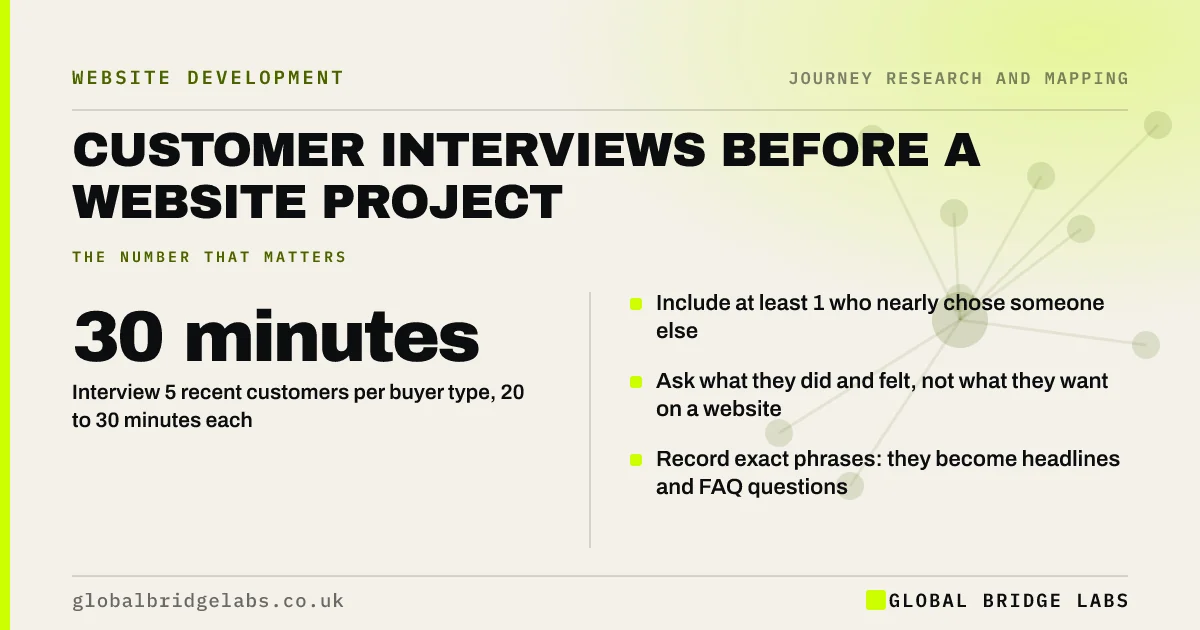
Customer interviews before a website project tell you how buyers found you, what they needed to know and what nearly stopped them, which no analytics report can. Interview five recent customers per main buyer type for 20 to 30 minutes each. Ask about what they did, not what they would like, and record their exact words for the website copy.
- Interview 5 recent customers per buyer type, 20 to 30 minutes each.
- Include at least 1 who nearly chose someone else.
- Ask what they did and felt, not what they want on a website.
- Record exact phrases: they become headlines and FAQ questions.
Want the full interview script? Ask for it on WhatsApp.
Chat on WhatsApp →Why interview customers before a website project?
Interview customers before a website project because they know things about your buying journey that you cannot see: where they looked first, what they compared, what almost put them off and why they chose you. Analytics shows what visitors did on the site; interviews show why, and what happened off it. The GOV.UK Service Manual makes user research a core part of designing any service for the same reason.
Who should you interview?
Interview recent customers, ideally from the last three to six months, so the journey is fresh. Choose five per main buyer type and include at least one who nearly chose a competitor and, if possible, one who enquired but did not buy. Nielsen Norman Group's finding that five users reveal about 85% of usability problems is a useful guide: the sixth conversation rarely changes the picture.
- Recent: bought within the last 3 to 6 months.
- Representative: your most valuable or most common buyer types.
- Mixed: at least one near-miss and, ideally, one lost prospect.
- Not friends or family who would have bought anyway.
What questions should you ask?
Ask questions about past behaviour in the order the journey happened. Start with the trigger, move through searching and comparing, and finish with the decision and what happened after. Avoid asking what they would like on a website; people are poor at predicting that, but good at recalling what they did.
- What was happening when you first started looking?
- Where did you look first, and what did you type or ask?
- Which other businesses did you consider?
- What did you need to know before you got in touch?
- Was anything hard to find or unclear on our website?
- What nearly stopped you, or made you hesitate?
- Why did you choose us in the end?
- Who else was involved in the decision?
- What happened after you got in touch? Was anything slow?
- How would you describe what we do to a friend?
- What would you have searched for if you had not known our name?
- Is there anything you wish you had known earlier?
Want this script adapted to your sector? Message us on WhatsApp.
Chat on WhatsApp →How do you turn interview answers into website changes?
Turn answers into changes by grouping them by journey stage, highlighting repeated themes and exact phrases, and asking what the website should do about each. A question three customers asked becomes an answer on the service page. A phrase they used becomes a headline. A hesitation becomes proof or reassurance near the button.
What about privacy and consent?
Tell interviewees why you are asking, how long it will take and how you will use their answers. If you record the call, ask permission first and store recordings securely. Under UK GDPR, notes that identify a person are personal data, so keep only what you need, delete recordings once summarised, and do not quote customers by name on the website without their agreement.
When are interviews not enough?
Interviews are not enough on their own because people remember selectively and rationalise decisions after the fact. Check what they say against analytics, recordings and your enquiry data. If customers say they read your case studies but GA4 shows nobody visits them, the truth is somewhere in between and worth testing.
What does this look like in practice?
A pattern we see in interview notes: customers describe the service in different words from the business. A firm sells 'facilities management' while customers say 'someone to sort out the building'. The website ranks for the firm's term and misses the buyers' one.
Moving customers' words into headlines and page titles connects the site to how buyers search and talk. Across our client work we have seen a 2.4x enquiry rate from conversion changes of this kind. Global Bridge Labs (GBL) quotes customers before it writes copy.
Customer interview checklist
- Pick 5 recent customers per buyer type, including a near-miss.
- Book 20 to 30 minutes and explain the purpose.
- Ask permission before recording.
- Ask about past behaviour in journey order.
- Capture exact phrases and repeated questions.
- Group findings by stage and turn each into a page change.
Next step
Customers are often more candid with someone outside the business. We can run the interviews for you and hand back the themes, phrases and page changes.
Message us on WhatsApp to plan customer interviews for your website, or book a 30-minute consultation.
Chat on WhatsApp →Sources and further reading
- User research · GOV.UK Service Manual
- Why you only need to test with 5 users · Nielsen Norman Group
- Lawful basis for processing personal data · Information Commissioner's Office
Frequently asked questions
How many customers should I interview before a website redesign?
Five per main buyer type is a practical number for a small business. Nielsen Norman Group's research found five users reveal about 85% of usability problems, and interviews show similar diminishing returns. Include at least one customer who nearly chose a competitor.
What questions should I ask customers about my website?
Ask about what they did rather than what they want: what triggered their search, where they looked, what they compared, what they needed to know, what nearly stopped them, why they chose you and what happened after they got in touch. Record their exact words.
Do I need consent to interview customers?
Explain the purpose and how you will use their answers, and ask permission before recording. Notes that identify a person are personal data under UK GDPR, so keep only what you need, store it securely, delete recordings once summarised and do not publish names without agreement.
Written by

Global Bridge Labs (GBL) is a UK–Sri Lanka partner for social media, websites and BPO. Everything here comes from client delivery, not theory.