On this page
- 01Key takeaways
- 02What are the rules on sustainability claims?
- 03What does a good claim look like?
- 04Should sustainability go on your homepage at all?
- 05What about badges and certifications?
- 06When should you say less?
- 07What does this look like in practice?
- 08Homepage sustainability claims checklist
- 09Next step
- 10Sources and further reading
- 11Frequently asked questions
Key takeaways
Sustainability claims on a website must be truthful, clear and backed by evidence. The CMA's Green Claims Code and the ASA both apply. Avoid vague words such as 'eco-friendly' or 'sustainable' unless you can explain what they mean, and state exactly what you have done, with figures and dates a buyer could check.
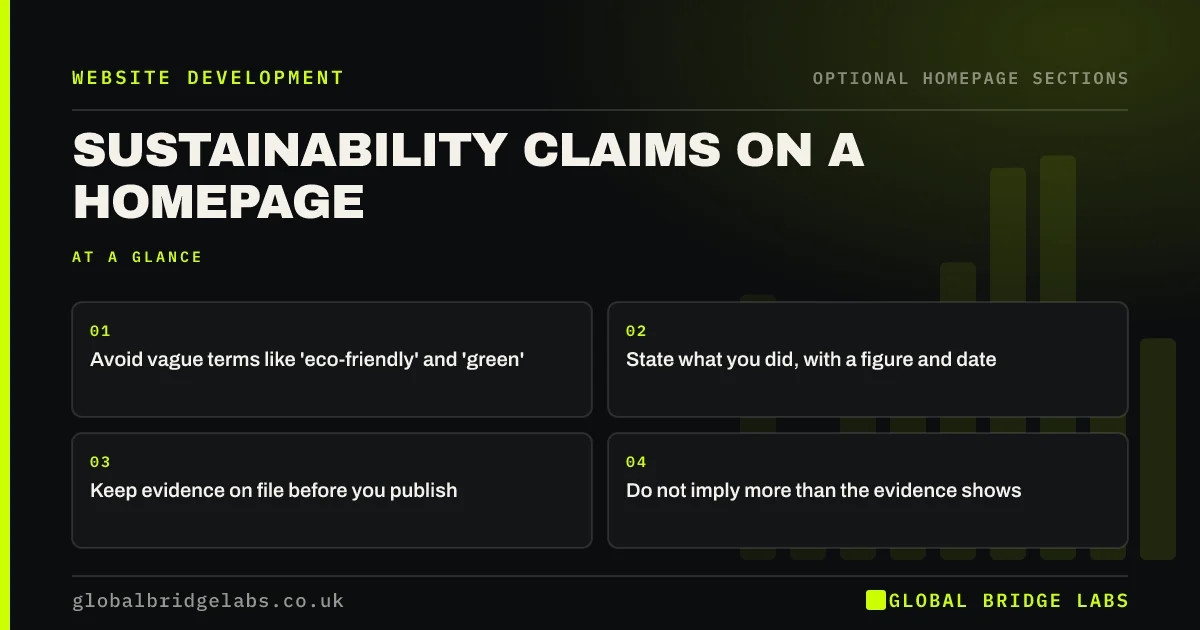
- Avoid vague terms like 'eco-friendly' and 'green'.
- State what you did, with a figure and date.
- Keep evidence on file before you publish.
- Do not imply more than the evidence shows.
Want your claims checked for clarity? Message us on WhatsApp.
Chat on WhatsApp →What are the rules on sustainability claims?
UK businesses must not mislead consumers, and that covers environmental claims. The CMA's Green Claims Code sets six principles, including that claims be truthful, clear and able to be substantiated. The ASA also rules on green advertising. The Digital Markets, Competition and Consumers Act 2024 lets the CMA fine businesses directly.
What does a good claim look like?
A good claim is specific about what, how much and by when. 'Our vans have been fully electric since March 2025' can be checked. 'We care about the planet' cannot. If a claim covers only part of a product or business, say so, because partial truths can still mislead.
- Vague: 'Eco-friendly packaging.'
- Specific: 'Packaging made from 100% recycled card.'
- Vague: 'A carbon neutral business.'
- Specific: 'We offset these named emissions, verified by this standard.'
Should sustainability go on your homepage at all?
Include it if it affects why people buy from you or if tender buyers ask for it. Public sector and larger B2B buyers may need evidence of environmental policy. If it is not part of the decision, one honest line or a link to a policy page is enough.
What about badges and certifications?
Show them only if you currently hold them, and link to the certifying body. Made-up leaf icons or badges that look like official marks can mislead. B Corp, ISO 14001 and similar standards have their own rules on use, so check the terms before you add the logo.
When should you say less?
Say less when your evidence is weak or your supply chain is unknown. Claims about 'net zero' or 'carbon neutral' attract close scrutiny, and offsetting needs clear explanation. A smaller, true statement carries less risk than a broad promise. If in doubt, take advice before publishing.
What does this look like in practice?
A pattern worth checking: 'sustainable' sits in a homepage headline because a competitor's site uses it, and nobody can say what it refers to. Replacing the word with one verifiable action is a modest change, and it turns a risk into something that actually persuades.
Homepage sustainability claims checklist
- List every environmental claim on the page.
- Find evidence for each one.
- Replace vague words with specifics.
- Say what the claim covers.
- Check badge rules and validity.
- Name who reviews claims each year.
Next step
Search your homepage for 'green', 'eco', 'sustainable' and 'carbon'. For each one, write down the evidence. If you cannot, remove or rewrite it.
Message us on WhatsApp for a homepage copy review, or book a 30-minute consultation.
Chat on WhatsApp →Sources and further reading
- Green claims code: making environmental claims · Competition and Markets Authority
- UK Code of Non-broadcast Advertising and Direct & Promotional Marketing (CAP Code) · ASA / CAP
- Substantiation: advice on backing up marketing claims · ASA and CAP
- Digital Markets, Competition and Consumers Act 2024 · legislation.gov.uk
Frequently asked questions
Can I say my business is eco-friendly on my website?
Only if you can explain and prove what you mean. Vague terms are high risk because they may suggest more than the evidence shows. A specific statement about one action, with a figure and date, is much safer and more persuasive.
What is the Green Claims Code?
It is guidance from the Competition and Markets Authority on making environmental claims without misleading consumers. Claims must be truthful, clear, not omit important information, compare fairly, consider the full life cycle and be substantiated.
Do green claims rules apply to small businesses?
Yes. Consumer protection law applies to businesses of all sizes, and the ASA's rules cover marketing on your own website. You may be less likely to attract attention than a large brand, but the rules are the same.
Written by

Global Bridge Labs (GBL) is a UK–Sri Lanka partner for social media, websites and BPO. Everything here comes from client delivery, not theory.