On this page
- 01Key takeaways
- 02What is the GBL Homepage Blueprint?
- 03What does each stage produce?
- 04Why does the order matter so much?
- 05How long should each stage take?
- 06When is a six-stage process too much?
- 07What does this look like in practice?
- 08Homepage blueprint checklist
- 09Next step
- 10Sources and further reading
- 11Frequently asked questions
Key takeaways
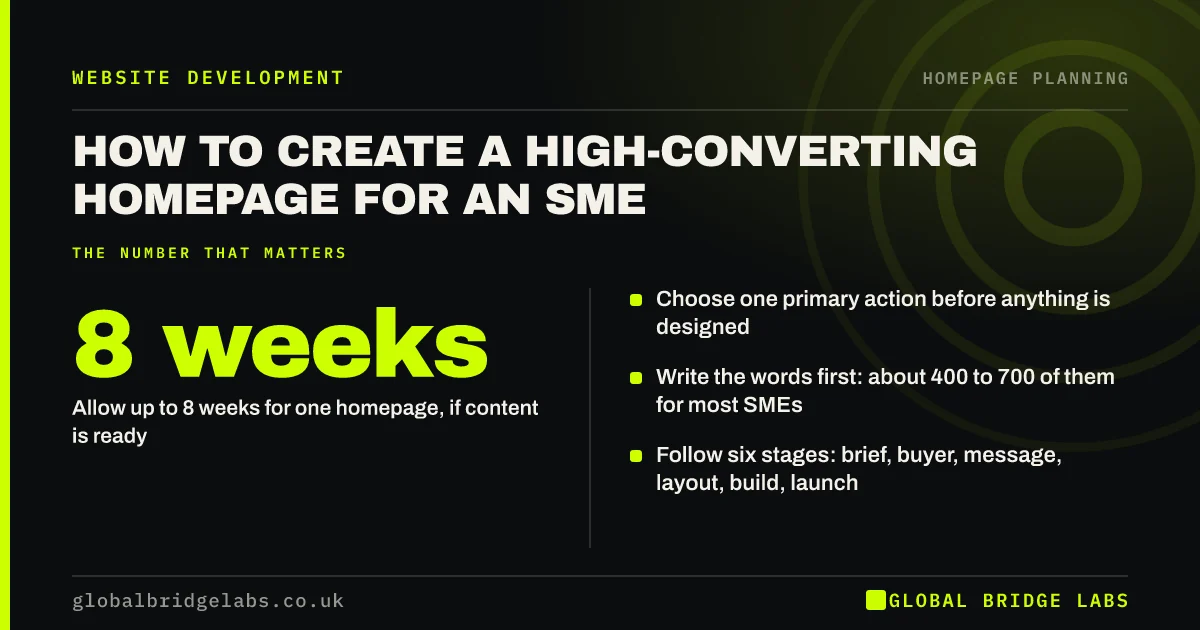
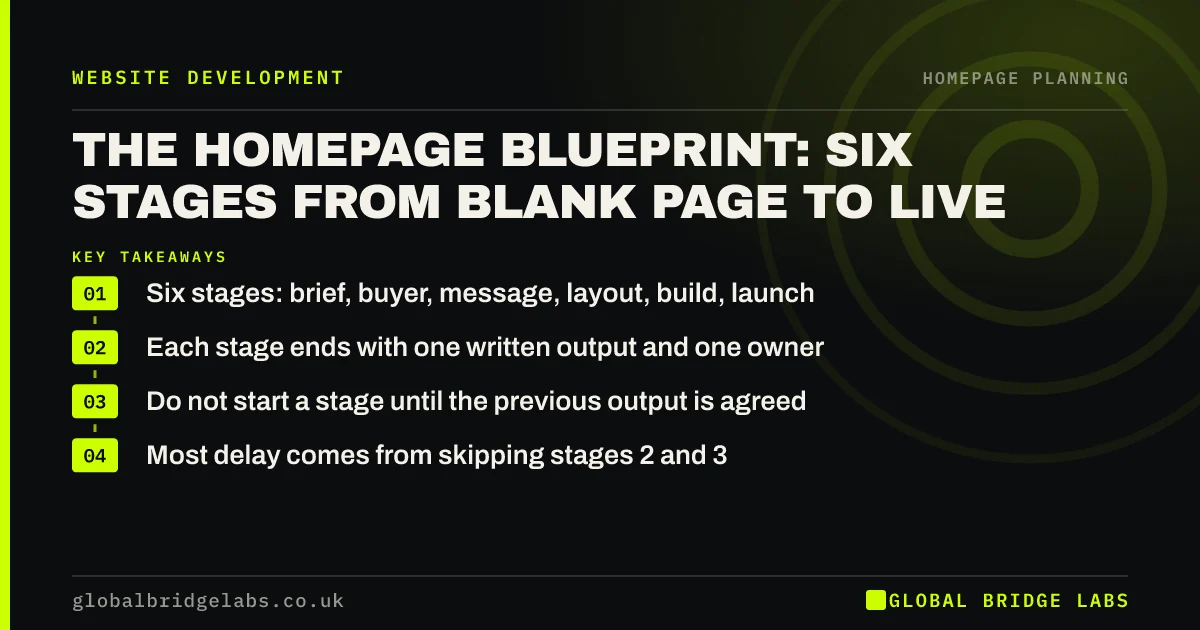
A homepage blueprint is a build order for creating a business homepage, with one output at each stage. The Global Bridge Labs (GBL) Homepage Blueprint has six: brief, buyer, message, layout, build and launch. Each output feeds the next, so decisions made early do not get reopened at the end of the project.
- Six stages: brief, buyer, message, layout, build, launch.
- Each stage ends with one written output and one owner.
- Do not start a stage until the previous output is agreed.
- Most delay comes from skipping stages 2 and 3.
Want the blueprint applied to your homepage? Message us on WhatsApp.
Chat on WhatsApp →What is the GBL Homepage Blueprint?
The GBL Homepage Blueprint is a six-stage method for creating a homepage from scratch: brief, buyer, message, layout, build, launch. It puts the decisions that are expensive to change first, and the ones that are cheap to change last, so a small business does not pay for design that gets thrown away.
It sits alongside the GBL Homepage Ladder, which diagnoses a homepage that already exists. Use the blueprint to make the page, and the ladder to find out what is wrong with it later.
What does each stage produce?
Each stage produces one thing someone can read and approve. That keeps progress visible and gives the next person something firm to work from. If a stage has no written output, the work has probably only happened in someone's head, and it will be argued over later.
- Brief: a one-page plan with a goal, an action and an owner.
- Buyer: a page of real customer phrases, triggers and fears.
- Message: the full draft of every section as a document.
- Layout: an agreed wireframe showing section order.
- Build: a working staging page that passes speed checks.
- Launch: a live page with tracking and a tested enquiry route.
Why does the order matter so much?
The order matters because each stage makes the next one cheaper. Changing a sentence in a document takes a minute; changing it after design and build can mean reflowing a whole section. When words arrive last, designers guess, and the guesses become arguments when the real copy does not fit.
How long should each stage take?
For a straightforward SME homepage on a template, allow a few days for each of the first four stages, about a week for the build and a few days for launch checks. As a GBL rule of thumb, that adds up to 2 to 4 weeks if decisions come back quickly.
These are working estimates, not promises. The stage most likely to overrun is the message, because it needs a decision-maker's time rather than a supplier's.
When is a six-stage process too much?
It is too much for a single campaign page or a small text change. If you are only changing a headline, use a simple change log. A sole trader can run all six stages alone in a few days, but should still do them in order, because the logic does not depend on company size.
What does this look like in practice?
A pattern we see when several directors are involved: visual design starts while the proposition is still being debated, so every round reopens the same disagreement. Pausing to agree the brief and draft copy feels like a delay, yet it is usually the point at which the project starts moving again.
Homepage blueprint checklist
- Name an owner for every stage.
- Agree the brief before any research starts.
- Keep buyer phrases in one shared page.
- Approve the draft before wireframing.
- Approve the wireframe before visual design.
- Build on staging, not the live site.
- Run launch checks before announcing anything.
Next step
Write the six stages down with a name and a date against each one. Any stage without a name is where your project will stall.
Message us on WhatsApp and we will help you scope each stage, with no pitch.
Chat on WhatsApp →Sources and further reading
- Creating helpful, reliable, people-first content · Google Search Central
- User research · GOV.UK Service Manual
- Mental models and user experience design · Nielsen Norman Group
Frequently asked questions
What is a homepage blueprint?
A homepage blueprint is a planned build order for creating a homepage, setting out what gets decided at each stage. The GBL Homepage Blueprint has six stages, brief, buyer, message, layout, build and launch, each ending in one written output.
What are the steps to create a homepage?
Agree a brief, research how buyers talk, draft all the words, plan the section layout, build the page on a staging site, then test tracking and the enquiry route before launch. Working in this order avoids paying for design that later has to change.
Can I skip the research stage?
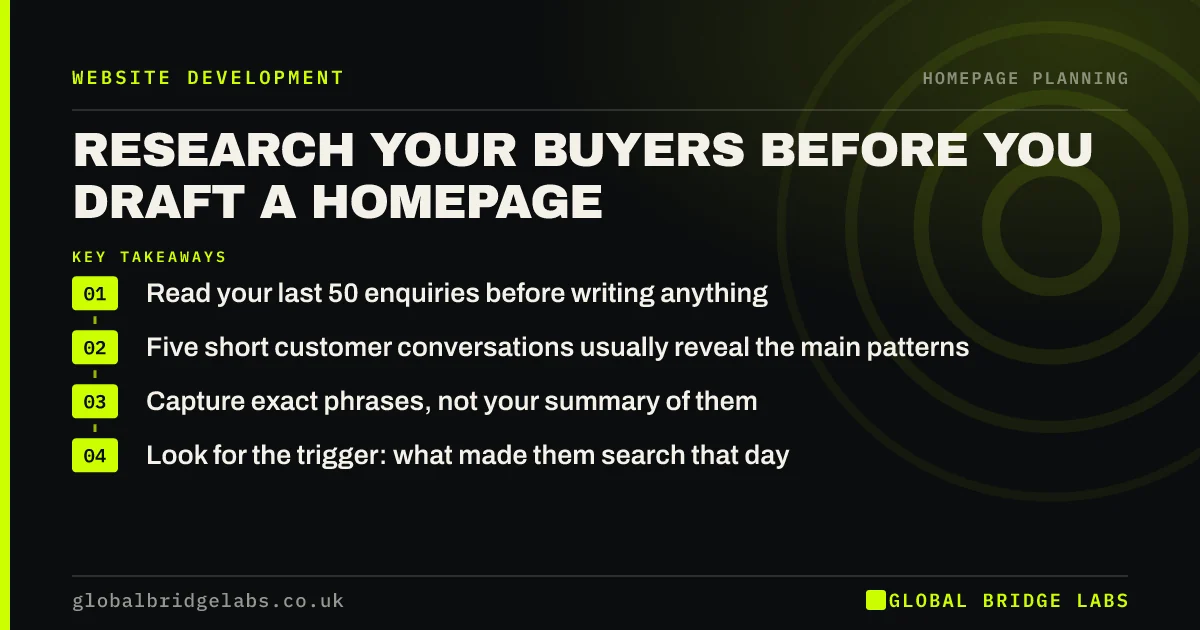
You can shorten it but should not skip it. Even an hour reading recent enquiry emails and reviews gives you real buyer language. Without it, the page tends to describe the business as the owner sees it rather than as customers do.
Written by

Global Bridge Labs (GBL) is a UK–Sri Lanka partner for social media, websites and BPO. Everything here comes from client delivery, not theory.