On this page
- 01Key takeaways
- 02Who actually reads a construction homepage?
- 03What proof should be on the first screens?
- 04How do you show health and safety credibly?
- 05How do you structure services?
- 06What should the enquiry route look like?
- 07When should private clients have their own page?
- 08What does this look like in practice?
- 09Construction homepage checklist
- 10Next step
- 11Sources and further reading
- 12Frequently asked questions
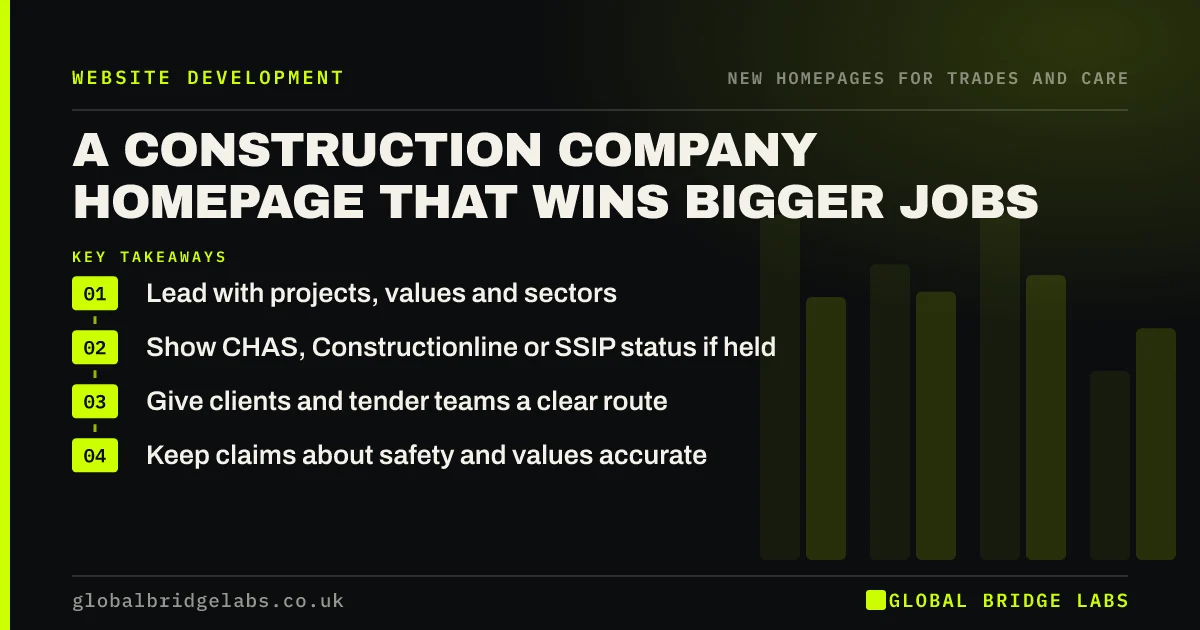
Key takeaways
A construction company homepage wins bigger jobs by proving capability, not by listing every trade. Show named projects with value bands, your accreditations and safety record, the sectors you work in and a clear enquiry route for tenders. Buyers are checking whether you are a safe choice, so make that evidence easy to find.
- Lead with projects, values and sectors.
- Show CHAS, Constructionline or SSIP status if held.
- Give clients and tender teams a clear route.
- Keep claims about safety and values accurate.
Run a construction firm? Message us on WhatsApp for a homepage review.
Chat on WhatsApp →Who actually reads a construction homepage?
Three groups do: private clients planning a project, commercial buyers and architects, and procurement teams checking your suitability. Subcontractors and job seekers also arrive. Procurement teams often visit after a tender or a recommendation, to confirm that you are a real, capable company, so give them proof without making them search.
What proof should be on the first screens?
Show recent projects with type, location and rough value band, plus accreditations such as CHAS, Constructionline or an SSIP scheme, if you hold them, and ISO standards. Name your insurance levels, if that helps. Buyers want to see work of their size, so lead with projects close to the ones you want.
How do you show health and safety credibly?
State how you manage it, rather than saying that safety comes first. Refer to your accreditations and name who is responsible. Under the CDM Regulations 2015, clients and contractors have defined duties, and informed buyers look for evidence that you understand them. Accident-free claims need solid records behind them.
How do you structure services?
Organise by sector or project type, such as commercial fit-out, education or residential, rather than by trade. Buyers think in projects. Link each one to a relevant case. For a firm of this kind, three or four focus areas tell a more convincing story than a long list of everything you have ever built.
What should the enquiry route look like?
Offer a direct line to a named person for tender and project enquiries, not a generic form. Ask for project type, location and timing. Large buyers expect to talk to someone. Add a simple route to supplier registration and careers elsewhere, so that those visitors do not fill up your project inbox.
When should private clients have their own page?
Give them their own page when homeowners are a meaningful share of your work, as they ask very different questions: cost, disruption, planning and trust. Mixing those with tender language confuses both groups. If you only do commercial work, say so, and you will save everyone's time.
What does this look like in practice?
A pattern we see in construction: the homepage shows a drone shot of a site and the line 'building the future', and procurement staff have to dig through menus to find accreditations. Moving recent projects and credentials to the first two screens answers what these visitors arrived to check.
Construction homepage checklist
- Show recent, relevant projects.
- Give value bands where you can.
- List accreditations you hold.
- Organise by sector or project type.
- Name a contact for tenders.
- Keep safety claims evidenced.
- Route job seekers elsewhere.
Next step
Imagine a procurement manager checking you for a £500,000 job. Could they confirm your size, sectors and accreditations in one minute? If not, start there.
Message us on WhatsApp for a construction homepage review, or book a 30-minute consultation.
Chat on WhatsApp →Sources and further reading
- Construction (Design and Management) Regulations 2015 · Health and Safety Executive
- Building regulations approval · GOV.UK
- Procurement Act 2023: guidance documents · GOV.UK
- Substantiation: advice on backing up marketing claims · ASA and CAP
Frequently asked questions
What should a construction company have on its website?
Recent projects, sectors served, accreditations, insurance and safety information, a named contact and clear routes for clients, subcontractors and job seekers. Buyers want to confirm that you can deliver work of their size safely.
Do construction companies need a website to win tenders?
A website does not win a tender alone, but buyers do check you. A weak site can raise doubts just as you are being shortlisted. Clear proof of relevant experience and accreditation supports your bid.
How should a construction firm show its projects?
Show location, sector, value band and what you delivered, with real photos and client permission. Choose work that matches what you want next. Long lists are less useful than a few detailed, relevant examples.
Written by

Global Bridge Labs (GBL) is a UK–Sri Lanka partner for social media, websites and BPO. Everything here comes from client delivery, not theory.