On this page
- 01Key takeaways
- 02What goes on a homepage planning template?
- 03How is this different from a website brief?
- 04Who should fill it in?
- 05What is the most common mistake?
- 06When is a template not enough?
- 07What does this look like in practice?
- 08Homepage planning checklist
- 09Next step
- 10Sources and further reading
- 11Frequently asked questions
Key takeaways
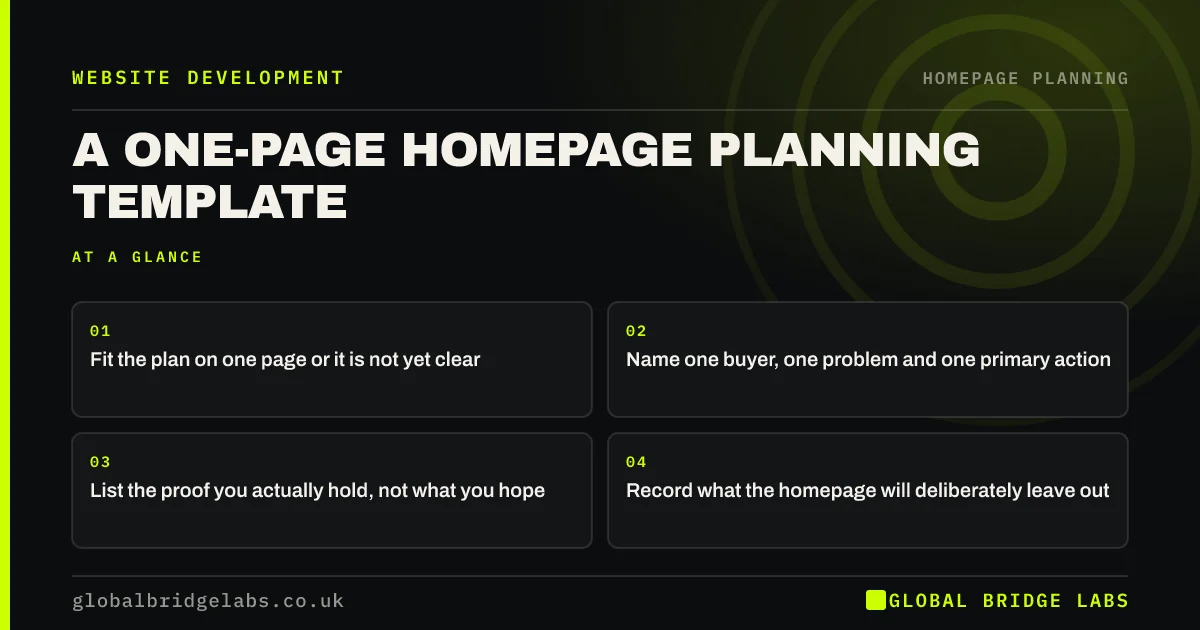
A homepage planning template is a one-page document that records the decisions a new homepage depends on: who it is for, what action it should produce, what proof you can show and who approves it. Fill it in before speaking to a designer, because every later decision depends on these answers.
- Fit the plan on one page or it is not yet clear.
- Name one buyer, one problem and one primary action.
- List the proof you actually hold, not what you hope for.
- Record what the homepage will deliberately leave out.
Want this template filled in with you? Message us on WhatsApp.
Chat on WhatsApp →What goes on a homepage planning template?
A useful homepage planning template holds eight answers: the buyer, their problem, your offer in one sentence, the primary action, the secondary action, the proof available, the sections needed and the sign-off owner. Keep each answer to a line or two. Long answers usually hide an undecided question.
- Buyer: who are we writing for first?
- Problem: what are they trying to fix or get?
- Offer: what do we do, in one sentence?
- Primary action: what do we want them to do?
- Secondary action: what if they are not ready yet?
- Proof: what reviews, results or credentials do we hold?
- Excluded: what will this page not cover?
- Owner: who makes the final decision?
How is this different from a website brief?
A website brief covers the whole project, including pages, budget, suppliers and timelines. A homepage plan covers the message of one page and takes less than an hour to complete. Use the plan first, then feed it into the wider brief if you are commissioning a full site.
Who should fill it in?
The person accountable for sales should draft it, ideally the owner or sales lead, not whoever manages the website. Then ask someone who talks to customers each day to challenge it. They will spot wishful answers quickly, especially in the buyer and proof lines.
What is the most common mistake?
The most common mistake is listing several audiences and several actions, because nobody wants to choose. A homepage can serve more than one audience, but it needs one first reader. Pick the group that brings in the most profit, write for them and route the others to their own pages.
When is a template not enough?
A template is not enough when the proposition itself is disputed, or when the business has just merged, pivoted or entered a new market. The template will show the disagreement but cannot settle it. In those cases, hold the positioning conversation first and return to the page afterwards.
What does this look like in practice?
A pattern worth checking: two directors fill in the template separately and name different primary buyers. It is an uncomfortable ten minutes, and a far cheaper place to find the disagreement than the third round of design.
Homepage planning checklist
- Complete all eight answers in one sitting.
- Limit each answer to two lines.
- Choose one first reader.
- Choose one primary action.
- List real proof with links or files.
- Ask a customer-facing colleague to challenge it.
- Name the person who signs off.
Next step
Copy the eight questions into a document and answer them today. Share it with one colleague and see which answers survive the conversation.
Send us your filled-in plan on WhatsApp and we will tell you what we would change.
Chat on WhatsApp →Sources and further reading
- Government design principles · GOV.UK
- Writing to GOV.UK standards: writing guidelines · GOV.UK
- Minimize cognitive load to maximize usability · Nielsen Norman Group
Frequently asked questions
What should a homepage plan include?
It should name the buyer, their problem, your offer in one sentence, the primary and secondary actions, the proof you hold, what the page excludes and who signs it off. One page is enough, and longer plans usually avoid making the hard choices.
How long does it take to plan a homepage?
The template itself takes under an hour if you know your customers. Allow longer if directors need to agree on the buyer or the offer. That discussion is time well spent, because it would otherwise surface during the design rounds.
Should I plan the homepage before the rest of the website?
Usually yes, because the homepage forces decisions on buyer, offer and proof that every other page depends on. Plan the overall site structure at the same time, so the homepage knows which pages it should lead visitors towards.
Written by

Global Bridge Labs (GBL) is a UK–Sri Lanka partner for social media, websites and BPO. Everything here comes from client delivery, not theory.