On this page
- 01Key takeaways
- 02Which homepage sections are essential?
- 03Which sections can usually go?
- 04How do you judge a section fairly?
- 05How do you remove a section without upsetting people?
- 06When should an optional section stay?
- 07What does this look like in practice?
- 08Optional homepage sections checklist
- 09Next step
- 10Sources and further reading
- 11Frequently asked questions
Key takeaways
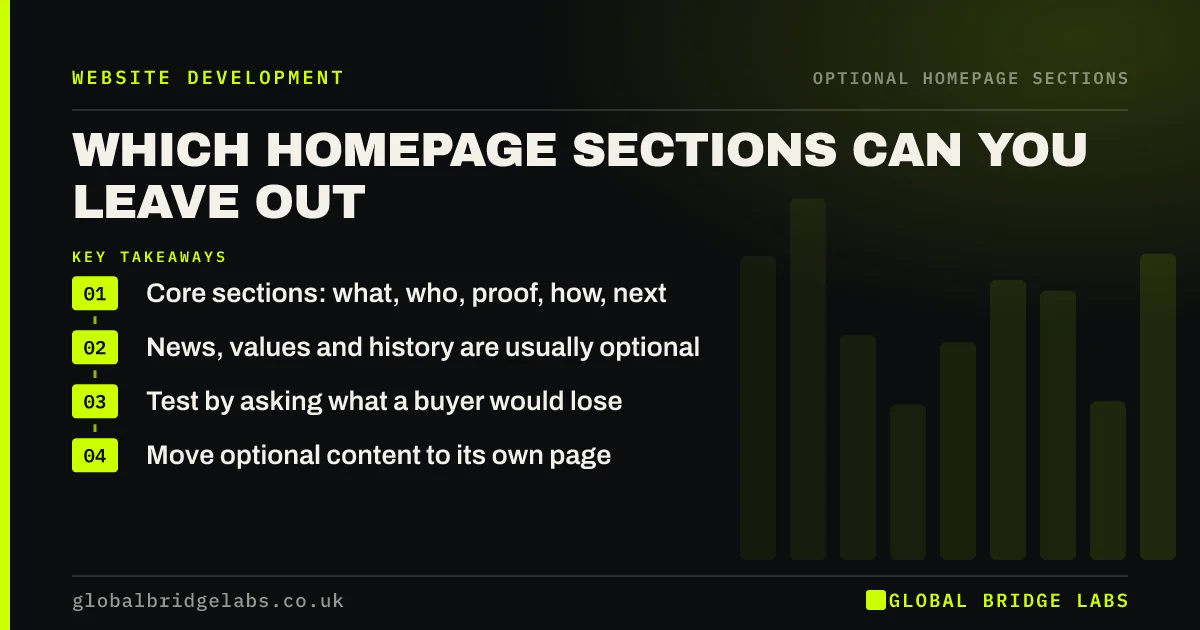
Optional homepage sections are those that do not answer a buyer's main questions, such as news, values, blog feeds, big team grids and long histories. Leaving them out makes the essential sections stronger. Keep the core five, what, who, proof, how and next, then add others only when buyers need them.
- Core sections: what, who, proof, how, next.
- News, values and history are usually optional.
- Test by asking what a buyer would lose.
- Move optional content to its own page.
Want a second opinion on what to cut? Message us on WhatsApp.
Chat on WhatsApp →Which homepage sections are essential?
Five jobs are essential: what you do, who it is for, why to trust you, how it works and what to do next. How you deliver those jobs varies by business, and some sections can do more than one. Everything else is optional, and it should compete for its place.
Which sections can usually go?
News, company values, mission statements, long histories, blog feeds, big team grids, partner lists and social feeds are the usual candidates. They tend to reflect what the company wants to say. Each could be right in some cases, but most exist because a template offered them or someone asked.
- Latest news: rarely decides a purchase.
- Company values: move to the about page.
- Blog feed: use only if posts are current and useful.
- Social feeds: slow and often stale.
- Long history: keep one line.
How do you judge a section fairly?
Ask three questions: which buyer question does it answer, what evidence shows that people use it and what would be lost without it? Check click data and scroll depth if you have them. If nobody can answer the first question, the section is there for the business and not the buyer.
How do you remove a section without upsetting people?
Move it instead of deleting it. Company history can go on the about page, and news can go to its own page. Show the person who asked for it where it now lives, and explain the buyer's question it was competing with. Most internal objections fade when the content is kept.
When should an optional section stay?
Keep it when it helps your particular buyers. Values may matter to charities and public sector clients, current news matters to a venue with events and team faces matter in clinics. There is no universal list, so let your research and enquiries decide what stays.
What does this look like in practice?
A pattern we see in established firms: every section has an internal sponsor, so none can be removed, and the page keeps growing. Framing the conversation as 'moved to its own page' rather than 'deleted' usually unblocks it, and the homepage gets shorter without anyone losing their content.
Optional homepage sections checklist
- Mark the five essential jobs.
- List everything else on the page.
- Name the buyer question each one answers.
- Check clicks and scroll data.
- Move what fails to its own page.
- Link to it from the footer or menu.
Next step
Print your homepage and cross out each section that does not answer a buyer's question. Look at what remains: that is the page you should have.
Message us on WhatsApp for a homepage review, with no pitch.
Chat on WhatsApp →Sources and further reading
- Minimize cognitive load to maximize usability · Nielsen Norman Group
- Hick's Law: designing long menu lists · Nielsen Norman Group
- Enhanced measurement events · Google Analytics Help
Frequently asked questions
What should I remove from my homepage?
Remove anything that does not help a buyer decide, such as old news, long histories, stale blog feeds and generic value statements. Move useful material to its own page, and keep a short link if some visitors need it.
What sections does every homepage need?
Every homepage needs to explain what you do, who it is for, why to trust you, how it works and what to do next. These can take different forms. The right mix depends on your business and your buyers.
Should I put a blog on my homepage?
Only if the posts are current and useful to buyers. A feed with an old date suggests a neglected site. Many small businesses are better off with one or two hand-picked guides linked from the page.
Written by

Global Bridge Labs (GBL) is a UK–Sri Lanka partner for social media, websites and BPO. Everything here comes from client delivery, not theory.