On this page
- 01Key takeaways
- 02What is the difference between a good website and a high-converting website?
- 03Why do good-looking websites fail to convert?
- 04How do a good website and a high-converting website compare?
- 05What makes a website high-converting?
- 06How much more does a high-converting website earn?
- 07What does it cost to close the gap?
- 08When is a good website good enough?
- 09What does this look like in practice?
- 10Which conversion guide do you need next?
- 11Your high-converting website checklist
- 12Next step
- 13Sources and further reading
- 14Frequently asked questions
Key takeaways
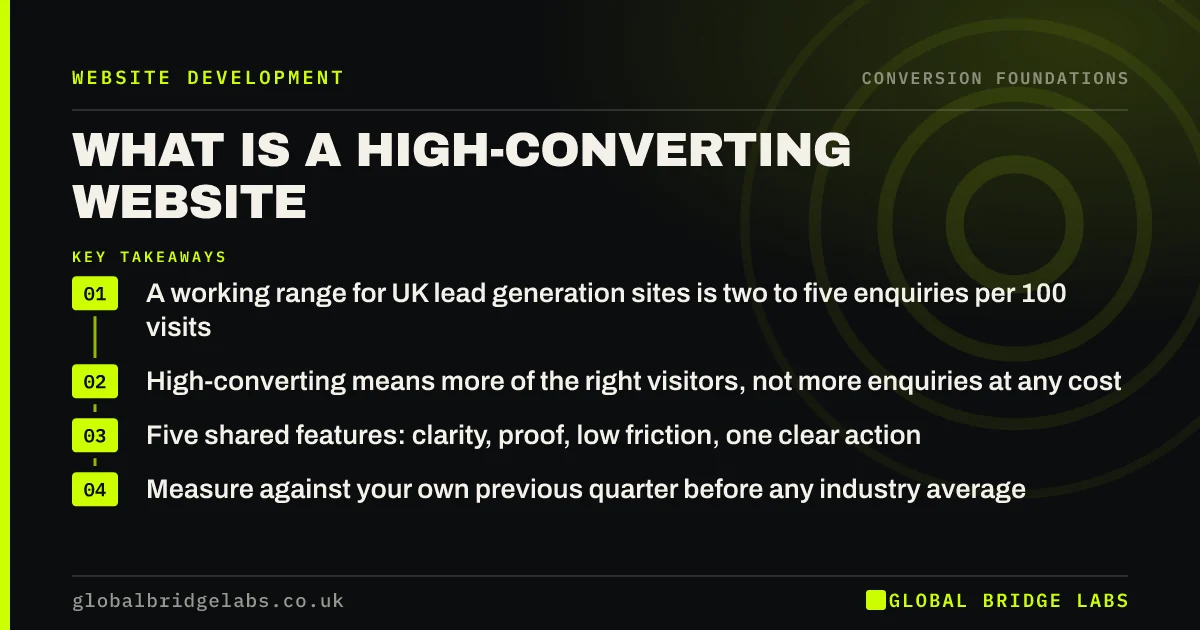
The difference between a good website and a high-converting website is purpose. A good website looks professional, loads and describes the business accurately. A high-converting website is built around the buyer's next decision, so it turns a measurably larger share of the right visitors into enquiries, bookings or sales. The gap is rarely visual. It sits in clarity, proof, friction, action and follow-up.
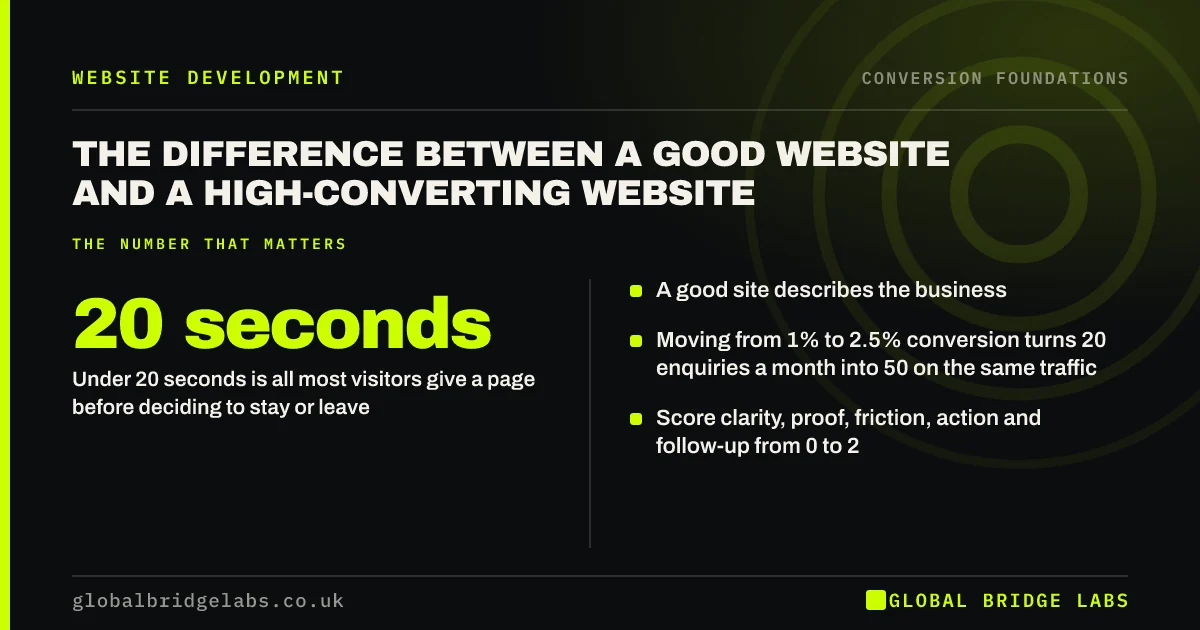
- Under 20 seconds is all most visitors give a page before deciding to stay or leave.
- A good site describes the business. A high-converting site answers the buyer's next question.
- Moving from 1% to 2.5% conversion turns 20 enquiries a month into 50 on the same traffic.
- Score clarity, proof, friction, action and follow-up from 0 to 2. Below 8 is leaking enquiries.
- Most of the gap closes with copy, proof and tracking, not a new design.
Want to know which side of the line your website sits on? Send us the URL on WhatsApp and we will score it.
Chat on WhatsApp →What is the difference between a good website and a high-converting website?
A good website is one that works: it looks current, loads without errors, is accurate and reflects the brand. A high-converting website is a business website that turns a consistently higher share of the right visitors into enquiries, bookings or sales, because every page is designed around what the buyer needs to decide next.
Both can look similar in a screenshot. The difference shows in the numbers. This guide, written by Global Bridge Labs (GBL) for UK founders, managing directors and marketing leads, explains where the two part ways and how to move a site from the first group to the second.
- Good website: judged by how it looks and whether it works.
- High-converting website: judged by qualified enquiries per month and cost per enquiry.
- Good website: written about the business. High-converting website: written about the buyer's problem.
- Good website: one contact page. High-converting website: a clear next step on every page.
Why do good-looking websites fail to convert?
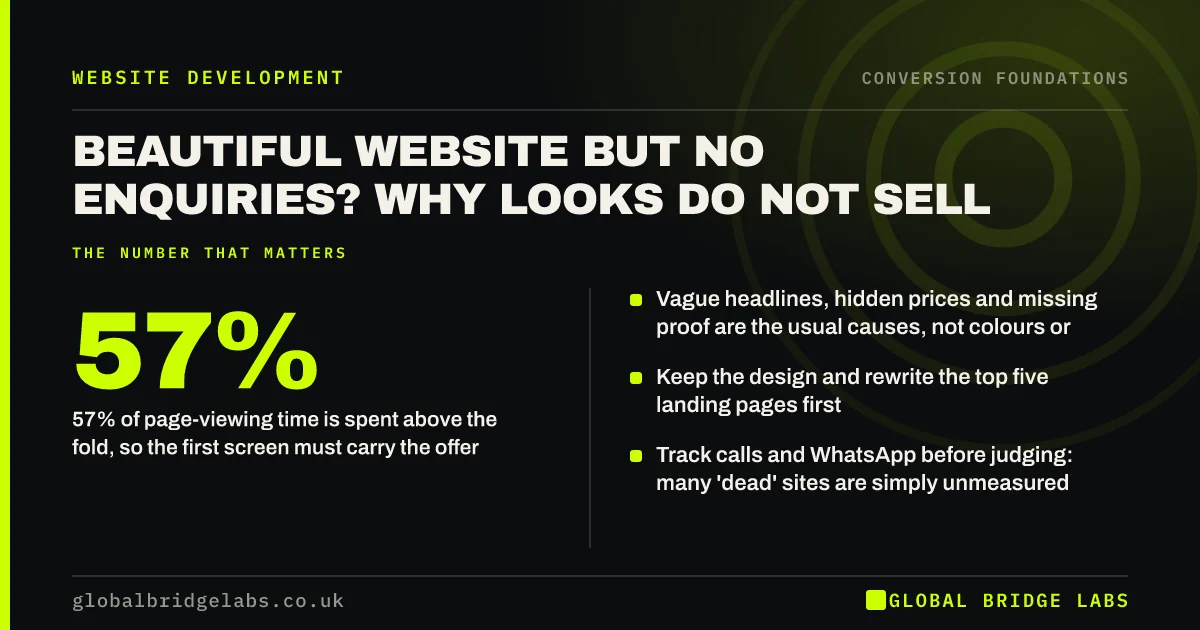
Good-looking websites fail to convert because appearance answers only one of the buyer's questions: is this business credible? It does not answer what you do, whether you do it for people like them, what it costs, what happens next and why they should choose you over the next result in Google.
Nielsen Norman Group research found that users often leave web pages within 10 to 20 seconds, and that pages with a clear value proposition hold attention far longer. A beautiful hero image with a vague headline uses those seconds on decoration. A plain page that states the offer, the audience and the next step uses them on the decision.
How do a good website and a high-converting website compare?
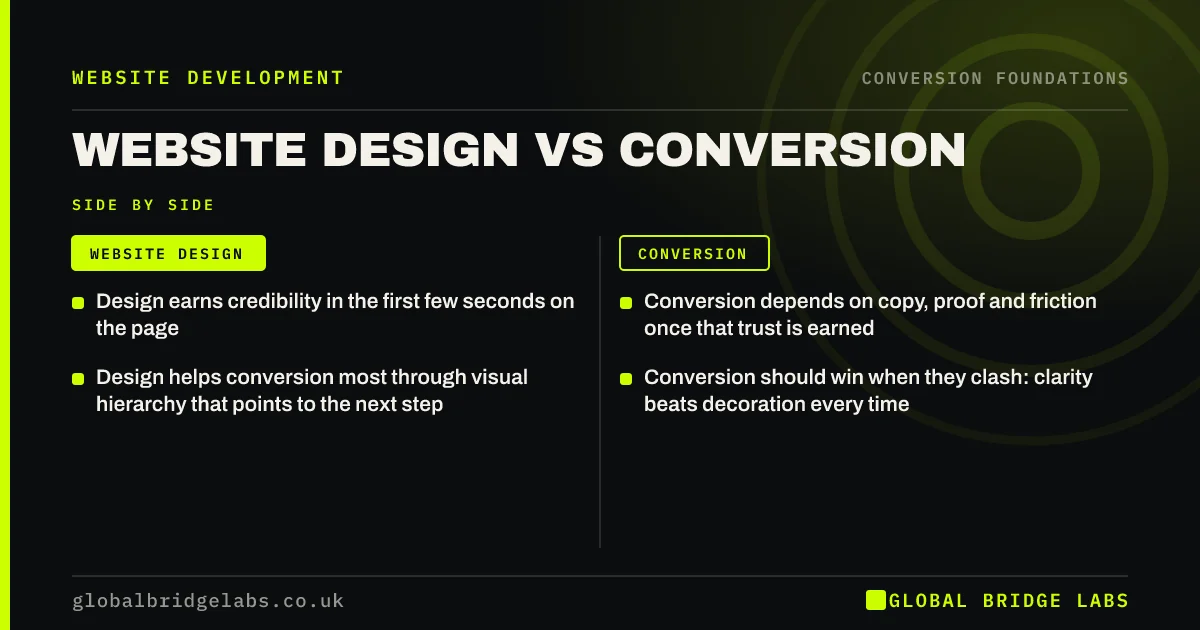
The comparison below uses the questions a UK buyer asks in the first minute on a site. A good website usually answers two or three. A high-converting website answers all of them on the page the visitor lands on, not three clicks away.
- Headline: a good site says who you are; a high-converting site says what you solve and for whom.
- Proof: a good site has a testimonials page; a high-converting site puts proof next to each claim.
- Price: a good site says 'contact us'; a high-converting site gives ranges or a starting point.
- Next step: a good site has a contact page; a high-converting site offers one obvious action per page.
- Mobile: a good site shrinks to fit; a high-converting site is designed for a thumb first.
- Measurement: a good site counts visits; a high-converting site tracks every form, call and chat.
What makes a website high-converting?
Five things make a website high-converting, and we score them with the GBL Conversion Gap Scorecard: Clarity, Proof, Friction, Action and Follow-up, each scored 0, 1 or 2 for a total out of 10. A score of 8 to 10 is a high-converting site. 5 to 7 is a good site that leaks enquiries. 4 or below is a brochure.
- Clarity: can a first-time visitor say what you do, for whom and where, within five seconds?
- Proof: is there specific evidence (numbers, named projects, reviews) next to each main claim?
- Friction: can a mobile visitor enquire in under a minute with no dead ends or slow pages?
- Action: does every key page have one obvious next step that fits the visitor's stage?
- Follow-up: is every enquiry tracked to its source and answered within one working hour?
How much more does a high-converting website earn?
A high-converting website earns more from the same traffic, which is why conversion is usually the cheapest growth lever a small business has. As a working range, UK lead generation sites convert around 2% to 5% of visits into enquiries. Many good-looking sites we audit sit near 1%.
Take a site with 2,000 visits a month, a 25% enquiry-to-sale rate and an average job worth £2,000. At 1% conversion it produces 20 enquiries, 5 sales and £10,000 a month. At 2.5% it produces 50 enquiries, about 12 sales and roughly £25,000. The traffic, the ad spend and the SEO work are identical. Only the website changed.
Want the same sum run on your own traffic and job values? Message us on WhatsApp for a costed view.
Chat on WhatsApp →What does it cost to close the gap?
Closing the gap usually costs far less than a new website. Indicative UK market ranges are £500 to £3,000 for focused conversion work on existing pages, £3,000 to £12,000 for a redesign of structure and key templates, and £5,000 to £20,000 or more for a full rebuild. Most sites scoring 5 to 7 on the scorecard need the first, not the third.
The order matters more than the budget. Fix tracking first so you can see the effect, then clarity on the top five landing pages, then proof, then friction on mobile. A rebuild is only justified when the platform itself blocks those fixes.
When is a good website good enough?
A good website is good enough when the website is not where buyers decide. If nearly all your work comes from referrals who phone you directly, or from a framework contract, the site only needs to confirm you exist and look credible. Spending on conversion there has little to convert.
It is also good enough when the business cannot handle more enquiries. Doubling enquiries into a team that already takes three days to reply lowers quality and wastes leads. Fix response capacity first, then turn up the website.
- Fewer than 300 visits a month: fix visibility before chasing conversion rate.
- Fully booked for months: prioritise lead quality and pricing guidance, not volume.
- Referral-only business: aim for credibility and a working contact route.
- No one answers enquiries within a day: fix follow-up before adding traffic.
What does this look like in practice?
A UK building services firm with 18 staff had a site that won a local design award. It was fast, attractive and well written, and it produced about eight enquiries a month from 1,900 visits. The homepage opened with a full-screen video and the words 'Building excellence since 1998'. Prices, service areas and project timescales were not mentioned anywhere.
We kept the design and changed what it said: a headline naming the services and the county, a project gallery with typical cost ranges, a two-field quote form on every service page, and tracking on calls and WhatsApp. Across GBL website clients we have seen a 2.4x enquiry rate from changes like these, and the gains came from content, proof and tracking decisions rather than from a new look.
Which conversion guide do you need next?
This guide is the hub of a 60-article series from Global Bridge Labs (GBL) on turning a good website into a high-converting one. Start with the question that matches your situation today.
- Your site looks great but enquiries are low: start with why looks do not sell.
- You have traffic but no sales: find where the visits leak.
- You want a number, not an opinion: score your site and run a conversion audit.
- You want to fix the words: start with objections, proof and specific claims.
- You want to measure properly: work out what an enquiry is worth and your cost per enquiry.
- You want a plan: follow the 90-day plan and the checklist.
- Beautiful website but no enquiries? Why looks do not sell
- Website traffic but no sales? Find where it leaks
- Run a website conversion audit in one afternoon
- Answer buyer objections on your website before they ask
- Where to place social proof so it lifts enquiries
- Why specific claims convert better than adjectives
- Design the path from first visit to enquiry
- Work out what a website enquiry is worth
- Cost per enquiry: what your website leads really cost
- A 90-day plan to turn a good website into a converting one
- Website conversion myths that waste budget
- Brochure website vs lead generation website
Your high-converting website checklist
- Rewrite the top five landing page headlines to say what you do, for whom and where.
- Put one piece of specific proof next to every main claim.
- Give a price range or starting point on every service page.
- Offer one obvious next step per page, repeated after each major section.
- Test the enquiry route on a phone and cut anything that slows it down.
- Track forms, calls, WhatsApp and bookings as key events.
- Reply to every enquiry within one working hour.
- Score the site on the GBL Conversion Gap Scorecard every quarter.
Next step
Stop judging your website by whether people say it looks nice. Judge it by how many of the right visitors take the next step, and by how quickly you can see why the rest did not. That is the difference between a good website and one that earns its keep.
Message us on WhatsApp and we will score your site on the GBL Conversion Gap Scorecard and send back the three fixes worth making first.
Chat on WhatsApp →Sources and further reading
- How long do users stay on web pages? · Nielsen Norman Group
- Scrolling and attention · Nielsen Norman Group
- About key events · Google Analytics Help
- Creating helpful, reliable, people-first content · Google Search Central
- Vodafone: a 31% improvement in LCP increased sales by 8% · web.dev
Frequently asked questions
What is the difference between a good website and a high-converting website?
A good website looks professional, works and describes the business accurately. A high-converting website is built around the buyer's next decision, so it turns a larger share of the right visitors into enquiries or sales. The difference usually sits in clarity, proof, friction, calls to action and follow-up, not in the visual design.
Why does my website look good but not convert?
Because looking good only answers whether you seem credible. Visitors also need to know what you do, whether it suits them, roughly what it costs, why you rather than a competitor, and what happens next. If those answers are missing or buried, visitors leave within seconds regardless of how polished the design is.
What conversion rate should a small business website have?
As a working range, UK lead generation sites convert around 2% to 5% of visits into enquiries, with urgent local services often higher and B2B services lower. Your own trend matters more than any average, so track every enquiry route and compare each quarter with the one before.
Do I need a new website to improve conversions?
Usually not. Most of the gap between a good site and a high-converting one closes with clearer headlines, proof next to claims, pricing guidance, shorter forms and proper tracking. A redesign or rebuild is only worth it when the platform or structure stops you making those changes.
How long does it take to see a conversion improvement?
Clear changes to headlines, proof and forms often show in the numbers within 4 to 8 weeks, depending on traffic. Low-traffic sites need longer to separate a real change from normal variation. Measure qualified enquiries per month against the same period before the change, not just the raw conversion rate.
Written by

Global Bridge Labs (GBL) is a UK–Sri Lanka partner for social media, websites and BPO. Everything here comes from client delivery, not theory.