On this page
- 01Key takeaways
- 02Why do section headings matter so much?
- 03What makes a good homepage section heading?
- 04Should headings be questions or statements?
- 05How do headings help search and accessibility?
- 06What mistakes should you avoid?
- 07When is a plain label fine?
- 08What does this look like in practice?
- 09Homepage headings checklist
- 10Next step
- 11Sources and further reading
- 12Frequently asked questions
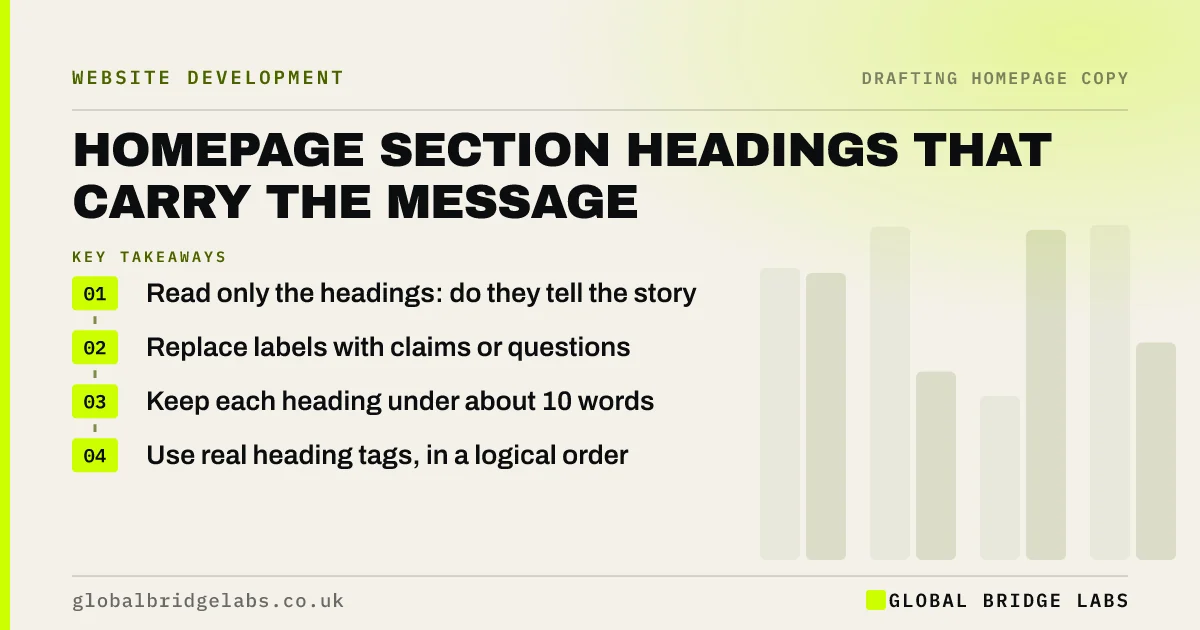
Key takeaways
Homepage section headings should tell your story on their own, so a visitor who only scans still understands the offer. Replace labels such as 'Our Services' and 'About Us' with claims or questions like 'Three ways we cut your admin'. Good section headings do the persuading for the many readers who skip body text.
- Read only the headings: do they tell the story?
- Replace labels with claims or questions.
- Keep each heading under about 10 words.
- Use real heading tags, in a logical order.
Want your homepage headings rewritten? Message us on WhatsApp.
Chat on WhatsApp →Why do section headings matter so much?
Section headings matter because scanning is the default on the web. Nielsen Norman Group's reading research shows users pick out headings and first words rather than reading every line. On a homepage, headings carry the argument for those people. Generic labels waste the most-read words on the page.
What makes a good homepage section heading?
A good heading states what the section means for the reader. It should make a claim, answer a question or name a benefit. Compare the pairs below. The second version of each tells a scanning visitor something useful, and it would still make sense if it were the only line they read.
- 'Our Services' becomes 'What we take off your plate'.
- 'About Us' becomes 'A Leeds firm, run by two engineers'.
- 'Testimonials' becomes 'What 200 local homeowners say'.
- 'Process' becomes 'From first call to finished job in three steps'.
Should headings be questions or statements?
Use statements for claims and questions when the visitor is actually asking one. 'How much does it cost?' works well near pricing, because it matches a thought already in the buyer's mind. Mixing the two is fine. Too many questions can sound like a quiz, so use them where they match real doubts.
How do headings help search and accessibility?
Use real heading tags in a logical order, with one H1 and H2s for sections, rather than bold text. Screen reader users often navigate by headings, and search engines use them to understand a page's structure. WCAG 2.2 expects headings to describe the topic or purpose of what follows.
What mistakes should you avoid?
Avoid clever puns that need context, one-word labels, all-capitals text and headings that promise more than the section delivers. Avoid repeating the same sentence structure in every section, because it becomes a drone. Do not choose heading sizes for looks alone, since the tag and the visual size should broadly agree.
When is a plain label fine?
Plain labels are fine for functional sections people look for, such as 'Contact', 'Prices' or 'Opening hours'. In those places, familiar wording helps visitors find what they want. Reserve descriptive headings for sections that must persuade, and keep labels for sections that only need to be found.
What does this look like in practice?
A pattern worth testing on your own page: copy only the headings into a blank document. Most homepages read as Welcome, Services, About, Testimonials, Contact, which could be anyone. Rewriting that list until it makes a case usually improves the whole page, because the body text then has something to support.
Homepage headings checklist
- Copy your headings into a blank document.
- Check that they tell a story alone.
- Replace labels with claims.
- Keep each under about 10 words.
- Use one H1 and logical H2s.
- Keep plain labels for functional sections.
Next step
Do the blank document test on your homepage now. If the headings could belong to any company, rewrite them before you touch anything else.
Paste your headings into WhatsApp and we will tell you what we would change.
Chat on WhatsApp →Sources and further reading
- F-shaped pattern of reading: misunderstood, but still relevant · Nielsen Norman Group
- Understanding WCAG 2.2 success criterion 2.4.6: Headings and Labels · W3C
- How users read on the web · Nielsen Norman Group
Frequently asked questions
What makes a good website heading?
It tells the reader what the section offers, in plain language, and it makes sense on its own. Good headings make a claim, answer a question or name a benefit. They are short, specific and written for someone who is scanning the page.
How long should a section heading be?
Aim for under about 10 words, so that it fits comfortably on a phone and can be taken in at a glance. A longer heading is fine if it is clearer, because clarity matters more than any word count.
Do headings help SEO?
Yes, they help search engines understand the structure and topics of your page, and they help users. Use real heading tags in a sensible order and write them for people. Stuffing them with keywords does not help and reads badly.
Written by

Global Bridge Labs (GBL) is a UK–Sri Lanka partner for social media, websites and BPO. Everything here comes from client delivery, not theory.