On this page
- 01Key takeaways
- 02Why add an industries section?
- 03Which sectors should you include?
- 04How should you word each tile?
- 05Where should each tile link?
- 06When should you avoid this section?
- 07What does this look like in practice?
- 08Homepage industries section checklist
- 09Next step
- 10Sources and further reading
- 11Frequently asked questions
Key takeaways
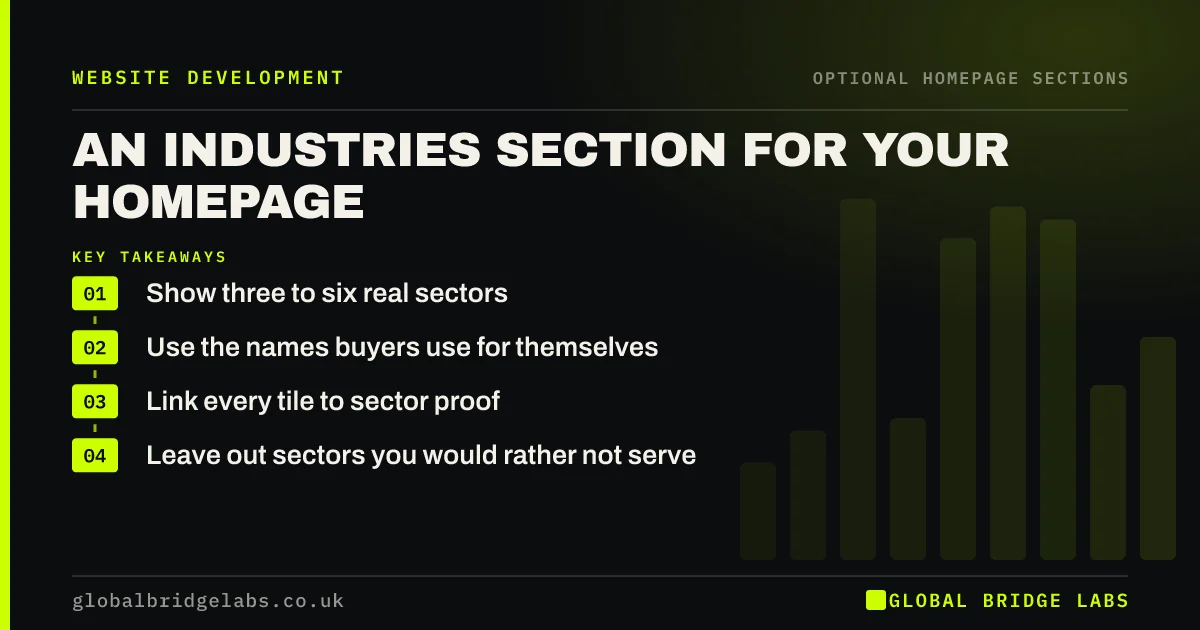
An industries section on a homepage lets B2B visitors find their sector and feel understood. Show three to six sectors you truly serve, using names buyers use for themselves, and link each to a page with relevant proof. A list of 20 industries says that you specialise in nothing and proves very little.
- Show three to six real sectors.
- Use the names buyers use for themselves.
- Link every tile to sector proof.
- Leave out sectors you would rather not serve.
Want help choosing your sectors? Message us on WhatsApp.
Chat on WhatsApp →Why add an industries section?
It speeds up recognition. A logistics manager scanning your page wants to know if you understand logistics. A tile with that name gives a quick answer, and it provides a route to relevant proof. It helps most for B2B services used across several sectors, where the headline cannot name them all.
Which sectors should you include?
Include sectors where you have real clients and want more. Rank them by margin and by the strength of your proof. Three to six is enough, as a Global Bridge Labs (GBL) rule of thumb. Adding a sector because you once did a job there dilutes the list, and it attracts enquiries that you may not want.
How should you word each tile?
Use the words buyers use about themselves, such as 'housing associations' rather than 'social housing sector stakeholders'. Add one line naming a sector-specific problem you solve. Keep tiles consistent in shape and length, because they must be scanned quickly, and each must look clearly clickable.
Where should each tile link?
Each tile should link to a page with sector proof: a case study, the sector's specific rules or a tailored version of your offer. A tile that goes to a generic services page breaks the promise. If you have no sector page, begin with a case study, or remove the link.
When should you avoid this section?
Avoid it if you serve one sector, because your headline should say that already. Avoid it too for consumer businesses, or when sector does not change what you do. If you have no sector proof yet, a line on who you work with, in your about section, is more honest.
What does this look like in practice?
A pattern we see: an 'industries we serve' grid listing fifteen sectors with stock images, each leading to the same page. Cutting it to the three sectors with real cases and linking each to one worked example produces a shorter, far more convincing section.
Homepage industries section checklist
- List sectors where you have real clients.
- Rank them by margin and proof.
- Keep three to six.
- Use the buyer's own sector name.
- Link each tile to relevant proof.
- Remove tiles with nothing behind them.
Next step
List your ten best clients by sector. The pattern in that list usually tells you which three tiles deserve a place on your homepage.
Message us on WhatsApp for a B2B homepage review, or book a 30-minute consultation.
Chat on WhatsApp →Sources and further reading
- Information scent: how users decide where to go next · Nielsen Norman Group
- Mental models and user experience design · Nielsen Norman Group
- Hick's Law: designing long menu lists · Nielsen Norman Group
Frequently asked questions
Should I list the industries I serve on my homepage?
Yes, if you are a B2B firm serving a few distinct sectors. Keep it to three to six that you can prove, and link each one to relevant evidence. If you serve one sector, say so in your headline instead.
How many industries should I show on my website?
Three to six usually works. Listing many more suggests you lack a real specialism and dilutes your proof. You can still accept work from elsewhere without promoting it on your homepage.
Do I need a separate page for each industry?
It helps if the needs differ, or if you want to rank for sector searches. Start with the sector that brings the most value, and write something truly specific. Near-identical pages for each sector add little.
Written by

Global Bridge Labs (GBL) is a UK–Sri Lanka partner for social media, websites and BPO. Everything here comes from client delivery, not theory.