On this page
- 01Key takeaways
- 02Why review a homepage at 90 days?
- 03What should you compare?
- 04How do you judge enquiry quality?
- 05What should the meeting decide?
- 06What if the results are flat?
- 07When should you review sooner?
- 08What does this look like in practice?
- 09Homepage 90-day review checklist
- 10Next step
- 11Sources and further reading
- 12Frequently asked questions
Key takeaways
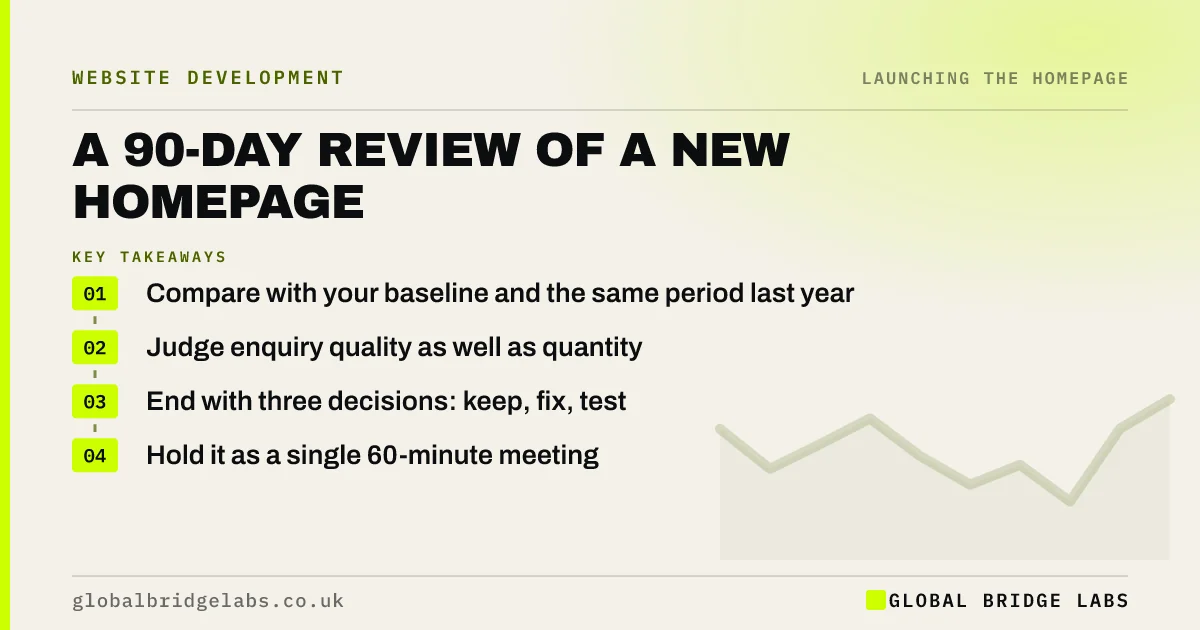
A homepage 90 day review checks whether the new page did what the brief set out to do. Compare enquiries, enquiry quality, conversion and search traffic with your baseline, allow for seasonality and decide what to keep, fix or test next. By then you have enough evidence to judge the page fairly.
- Compare with your baseline and the same period last year.
- Judge enquiry quality as well as quantity.
- End with three decisions: keep, fix, test.
- Hold it as a single 60-minute meeting.
Want a 90-day review of your homepage? Message us on WhatsApp.
Chat on WhatsApp →Why review a homepage at 90 days?
Ninety days usually gives you enough traffic and enquiries to see a pattern, particularly on low-traffic sites, while the project is still fresh. Search has had time to settle. Waiting longer tends to mean the review never happens, and the page quietly drifts away from the brief it was built to meet.
What should you compare?
Compare the same measures, for the same periods, against your baseline: enquiries, conversion, source mix, phone calls, enquiry quality, sales, mobile performance and search queries. Compare with the same months last year too if your trade is seasonal. Raw visit numbers matter least.
- Enquiries, by source.
- Enquiry-to-sale rate.
- Next-step click rate on the homepage.
- Mobile vs desktop conversion.
- Branded and non-branded search clicks.
- Mobile Largest Contentful Paint.
How do you judge enquiry quality?
Ask whoever handles enquiries to rate them: fit, budget and how ready the person was. Fewer but better enquiries can be a success. Check the sale value too. A homepage that filters out poor-fit leads saves your team time, which a simple count of enquiries would miss.
What should the meeting decide?
It should end with three lists: what to keep, what to fix now and what to test next. Assign a name and a date to each. Compare the outcome with the brief's goal. Then use the Global Bridge Labs (GBL) Homepage Ladder if results are weak, because it will show which rung needs the attention.
What if the results are flat?
Check external factors first: traffic changes, seasonality, staffing and price rises. Then look at the funnel. If visitors act but sales do not rise, the issue may be in the follow-up. A homepage cannot fix a slow reply, so do not blame the page before you have checked what happens after the enquiry.
When should you review sooner?
Review sooner if enquiries fall sharply, if the page was launched before a major peak or if high-traffic paid campaigns are running to it. On very low traffic, you may need six months for a fair view. Fit the timing to your volume, not to the calendar.
What does this look like in practice?
A pattern we see at this stage: the team is happy with the new page and cannot say why. Bringing the original brief to the meeting usually focuses the discussion, because it turns 'we like it' into 'did it do the job we set for it?'.
Homepage 90-day review checklist
- Bring the original brief.
- Compare against your baseline.
- Allow for seasonality.
- Review enquiry quality with sales.
- Check mobile performance.
- Decide what to keep, fix and test.
- Give each action a name and date.
Next step
Book the 90-day meeting today, however far off it is. If it is in the diary, it will happen. If not, it almost certainly will not.
Message us on WhatsApp for a homepage review, or book a 30-minute consultation.
Chat on WhatsApp →Sources and further reading
- Get started with attribution · Google Analytics Help
- Performance report (Search results) · Search Console Help
- Web Vitals: essential metrics for a healthy site · web.dev (Google)
Frequently asked questions
How long after launch should I review my website?
A review at about 90 days works well for most SMEs, as it allows enough time for meaningful data. Check for faults much earlier, in the first week. Very low-traffic sites may need longer to show a reliable picture.
What should I measure after a website redesign?
Enquiries, enquiry quality, sales, conversion rate, traffic sources, mobile performance and search queries. Compare them with your baseline and with last year's figures if you are seasonal. Visits alone tell you very little.
What if my new homepage is not performing?
Check traffic, season and follow-up first, then use a structured diagnosis to find the weakest stage. Fix one thing at a time. A flat result rarely needs another full redesign, and it often comes down to the message.
Written by

Global Bridge Labs (GBL) is a UK–Sri Lanka partner for social media, websites and BPO. Everything here comes from client delivery, not theory.