On this page
- 01Key takeaways
- 02How many sections should a homepage have?
- 03How do you decide what stays?
- 04What happens when there are too many sections?
- 05Can a homepage have too few sections?
- 06When should a section become its own page?
- 07What does this look like in practice?
- 08Homepage section count checklist
- 09Next step
- 10Sources and further reading
- 11Frequently asked questions
Key takeaways
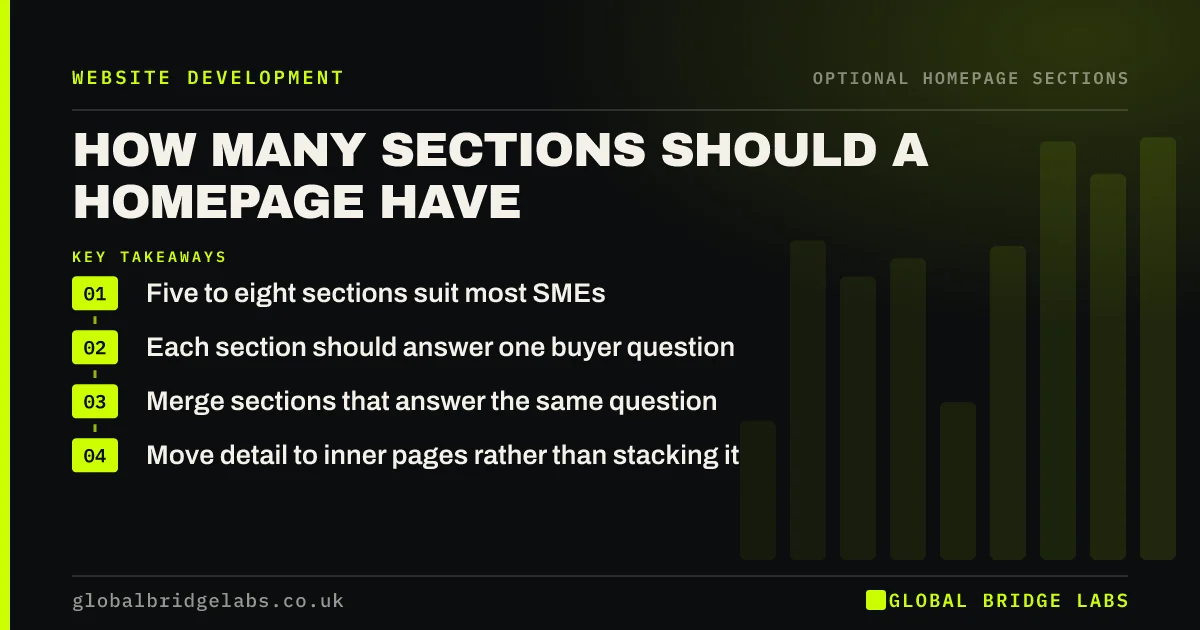
How many sections a homepage needs depends on what buyers must know, but most SMEs land on five to eight. Each section should answer one question. If two answer the same one, merge them. If a section answers nobody's question, remove it. The count is a result of your plan, never a target.
- Five to eight sections suit most SMEs.
- Each section should answer one buyer question.
- Merge sections that answer the same question.
- Move detail to inner pages rather than stacking it.
Unsure which sections to keep? Message us on WhatsApp.
Chat on WhatsApp →How many sections should a homepage have?
Most small business homepages work with five to eight sections, as a Global Bridge Labs (GBL) rule of thumb: hero, proof, services, how it works, further proof, FAQ and closing action. Simple local services may need four. Complex B2B firms may need more. What matters is that each one earns its place on the page.
How do you decide what stays?
List the questions a buyer needs answered before contacting you, then match one section to each. Remove any section that exists because a template included it or because someone internally asked for it. If a section was added for an internal reason, ask what a buyer would lose without it.
What happens when there are too many sections?
Attention falls as the page goes on. Nielsen Norman Group found 74% of viewing time falls within the first two screenfuls, so stacking sections mostly pushes useful content out of sight. Long pages also load more slowly on phones, and visitors find it harder to see what matters most.
Can a homepage have too few sections?
Yes. A hero and a contact form may be too thin for anyone who needs reassurance. If buyers are spending real money, or the service is unfamiliar, they need proof and process before they will act. A short page works when the reader already knows and trusts what you offer.
When should a section become its own page?
Move a section to its own page when it needs more than a few lines to do its job, or when it attracts a different audience. Careers, detailed pricing and full case studies usually fit this rule. Keep a short summary and a link on the homepage, so that visitors know where to find it.
What does this look like in practice?
A pattern we see: a homepage grows to 14 sections over several years, as each new idea was added and nothing was ever removed. Mapping every section to a buyer question usually shows several doing the same job, and merging them often makes the page feel like it has been redesigned.
Homepage section count checklist
- List the buyer's questions.
- Match one section to each question.
- Merge duplicates.
- Remove internal-only sections.
- Link out to detail.
- Check the page on a phone.
Next step
Write the question each section answers beside it. Any section where you cannot think of one is a candidate for removal.
Message us on WhatsApp for a section-by-section review, with no pitch.
Chat on WhatsApp →Sources and further reading
- Scrolling and attention · Nielsen Norman Group
- Progressive disclosure · Nielsen Norman Group
- Minimize cognitive load to maximize usability · Nielsen Norman Group
Frequently asked questions
How many sections should a website homepage have?
Five to eight suits most SMEs, based on a section per buyer question. There is no fixed rule. Simple offers need fewer, and complex ones need more. Remove anything that does not help the visitor to decide.
What are the main sections of a homepage?
Most homepages have a hero, a proof strip, services, how it works, more proof, FAQs and a closing call to action. The order follows the questions buyers ask. Your own research should decide which of these you keep.
Is it better to have a long or short homepage?
It depends on the decision. Considered purchases benefit from more proof and explanation, while simple, known purchases work with less. Length matters less than whether each part answers something the buyer needs to know.
Written by

Global Bridge Labs (GBL) is a UK–Sri Lanka partner for social media, websites and BPO. Everything here comes from client delivery, not theory.