On this page
- 01Key takeaways
- 02How do you use the homepage build checklist?
- 03Stage 1: is the brief clear?
- 04Stage 2: do you know the buyer?
- 05Stage 3: does the message work?
- 06Stage 4: does the layout serve the buyer?
- 07Stage 5: is the build sound?
- 08Stage 6: are you ready to launch?
- 09What does your score mean?
- 10What does this look like in practice?
- 11Before you run the checklist
- 12Next step
- 13Sources and further reading
- 14Frequently asked questions
Key takeaways
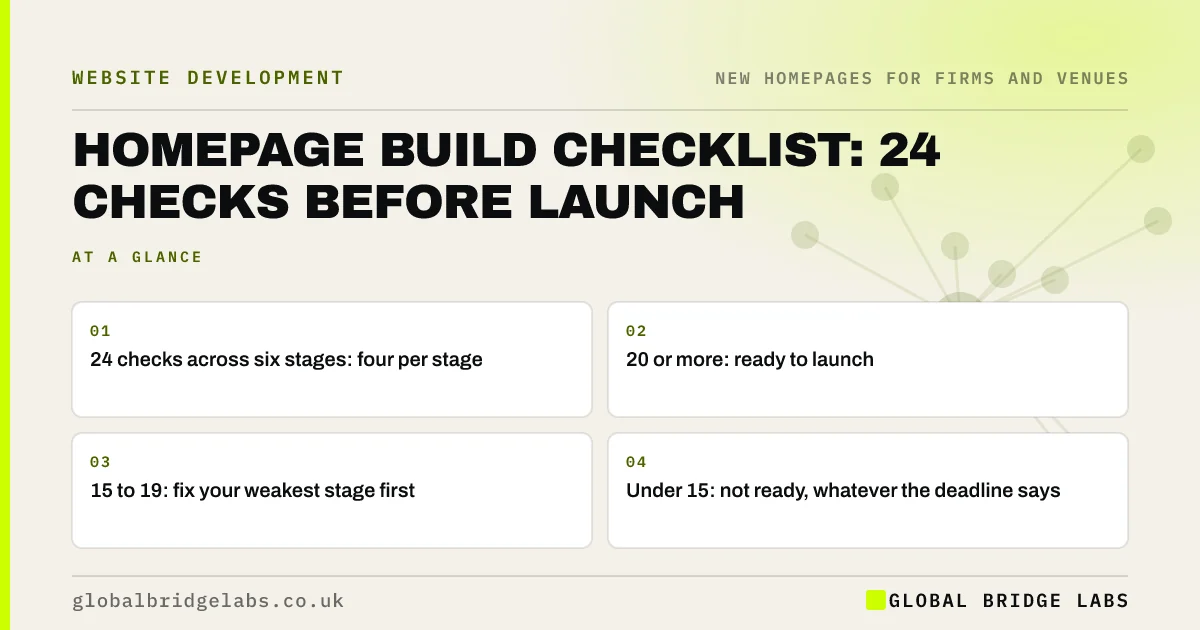
This homepage build checklist has 24 yes or no checks, four for each stage of the Global Bridge Labs (GBL) Homepage Blueprint: brief, buyer, message, layout, build and launch. Score your page before go-live. With 20 or more it is ready, with 15 to 19 fix your weakest stage and under 15 it is not ready to launch.
- 24 checks across six stages: four per stage.
- 20 or more: ready to launch.
- 15 to 19: fix your weakest stage first.
- Under 15: not ready, whatever the deadline says.
Want this scored for your page? Message us on WhatsApp.
Chat on WhatsApp →How do you use the homepage build checklist?
Score one point for each check you can answer yes to with evidence. Answer honestly, ideally with a colleague, on the staging version of the page. A check counts only if it is complete and not merely planned. Then add up your score and look at which stage scored lowest.
Stage 1: is the brief clear?
A clear brief means anyone on the project can state what the page is for. If two people answer differently, the rest of the score matters less, because the page has no agreed job. These four checks take minutes, and they prevent most of the arguments that delay launches.
- One goal is written down.
- One primary action is agreed.
- One first reader is named.
- One person signs off.
Stage 2: do you know the buyer?
You know the buyer when you hold their words, not just your assumptions about them. These checks confirm that research happened, even if it was brief. Without this, the page will describe you as you see yourself, which is the commonest failing of small business homepages.
- Recent enquiries have been read.
- At least five customers were asked.
- Their exact phrases are recorded.
- Main fears and objections are listed.
Stage 3: does the message work?
The message works if a stranger can tell what you do, for whom and why to trust you in a few seconds. Test this with real people rather than the team. Copy should be finished and approved at this stage, with no placeholder text remaining in any section of the page.
- The headline says what you do and who for.
- A stranger passes a five-second test.
- Claims are specific and provable.
- All copy is final and approved.
Stage 4: does the layout serve the buyer?
The layout serves the buyer if its section order follows their questions, and the main action stays easy to find. Check it on a phone. As a GBL rule of thumb, repeat the action about every two screens. Anything without a buyer's question behind it should have gone by now.
- Sections follow the buyer's questions.
- Proof appears within the first two screens.
- The action repeats down the page.
- No section lacks a clear job.
Stage 5: is the build sound?
The build is sound when the page meets Core Web Vitals on a real phone, works with a keyboard and has correct technical signals. Google's thresholds are LCP within 2.5 seconds, INP within 200 milliseconds and CLS below 0.1. Lab tests are a useful start, and field data confirms it later.
- Mobile speed meets your target.
- Text contrast and tap sizes pass.
- One clear H1 and logical headings.
- Someone in-house can edit the words.
Stage 6: are you ready to launch?
You are ready when an enquiry can travel from the page to a person who replies, when you can measure that and when you can undo the launch. Do not count any of these as done until each has been tested. These four checks protect the money already spent on the project.
- A test enquiry reached a named person.
- Key events are recording correctly.
- A tested backup exists.
- Search blocks are removed.
What does your score mean?
With 20 or more, launch. With 15 to 19, fix the weakest stage first, as a low score in one stage matters more than the total. Under 15, you are not ready. A deadline does not change the score. These bands are GBL rules of thumb, not an industry standard.
After launch, switch to the Homepage Conversion Checklist, which diagnoses a live page. Across our client work, conversion-first rebuilds have delivered a 2.4× enquiry rate, which is why we start with the checks that come before any design.
What does this look like in practice?
A pattern we see when teams score honestly: the build stage scores well, and the buyer stage scores one or two, because design was easier to start than research. That imbalance explains many well-made homepages that fail to convert, and it is far cheaper to find it before launch than after.
Before you run the checklist
- Print the 24 checks.
- Score on the staging page.
- Count only finished work.
- Score with a colleague.
- Find your weakest stage.
- Fix that stage before launch.
Next step
Score your homepage today, even if it is half-built. The result will tell you what to do next, which is worth more than another design round.
Message us on WhatsApp and we will send you the checklist and score your page with you.
Chat on WhatsApp →Sources and further reading
- Web Vitals: essential metrics for a healthy site · web.dev (Google)
- Understanding Core Web Vitals and Google search results · Google Search Central
- Understanding SC 1.4.3: Contrast (Minimum) · W3C
- About key events · Google Analytics Help
Frequently asked questions
What should I check before launching a homepage?
Check that the goal is clear, the words reflect buyer research, the layout follows buyer questions, speed and accessibility pass on a phone, an enquiry reaches a real person, tracking works and you have a tested backup.
What is a good score on the homepage build checklist?
20 or more out of 24 means that you are ready to launch. A score of 15 to 19 means fixing your weakest stage first. Under 15 means the page is not ready. These bands are GBL rules of thumb.
What is the difference between this and the homepage conversion checklist?
This checklist is used before launch, to confirm that a new page has been built properly. The conversion checklist is used on a live page, to diagnose why it is not turning visitors into enquiries.
Written by

Global Bridge Labs (GBL) is a UK–Sri Lanka partner for social media, websites and BPO. Everything here comes from client delivery, not theory.