On this page
- 01Key takeaways
- 02Why research buyers before drafting a homepage?
- 03Where can a small business find this evidence?
- 04What should you ask in a customer conversation?
- 05How many customers do you need to speak to?
- 06How do you turn research into homepage copy?
- 07When does this research go wrong?
- 08What does this look like in practice?
- 09Homepage buyer research checklist
- 10Next step
- 11Sources and further reading
- 12Frequently asked questions
Key takeaways
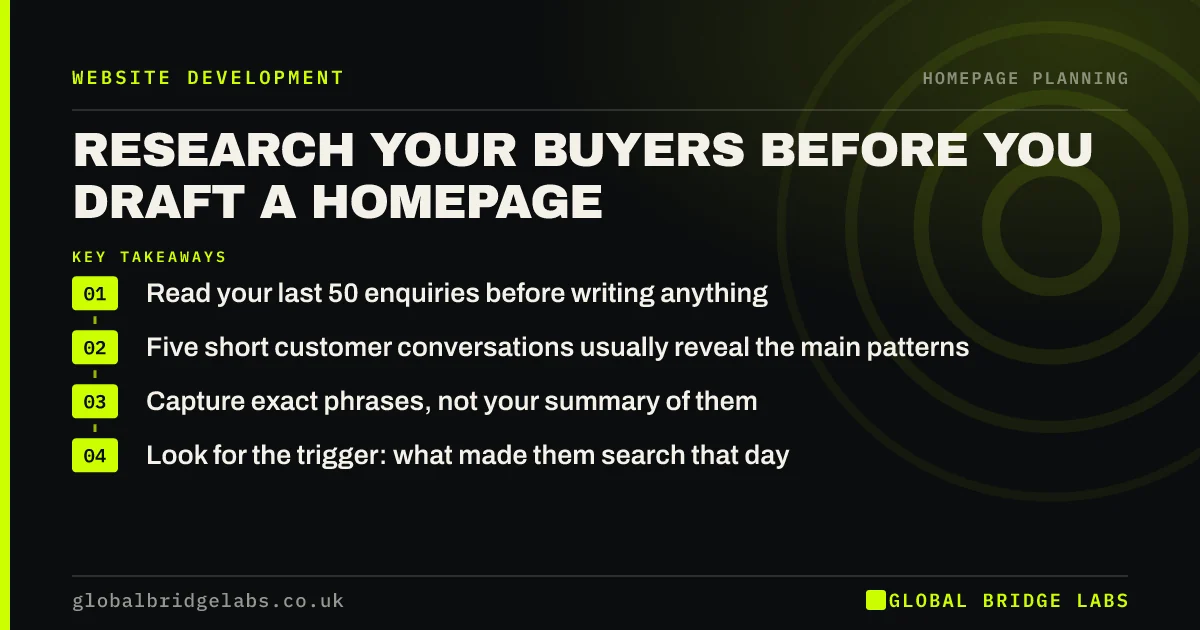
Homepage buyer research means collecting the words, triggers and fears of real customers before you write. An SME can do it in about half a day using enquiry emails, reviews, sales call notes and five short conversations, without a research budget. The output is a page of phrases the homepage can use directly.
- Read your last 50 enquiries before writing anything.
- Five short customer conversations usually reveal the main patterns.
- Capture exact phrases, not your summary of them.
- Look for the trigger: what made them search that day?
Want help turning customer words into homepage copy? Message us on WhatsApp.
Chat on WhatsApp →Why research buyers before drafting a homepage?
Owners describe the business from the inside, in service names and internal language, while buyers describe a problem. Research closes that gap. A homepage written in customers' own words is easier to recognise and scan, and it reads as though the business understands them before anyone has spoken.
Where can a small business find this evidence?
Most small businesses already hold what they need. Enquiry emails and web forms show how people describe the problem. Reviews show what they valued. Sales calls reveal objections. Search Console shows the queries that reach you. Competitors' reviews show what buyers disliked elsewhere, which is often the best material of all.
- The last 50 enquiry emails or form messages.
- Your reviews, plus competitors' three-star reviews.
- Notes from won and lost sales conversations.
- Search Console queries for your existing site.
- Common questions your front-line staff receive.
What should you ask in a customer conversation?
Ask recent customers about the moment they decided to look for help, what else they considered, what nearly stopped them and what they would say to a friend. Keep to 15 minutes. Ask about what happened rather than what they would prefer, because memories of real decisions are more reliable than opinions.
How many customers do you need to speak to?
For homepage copy, about five recent customers usually show the main patterns. Nielsen Norman Group's usability work found five users reveal most problems, and the same logic of diminishing returns tends to apply to small qualitative samples. Stop when you start hearing the same phrases again.
How do you turn research into homepage copy?
Sort the phrases into four lists: the problem, the desired result, the fears and the reasons they chose you. The problem list feeds your headline and problem section. The fears feed proof and FAQs. Reasons for choosing you feed the benefits. Keep the customers' wording wherever it reads clearly.
When does this research go wrong?
It goes wrong when you only speak to your happiest customers, or when you ask leading questions. It also fails when one loud customer steers the page. Treat each comment as a clue, and look for patterns across sources. Never publish customer words as a quotation without permission.
What does this look like in practice?
A pattern we see: a firm describes its service as an integrated compliance solution, while its reviews repeatedly say the firm took the paperwork off their plate. The second phrase is plainer, more believable and already proven to be what buyers valued.
Homepage buyer research checklist
- Export your last 50 enquiries.
- Read reviews of yours and three competitors.
- Book five 15-minute customer calls.
- Record exact phrases in one document.
- Sort phrases into problem, result, fear and reason.
- Ask permission before quoting anyone.
Next step
Spend one hour reading enquiries today and write down every phrase a customer used to describe their problem. You will probably find your headline in that list.
Message us on WhatsApp for a review of your research, or book a 30-minute consultation.
Chat on WhatsApp →Sources and further reading
- Why you only need to test with 5 users · Nielsen Norman Group
- User research · GOV.UK Service Manual
- Google Search Console · Google
- Digital Markets, Competition and Consumers Act 2024, Schedule 20 (banned practices, including fake reviews) · legislation.gov.uk
Frequently asked questions
How do I research my customers for a homepage?
Read recent enquiries, reviews and sales notes, then speak to about five recent customers for 15 minutes each. Ask what triggered their search, what they compared and what nearly stopped them, and record their exact words.
What questions should I ask customers before writing website copy?
Ask what was happening when they started looking, what they tried first, what nearly put them off, why they chose you and how they would describe you to a friend. These questions draw out real decisions, not polite opinions.
Can I use customer reviews as homepage copy?
Yes, as source material for phrasing, and as quoted proof when the review is genuine and you have permission or it is published publicly. Never edit a review in a way that changes its meaning, because UK law bans misleading and fake reviews.
Written by

Global Bridge Labs (GBL) is a UK–Sri Lanka partner for social media, websites and BPO. Everything here comes from client delivery, not theory.