On this page
- 01Key takeaways
- 02Can a homepage work without reviews?
- 03What can replace reviews at the start?
- 04How do you get your first reviews quickly?
- 05What are the legal limits?
- 06When should the page change?
- 07What does this look like in practice?
- 08No-reviews homepage checklist
- 09Next step
- 10Sources and further reading
- 11Frequently asked questions
Key takeaways
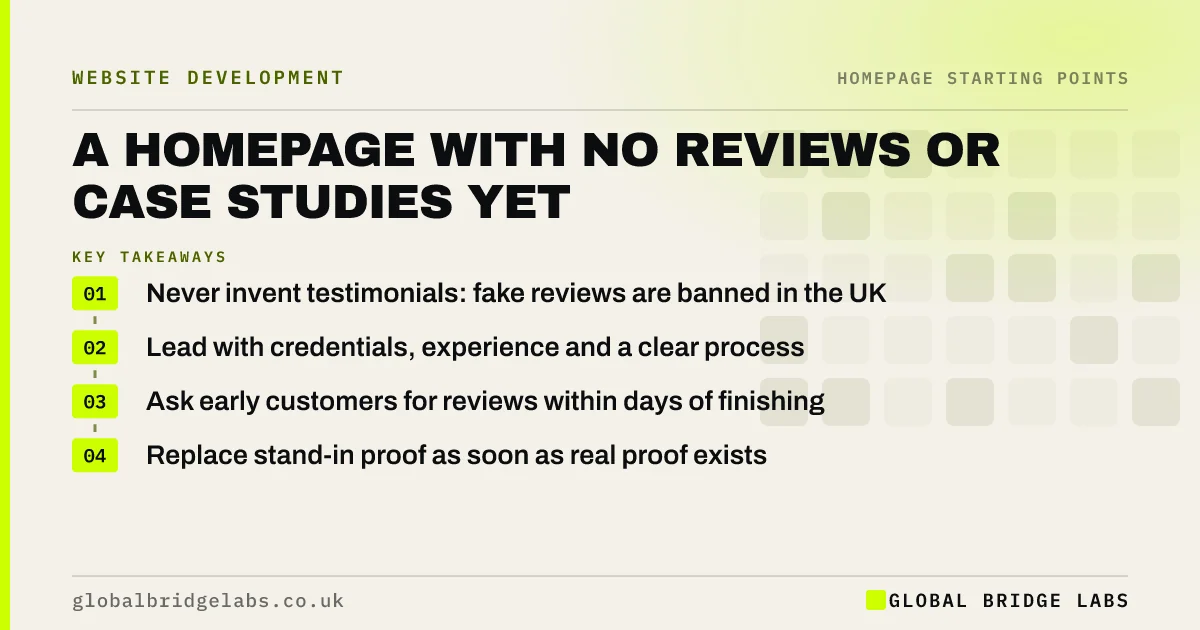
A homepage with no reviews can still build trust by showing what you can prove today: qualifications, experience, a clear process, specific examples and honest terms. Do not write fake testimonials, because UK law bans them. Instead, use the proof you have, then set up a simple way to collect genuine reviews quickly.
- Never invent testimonials: fake reviews are banned in the UK.
- Lead with credentials, experience and a clear process.
- Ask early customers for reviews within days of finishing.
- Replace stand-in proof as soon as real proof exists.
Short of proof? Message us on WhatsApp and we will find what you already have.
Chat on WhatsApp →Can a homepage work without reviews?
Yes, for a while. Reviews are strong proof, but they are not the only kind. A homepage without them can still work if it is specific about who you are, what you have done and how the work runs. Buyers are looking for reduced risk, and that can come from several sources.
What can replace reviews at the start?
Replace reviews with proof that is true right now: qualifications, trade body memberships, insurance, years of relevant experience, sample work, a named person and clear terms. Show work done in previous employment only if you have permission and describe it honestly, without implying that it was done by the new business.
- Named qualifications and memberships.
- Relevant experience, stated with care.
- Photos of real work or samples.
- A written process and clear response times.
- Honest terms for putting things right.
How do you get your first reviews quickly?
Ask every early customer directly, within a few days of finishing, and send a short link to your Google Business Profile. Make it easy, and ask for honest feedback. Do not offer payment for positive reviews. Five genuine reviews will change a new homepage far more than clever design can.
What are the legal limits?
The Digital Markets, Competition and Consumers Act 2024 bans fake reviews and the concealed incentivising of reviews, and the CMA can enforce this directly with fines. Quoting a friend as if they were a customer is a risk. So is rewriting a real comment until it no longer reflects what was said.
When should the page change?
Change the page as soon as you have three to five genuine reviews or one case you can describe. Move the proof higher, and reduce the stand-in material. Set a reminder to review it monthly at first, because a homepage for a new business should change as often as the evidence does.
What does this look like in practice?
A pattern worth avoiding: a young firm fills its testimonial slider with first-name quotes that all sound alike, and buyers can tell. Replacing them with one line on the founder's qualifications and a clear process is less impressive to look at, but far more believable.
No-reviews homepage checklist
- List every credential you can verify.
- Remove anything you cannot prove.
- Publish a clear process.
- Set up a Google Business Profile review link.
- Ask each early customer for feedback.
- Add genuine reviews as soon as they arrive.
Next step
Write down everything a nervous buyer could verify about you today. That list is your proof section, and it is probably longer than you expected.
Message us on WhatsApp and we will help you build a proof section from what you already hold.
Chat on WhatsApp →Sources and further reading
- Digital Markets, Competition and Consumers Act 2024, Schedule 20 (banned practices, including fake reviews) · legislation.gov.uk
- Publishing consumer reviews and complying with consumer protection law · Competition and Markets Authority
- Maps user-generated content policy: prohibited and restricted content · Google
Frequently asked questions
How do I get testimonials for a new business?
Ask early customers directly, soon after finishing the job, and make it easy with a short link. A personal request works best. Ask for honest feedback and do not pay for praise, because concealed incentives for reviews are banned.
Can I use reviews from my previous job?
Only with care. You should not present them as reviews of your new business. You could state your relevant experience factually, or ask a former client for a new reference if your employment terms allow it.
Should I show a testimonial section with only one review?
Yes, if it is genuine and specific. One real, detailed comment from a named customer is better than several vague ones. Show it near the point where it helps, and add more as they arrive.
Written by

Global Bridge Labs (GBL) is a UK–Sri Lanka partner for social media, websites and BPO. Everything here comes from client delivery, not theory.