On this page
- 01Key takeaways
- 02What should a consultant's homepage say first?
- 03How do you show credibility without big logos?
- 04Should the page be about you or your company?
- 05What is the right next step?
- 06How should you handle fees?
- 07When should you broaden the message?
- 08What does this look like in practice?
- 09Consultant homepage checklist
- 10Next step
- 11Sources and further reading
- 12Frequently asked questions
Key takeaways
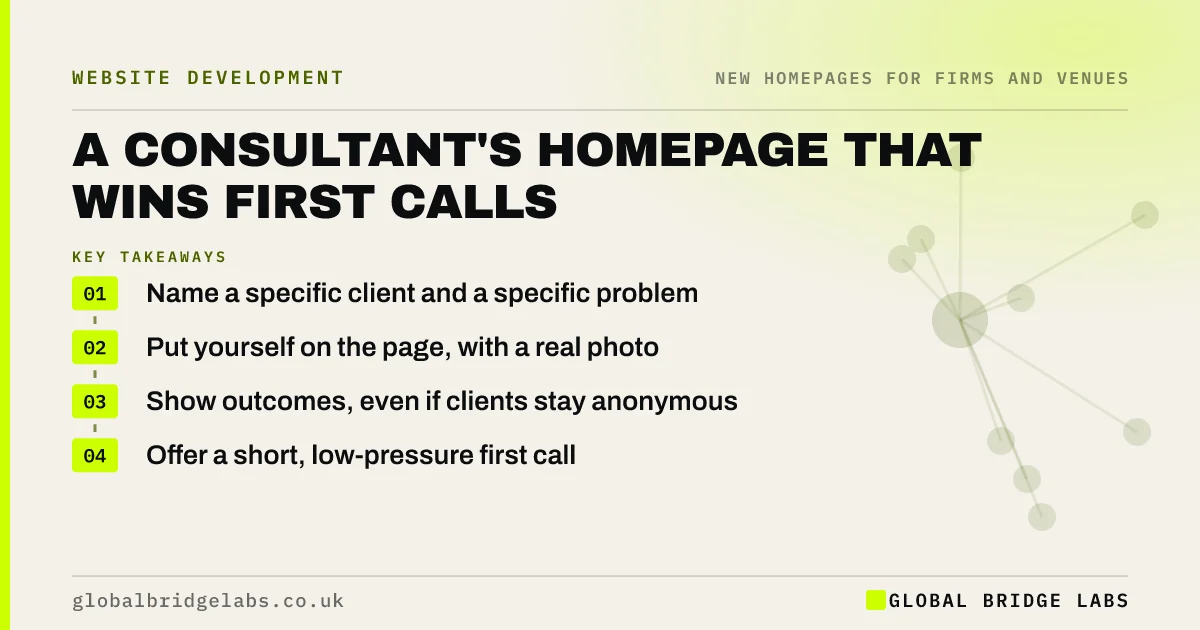
A consultant homepage sells judgement, so it must quickly show who you help, the problem you solve and why you can be trusted with it. Name a clear client type, give proof with real outcomes, show the person and offer a short first call. Vague phrases like 'strategic partner' tell a buyer nothing.
- Name a specific client and a specific problem.
- Put yourself on the page, with a real photo.
- Show outcomes, even if clients stay anonymous.
- Offer a short, low-pressure first call.
Are you a consultant? Message us on WhatsApp for a homepage review.
Chat on WhatsApp →What should a consultant's homepage say first?
It should say who you help with what. 'I help manufacturing SMEs cut late deliveries' is more useful than 'Realising potential through strategic insight'. Specificity is uncomfortable, because it excludes people, yet it is what makes you memorable and easy to refer. Generalists are hard to recommend.
How do you show credibility without big logos?
Use anonymised stories with a clear before and after: the type of company, the problem, what you did and what changed. Add your background, qualifications and any talks or articles. A clear description of how you think, shown in useful content, is often stronger than a long CV.
Should the page be about you or your company?
If clients are hiring you personally, say so, and put your name and face near the top. Writing 'we' for a one-person practice raises doubts when the client meets you. Associates can be mentioned honestly. In a consultancy, the person is the product, so the personal version usually wins.
What is the right next step?
A short first call, framed as useful in itself: '30 minutes to look at your problem, with no pitch'. Offer a booking link if you can. Add a softer step, such as a short guide, because consulting buyers often need months. Stay in front of them by making something worth saving.
How should you handle fees?
Explain how you charge, such as by project, retainer or day rate, even if you do not state a figure. An indicative starting point filters buyers well. Silence leaves people guessing, and some assume you are too expensive. Publishing how you work lets you discuss value, not hourly rates.
When should you broaden the message?
Broaden it only after the narrow version works and your referrals reach new sectors. Being specific on the homepage does not stop you from taking other work. A wider offer can sit on inner pages. Most consultants worry far too much about what they exclude, and too little about being forgettable.
What does this look like in practice?
A pattern we see with consultants: a homepage of abstract nouns and a stock skyline, from someone with twenty years of valuable experience. Rewriting it around one type of client and one painful problem usually makes it far easier for past clients to pass the name on.
Consultant homepage checklist
- Name the client and problem.
- Show your name and photo.
- Add anonymised outcome stories.
- Explain how you charge.
- Offer a short first call.
- Add something useful to save.
Next step
Ask a past client to describe what you do in one sentence. If their answer differs from your headline, use theirs.
Message us on WhatsApp for a consultant homepage review, or book a 30-minute consultation.
Chat on WhatsApp →Sources and further reading
- 'About Us' information on corporate websites · Nielsen Norman Group
- Trustworthiness in web design: 4 credibility factors · Nielsen Norman Group
- Plain language is for everyone, even experts · Nielsen Norman Group
Frequently asked questions
What should a consultant put on their homepage?
A clear statement of who you help and with what, evidence of results, your name and photo, how you work and a simple next step. Avoid abstract language, because buyers want to know whether you understand their specific problem.
How do consultants get clients from a website?
Mostly by confirming a recommendation and giving people something useful to remember you by. A specific message, proof and a short call do most of the work. Valuable articles can also bring in people searching for answers.
Should consultants publish their fees?
State at least how you charge, and ideally give a starting point or typical project range. This helps buyers qualify themselves. Bespoke fees are fine, but complete silence makes some good clients assume that you are out of reach.
Written by

Global Bridge Labs (GBL) is a UK–Sri Lanka partner for social media, websites and BPO. Everything here comes from client delivery, not theory.