On this page
- 01Key takeaways
- 02How do people read a homepage?
- 03What do visitors actually look at?
- 04How should homepage copy be written for scanners?
- 05What does the F-pattern mean for a homepage?
- 06When do visitors read more carefully?
- 07What does this look like in practice?
- 08Scannable homepage checklist
- 09Next step
- 10Sources and further reading
- 11Frequently asked questions
Key takeaways
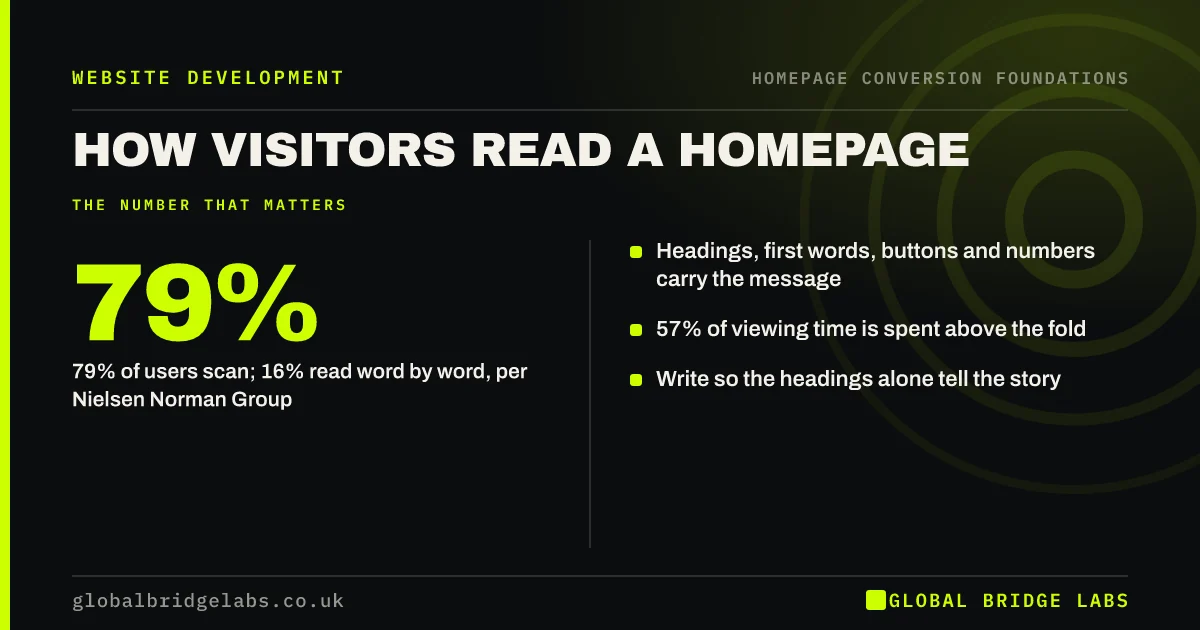
How people read a homepage is simple: they scan it rather than read it. In Nielsen Norman Group's research, 79% of users scanned new pages and only 16% read word by word. Visitors pick out headings, the first words of lines, buttons, numbers and images, so those are the places your message has to live.
- 79% of users scan; 16% read word by word, per Nielsen Norman Group.
- Headings, first words, buttons and numbers carry the message.
- 57% of viewing time is spent above the fold.
- Write so the headings alone tell the story.
Want your homepage read the way visitors scan it? Message us on WhatsApp.
Chat on WhatsApp →How do people read a homepage?
People scan a homepage in short jumps: the headline, an image, a button, the first words of a few lines, a number, a heading further down. They read fully only when something looks relevant. Nielsen Norman Group found that 79% of test users scanned new pages and only 16% read word by word, and scanning remains the dominant pattern.
What do visitors actually look at?
Visitors look at large text, faces, contrast and anything that looks clickable. They spend most of their time near the top: Nielsen Norman Group found 57% of page-viewing time above the fold and 74% within the first two screenfuls. Long paragraphs in the middle of the page get the least attention.
How should homepage copy be written for scanners?
Write so a scanner gets the point from the parts they see. Make headings statements, not labels: 'Most boilers fitted in one day' beats 'Our process'. Start lines with the important word. Use numbers in digits. Keep paragraphs to two or three lines, and put the call to action where the eye already is.
What does the F-pattern mean for a homepage?
The F-pattern describes how people scan dense text: across the top, a shorter line lower down, then down the left edge. It happens when the page gives no better structure. Good headings, short blocks and clear visual hierarchy break the F-pattern into something more useful: a path from message to proof to action.
When do visitors read more carefully?
Visitors read carefully when the stakes are high and they have already decided you are relevant: legal, medical, financial or expensive purchases. Even then, they read the sections that answer their worry. Give careful readers depth on inner pages and keep the homepage scannable.
What does this look like in practice?
A pattern we see: a homepage with a careful, well-written 300-word introduction that nobody reads. Turning that paragraph into a headline, a one-line subheadline and three short benefit lines with numbers gives scanners the same message in the places they actually look.
Scannable homepage checklist
- Read only the headings: do they tell the story?
- Start each line with the most important word.
- Use digits for numbers.
- Keep paragraphs to two or three lines.
- Put the main action where the eye lands after the headline.
- Move long explanations to inner pages.
Next step
Print your homepage, highlight only the headings, buttons and numbers, and read just the highlighted words. If they do not make the case, rewrite them first.
Message us on WhatsApp and we will run the scan test with you, or book a 30-minute consultation.
Chat on WhatsApp →Sources and further reading
- How users read on the web · Nielsen Norman Group
- F-shaped pattern of reading: misunderstood, but still relevant · Nielsen Norman Group
- Scrolling and attention · Nielsen Norman Group
Frequently asked questions
Do people read website homepages?
Mostly they scan. Nielsen Norman Group found that 79% of users scanned new pages and only 16% read word by word. Visitors read headings, buttons, numbers and the first words of lines, and only read fully when a section looks directly relevant to them.
How long should homepage paragraphs be?
Two or three short lines on a desktop screen, which is often four or five on a phone. Short blocks are easier to scan, and each should carry one point. Move longer explanations to service pages where interested visitors will read them.
What is the F-pattern in web design?
It is a common scanning pattern on text-heavy pages: people read across the top, then a shorter line lower down, then scan down the left side. It signals that the page lacks better structure. Clear headings and short blocks give visitors a more useful path.
Written by

Global Bridge Labs (GBL) is a UK–Sri Lanka partner for social media, websites and BPO. Everything here comes from client delivery, not theory.