On this page
- 01Key takeaways
- 02What does a dental homepage need to answer first?
- 03What must dentists show on a website?
- 04How should you show prices?
- 05How can you support nervous patients?
- 06What are the limits on claims?
- 07When should treatments get their own pages?
- 08What does this look like in practice?
- 09Dental homepage checklist
- 10Next step
- 11Sources and further reading
- 12Frequently asked questions
Key takeaways
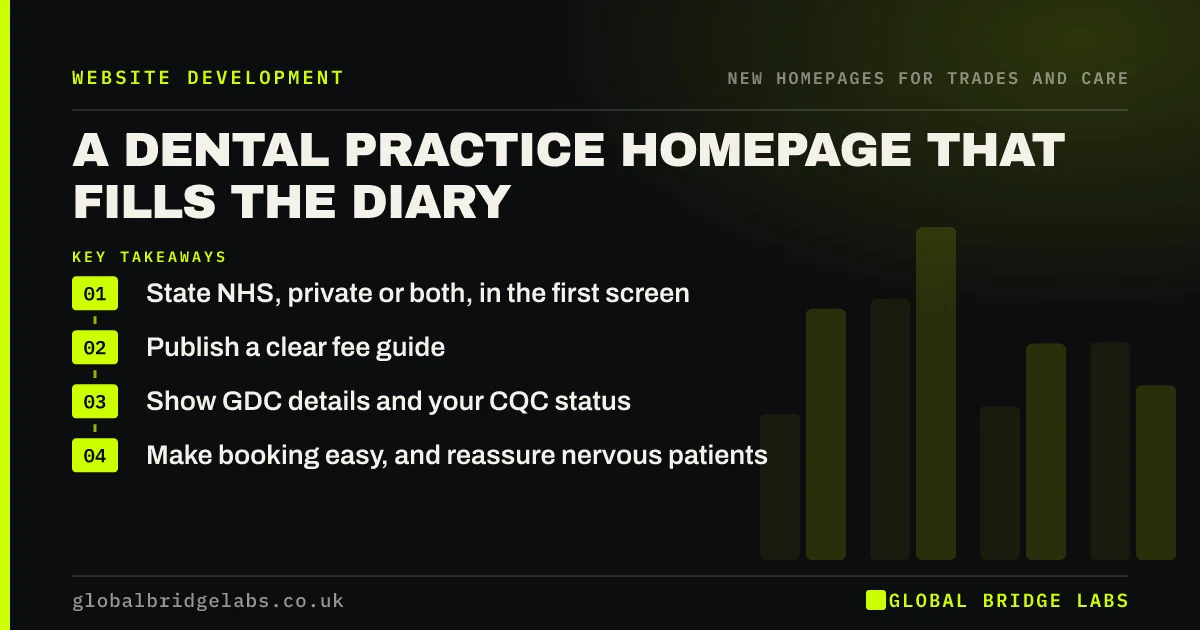
A dentist homepage should tell people quickly whether you take NHS or private patients, what it costs, how to book and whether you are welcoming to nervous patients. It must also respect GDC standards and advertising rules. A clear, calm page that answers these questions will fill the diary better than a gallery of perfect smiles.
- State NHS, private or both, in the first screen.
- Publish a clear fee guide.
- Show GDC details and your CQC status.
- Make booking easy, and reassure nervous patients.
Running a dental practice? Message us on WhatsApp for a homepage review.
Chat on WhatsApp →What does a dental homepage need to answer first?
It needs to answer: are you taking patients, NHS or private, near me and how do I book? People often search because they need a dentist now, or because they have moved. Stating whether you accept new patients is one of the most valuable lines on the page.
What must dentists show on a website?
GDC guidance on advertising expects clear information about the team, including names, qualifications and GDC registration numbers, along with the practice's details and complaints route. In England, practices register with the CQC, and they must display their rating if they have one. Only dentists on a GDC specialist list should be described as specialists.
How should you show prices?
Publish a fee guide for common treatments, and explain NHS bands separately from private fees. GDC standards expect patients to have clear information on costs. Prospective patients want to know what a check-up costs before they call, and hiding the figure can push them to a practice that shows it.
How can you support nervous patients?
Dental anxiety is common, so a short section can make a real difference: what happens at a first visit, how you help anxious patients and that they can stop at any time. Photos of real staff and rooms help. Calm wording beats clinical terms, and it may be what persuades someone to book.
What are the limits on claims?
Treatment claims must be accurate and evidenced under the CAP Code and GDC guidance. You cannot advertise prescription-only medicines such as botulinum toxin to the public. Before and after photos need consent and must not mislead. Treat cosmetic marketing carefully, because regulators have taken a close interest in this area.
When should treatments get their own pages?
Give high-value treatments such as implants, Invisalign and whitening their own pages, as these buyers research for longer. The homepage should concentrate on new patients and general care. Link across to treatment pages, rather than stacking all the detail, and make each page answer cost, process and suitability.
What does this look like in practice?
A pattern worth checking: a practice homepage shows a perfect smile and a list of cosmetic treatments, while the one thing new patients want to know, whether the practice is accepting them and at what cost, needs a phone call. A single line near the top often does more than the gallery.
Dental homepage checklist
- State NHS or private status.
- Say whether you take new patients.
- Publish a fee guide.
- Add team names and GDC numbers.
- Show CQC or equivalent details.
- Add a section for nervous patients.
- Check treatment claims.
Next step
Find out how many of your phone calls ask whether you take new patients, or how much a check-up costs. Then answer both on the homepage.
Message us on WhatsApp for a dental homepage review, or book a 30-minute consultation.
Chat on WhatsApp →Sources and further reading
- GDC guidance for dental professionals · General Dental Council
- Regulations for service providers and managers · Care Quality Commission
- UK Code of Non-broadcast Advertising and Direct & Promotional Marketing (CAP Code) · ASA / CAP
- Substantiation: advice on backing up marketing claims · ASA and CAP
Frequently asked questions
What should be on a dental practice homepage?
NHS or private status, whether you take new patients, location, fees, team details, booking and how you support nervous patients. Include your regulatory information, and make sure that any claims are accurate and evidenced.
Do dentists have to show GDC numbers on their website?
GDC guidance on advertising expects information such as names, qualifications and registration numbers for the dental team. Check the GDC's current guidance, and review your site against it, because it applies to practice websites as well as printed marketing.
Can dentists advertise Botox on their website?
Botulinum toxin is a prescription-only medicine, so it must not be advertised to the public. You can describe consultations for facial treatments, with care. Check the current CAP guidance and take advice before promoting these services.
Written by

Global Bridge Labs (GBL) is a UK–Sri Lanka partner for social media, websites and BPO. Everything here comes from client delivery, not theory.