On this page
- 01Key takeaways
- 02Why does lorem ipsum cause problems in homepage design?
- 03What goes wrong when the real copy arrives?
- 04What should you use instead?
- 05How does placeholder text reach live sites?
- 06When is dummy text acceptable?
- 07What does this look like in practice?
- 08Homepage placeholder text checklist
- 09Next step
- 10Sources and further reading
- 11Frequently asked questions
Key takeaways
Lorem ipsum on a homepage design hides the most important problem: whether the message works. Placeholder text always fits, so layouts look finished until the real copy arrives and breaks them. Design with real or rough draft words. Rough words give designers, clients and reviewers something honest to react to, which keeps the rework down.
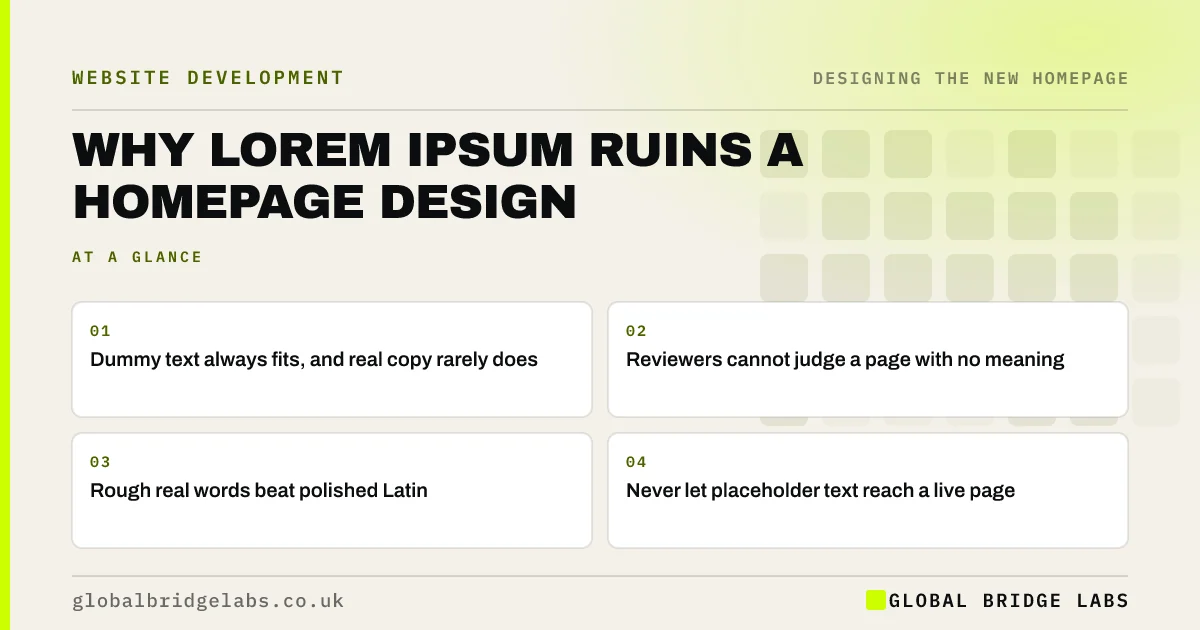
- Dummy text always fits, and real copy rarely does.
- Reviewers cannot judge a page with no meaning.
- Rough real words beat polished Latin.
- Never let placeholder text reach a live page.
Stuck designing without copy? Message us on WhatsApp.
Chat on WhatsApp →Why does lorem ipsum cause problems in homepage design?
Lorem ipsum makes a layout look complete when the thinking is not. Its neat line lengths hide the fact that real headlines wrap differently, real proof may not exist and sections may have no point. Teams then approve the appearance of a page, not the message it has to deliver.
What goes wrong when the real copy arrives?
Headlines run to two lines and push the button down. Short service names leave gaps in a three-column layout. Proof sections look empty. Each problem reopens the design at the most expensive time. A short section that seemed to work beautifully in Latin may not survive contact with your actual content.
What should you use instead?
Use your rough draft, even if the words will change. If the copy truly does not exist, write realistic stand-ins: an actual headline of the expected length and likely sentence in each section. Mark them as draft, so nobody mistakes them for approved text. Honest rough content is enough for design.
How does placeholder text reach live sites?
It slips through when pages are built before content is ready, or when a template's demo text is overlooked in a section nobody checked. Search your site for 'lorem', 'ipsum' and 'sample' before launch, then check Google with a site search. It damages trust immediately when buyers see it.
When is dummy text acceptable?
It is acceptable when testing a type scale or component in isolation, where the meaning is irrelevant. Designers may use it for this kind of system work. It is not acceptable in anything a stakeholder is asked to approve, or for any page whose success depends on what it says.
What does this look like in practice?
A pattern worth recognising: a design is signed off in Latin, the copy arrives two months later and three of the seven sections no longer fit. Asking for rough drafts before design starts would have cost a few hours, instead of a further round of paid revisions.
Homepage placeholder text checklist
- Draft rough copy before design.
- Mark stand-in text as draft.
- Use a realistic headline length.
- Refuse to approve Latin layouts.
- Search for 'lorem' before launch.
- Check template demo pages too.
Next step
Search your website for 'lorem ipsum' and your template's sample phrases right now. It takes a minute, and the result may surprise you.
Message us on WhatsApp for help getting the words right before design.
Chat on WhatsApp →Sources and further reading
- Creating helpful, reliable, people-first content · Google Search Central
- Plain language is for everyone, even experts · Nielsen Norman Group
- Writing to GOV.UK standards: writing guidelines · GOV.UK
Frequently asked questions
Why is lorem ipsum bad for web design?
It hides whether the message and layout work together, so problems appear only when the real text arrives. It also stops reviewers from judging meaning. Rough draft words are better, even if they will change before launch.
Should I write website content before design?
Yes, at least in draft. Writing first gives designers real lengths and priorities to work from, and it reveals any gaps in your proof. This usually leads to fewer revisions and a page that fits the message.
Does lorem ipsum hurt SEO if left on a site?
It makes the page look low-quality and unfinished to users and to search engines, and it provides no useful content for that section. Worse, it damages buyers' trust. Search for it and remove any instances before launch.
Written by

Global Bridge Labs (GBL) is a UK–Sri Lanka partner for social media, websites and BPO. Everything here comes from client delivery, not theory.