On this page
- 01Key takeaways
- 02Who is reading a care home homepage?
- 03What must a care home show?
- 04How should you present fees?
- 05What should photos and proof show?
- 06What is the right next step?
- 07When does a group need a different approach?
- 08What does this look like in practice?
- 09Care home homepage checklist
- 10Next step
- 11Sources and further reading
- 12Frequently asked questions
Key takeaways
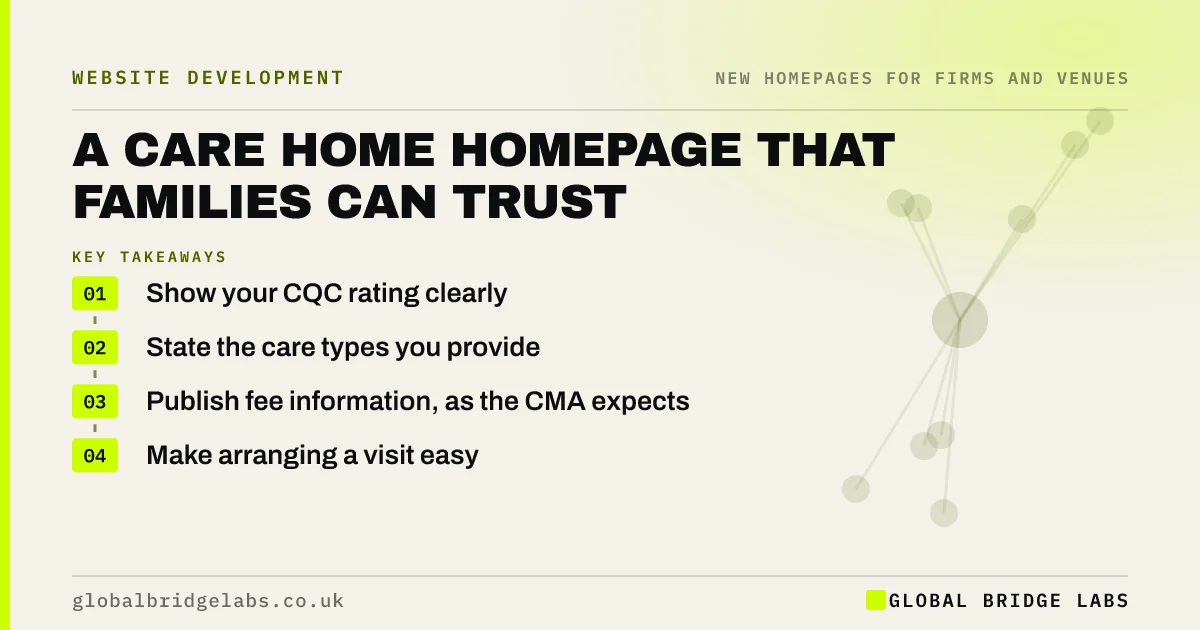
A care home homepage speaks to families making a difficult, often urgent decision. Show your CQC rating, the types of care you provide, fee information, real photos and how to arrange a visit. Use warm, honest language. Families are looking for evidence that their relative will be safe and treated kindly, and for someone they can talk to.
- Show your CQC rating clearly.
- State the care types you provide.
- Publish fee information, as the CMA expects.
- Make arranging a visit easy.
Run a care home? Message us on WhatsApp for a homepage review.
Chat on WhatsApp →Who is reading a care home homepage?
It is usually an adult son or daughter, often stressed, researching late in the evening after a hospital discharge or a fall. They need facts and reassurance quickly. Write for that person. A calm tone, plain language and a phone number answered by a real person will help far more than a slogan.
What must a care home show?
CQC-registered services in England must display their latest rating on their website, in line with regulations, and clearly, near the top is sensible. Care homes in Scotland, Wales and Northern Ireland have their own regulators. The CMA's guidance also expects care homes to give clear information, including fees, up front.
How should you present fees?
Publish weekly fee ranges for each care type, what is included and what is charged as an extra. Explain any deposits, and what happens with fees if funding changes. CMA guidance expects this information to be available on your website. Openness reassures families, who are often comparing several homes.
What should photos and proof show?
Show real rooms, gardens, staff and daily life, with consent from residents and families. Avoid stock images of smiling older people, which families can spot immediately. Reviews from relatives can be powerful. Be honest about the type of home you are, as the wrong placement can distress everyone.
What is the right next step?
Offer a visit or a conversation, and make it feel easy: 'Call Sarah, our manager, or book a visit.' Show when you can be reached, including evenings. State whether rooms are available. Avoid long forms. People in this position want to speak to someone, so the phone route matters most.
When does a group need a different approach?
A group with several homes needs a good home finder, and pages for each location with individual ratings, fees and managers. Do not let a central brand message hide the local facts. Families choose a place and the people there, rather than a group name.
What does this look like in practice?
A pattern worth checking: a home with an excellent reputation displays warm brand language, but families must phone to learn the fees or the types of care it offers. Adding these facts and the manager's name respects the situation they are in, and it should reduce repetitive calls.
Care home homepage checklist
- Display your current CQC rating.
- List your care types.
- Publish fee ranges and extras.
- Use real, consented photos.
- Name the manager.
- Show room availability.
- Offer a visit by phone.
Next step
Ask a relative of a current resident what they most wanted to find online when choosing. Make sure that it is on your homepage.
Message us on WhatsApp for a care home homepage review, or book a 30-minute consultation.
Chat on WhatsApp →Sources and further reading
- Regulations for service providers and managers · Care Quality Commission
- Care homes: consumer law advice for providers · Competition and Markets Authority
- Special category data · Information Commissioner's Office
Frequently asked questions
What should a care home have on its website?
Your regulator rating, care types, fee information, real photos, staff names, availability and how to arrange a visit. Write in a warm, plain tone for relatives who may be making a difficult decision in a hurry.
Do care homes have to display their CQC rating on their website?
Yes. In England, CQC-registered providers with a rating must display it on their website, and in the premises. Check the CQC's current guidance on how to do so, and update it whenever a new rating is published.
Should care homes publish their fees online?
Yes. CMA consumer law guidance expects care homes to provide clear fee information, including on websites. Show the likely weekly range, what is included and any extras, so that families can compare options fairly.
Written by

Global Bridge Labs (GBL) is a UK–Sri Lanka partner for social media, websites and BPO. Everything here comes from client delivery, not theory.